
MemReranker: Distilling LLM Reasoning into Compact Rerankers for Agent Memory
MemReranker: Reasoning-Aware Reranking for Agent Memory Retrieval
MemReranker is a specialized family of reranking models (0.6B and 4B parameters) designed for AI agent long-term memory retrieval. By employing a multi-stage distillation pipeline from large language models (LLMs), it achieves ranking performance on par with GPT-4o-mini and Gemini-3-Flash while maintaining significant inference speed advantages.
Executive Summary
TL;DR: MemReranker is a new family of lightweight reranking models (0.6B/4B) specifically optimized for the "missing link" in AI agents: long-term memory retrieval. By distilling reasoning capabilities from massive LLMs via a progressive multi-stage pipeline, MemReranker bridges the gap between slow, expensive LLM-based ranking and "dumb" semantic-only cross-encoders. It matches the quality of models like GPT-4o-mini while delivering an 8x speedup (approx. 200ms latency).
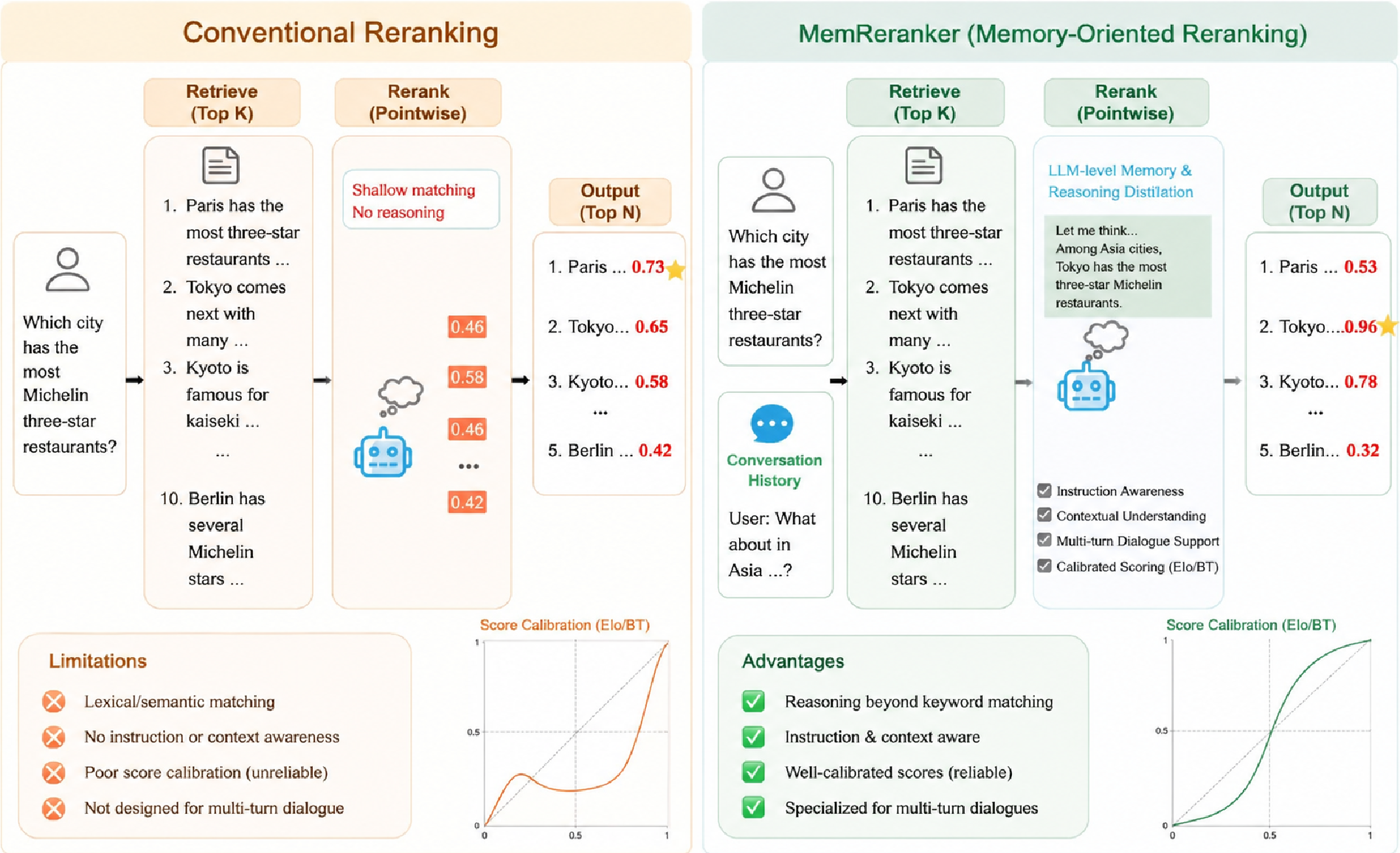
Background: Within the "retrieve-then-rerank" paradigm, generic rerankers often fail because they confuse "semantic similarity" with "answer sufficiency." This work transforms the reranker from a simple similarity measurer into a reasoning-aware component capable of handling complex dialogue histories.
The "Similarity vs. Reasoning" Gap
Existing rerankers (like BGE-Reranker) suffer from three critical failures in agentic scenarios:
- Calibration Failure: Scores are heavily left-skewed, making it impossible to set a "quality threshold" for retrieval.
- Reasoning Deficit: They struggle with "I want to look at Apple" if the previous context was about tech stocks vs. fruit.
- Contextual Blindness: They ignore multi-turn dialogue dynamics, such as coreference resolution (e.g., understanding what "it" refers to across 10 turns).
Methodology: The Distillation Masterclass
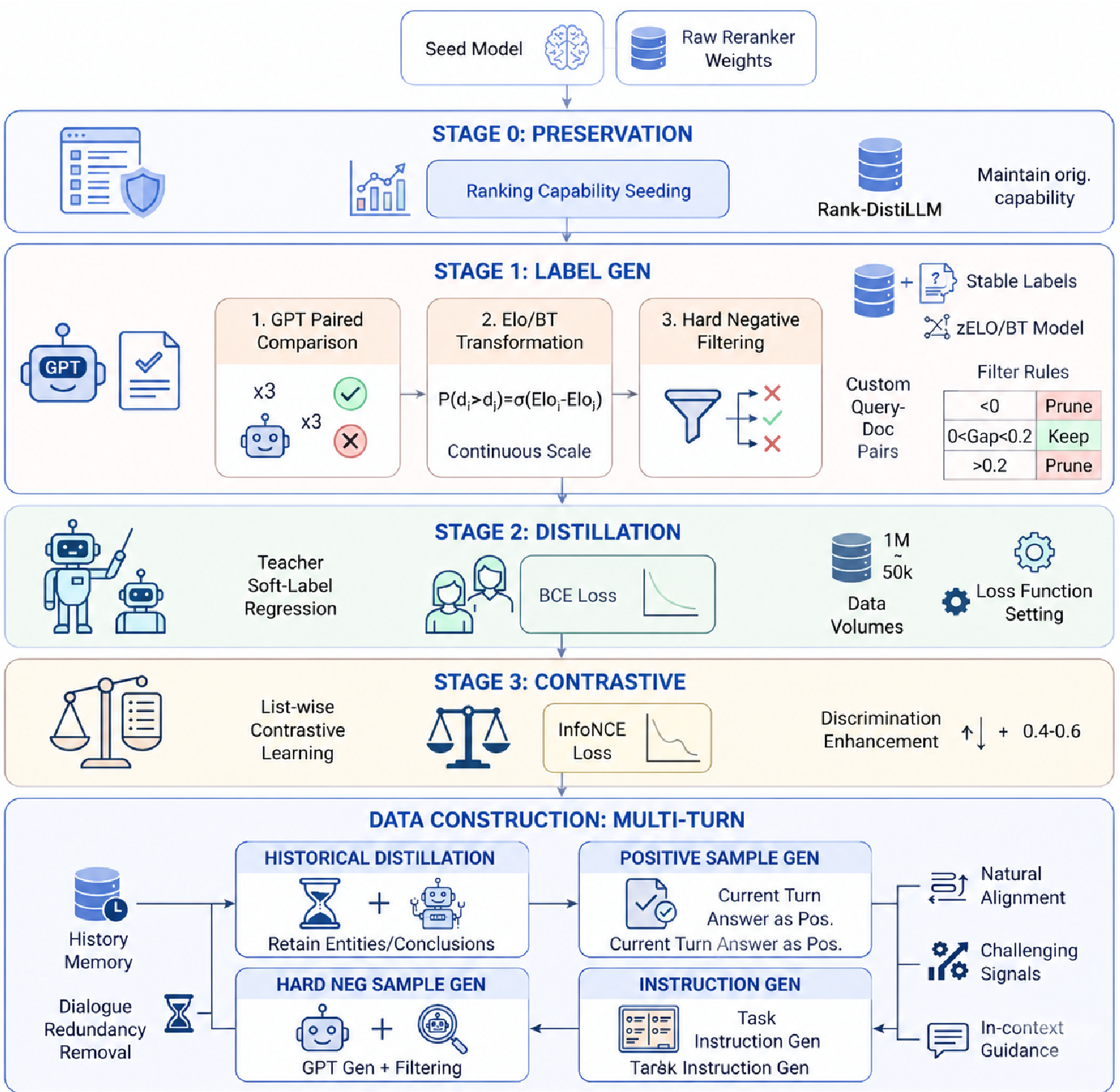
The core innovation lies in a three-stage progressive distillation pipeline that moves from "General Capability" to "Calibrated Reasoning."
1. The Scoring System
MemReranker adopts a 5-level relevance scale (0-1.0), moving away from raw logits. This is achieved by:
- Pairwise Teacher Evaluation: Using GPT and Qwen ensembles to compare pairs of documents.
- Elo/Bradley-Terry Conversion: Transforming relative preferences into absolute, calibrated scores.
2. Multi-Stage Training
- Stage 2 (BCE Pointwise): Stable regression on soft labels. Research shows BCE outperforms contrastive loss for calibration at the <1B parameter scale.
- Stage 3 (InfoNCE Listwise): Fine-tuning to sharpen the model's ability to distinguish "hard negatives" (documents that look relevant but aren't).
Performance: Small Model, Big Brain
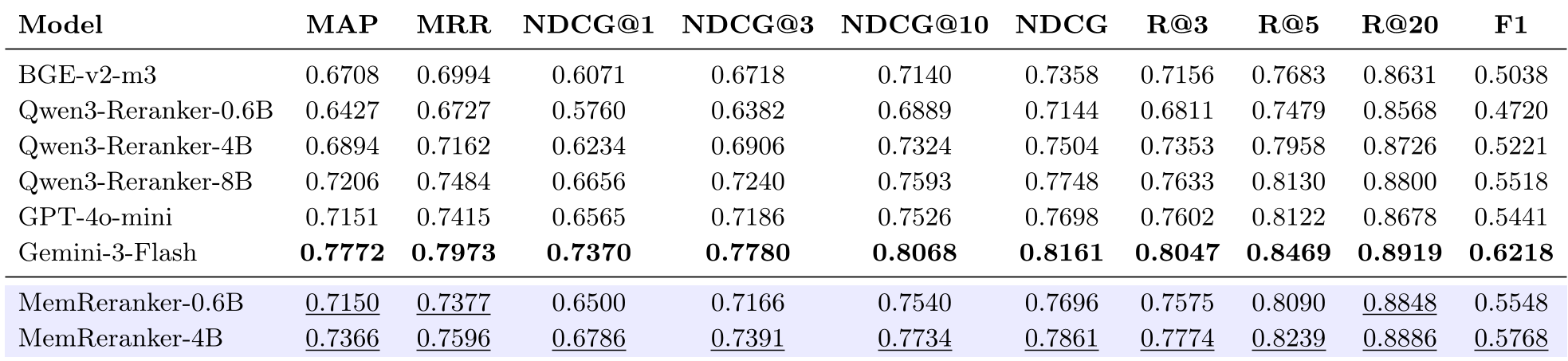
The experimental results on the LOCOMO and LongMemEval benchmarks are particularly striking.
- Efficiency: MemReranker-0.6B outperforms the original Qwen3-Reranker-4B, proving that specialized data beats raw parameter count.
- Competitiveness: The 4B model matches Gemini-3-Flash and GPT-4o-mini in MAP (Mean Average Precision) while being significantly cheaper to run.
- Hard Case Mastery: In "Case 3: Multi-Hop Reasoning," MemReranker correctly identifies the author of One Hundred Years of Solitude and his nationality across disconnected document fragments, a feat baseline models failed to achieve.
Latency Analysis
Real-time agents cannot wait 1.5 seconds for an LLM to rank a memory chunk. MemReranker-0.6B delivers an average latency of 247ms, roughly the same as the much "simpler" BGE-Reranker, but with the intelligence of a massive LLM.
| Model | Latency (ms) | MAP (LOCOMO) | | :--- | :--- | :--- | | BGE-v2-m3 | 241.0 | 0.6708 | | MemReranker-0.6B | 247.2 | 0.7150 | | GPT-4o-mini | 1549.2 | 0.7151 |
Deep Insight & Conclusion
MemReranker represents a shift towards reasoning-intensive retrieval. By focusing on "Information Density" and "Instruction Awareness," the authors have solved the "hallucination by retrieval" problem often seen in RAG systems.
Limitations: The model is currently constrained to an 8k context window due to training resources, and the recall stage (Stage 1) remains a potential bottleneck.
Future Outlook: As agents move toward "infinite context," the ability to quickly and intelligently prune memories will be the defining factor of user experience. MemReranker provides the high-fidelity, high-speed filter required for the next generation of AI "Companions."