
MemSearch-o1: Scaling Deep Reasoning via Reasoning-Aligned Memory Growth
MemSearch-o1 is a novel agentic search framework designed to enhance Large Language Models (LLMs) by implementing reasoning-aligned memory growth and retracing. It achieves State-of-the-Art (SOTA) performance across eight benchmark datasets (e.g., HotpotQA, MuSiQue), outperforming standard RAG and existing agentic search methods by significant margins.
TL;DR
The "iterative think-search" loop is the hallmark of modern agentic intelligence, but it has a hidden cost: Memory Dilution. As an agent searches more, its context window fills with noise, drowning out the signal. MemSearch-o1 fixes this by replacing messy summarization with structured, token-level memory growth. By extracting "seeds" from queries and retracing the most high-value "memory paths," it achieves massive performance boosts—improving HotpotQA scores by over 21% while using fewer tokens.
Problem & Motivation: The Dilution Dilemma
In deep search paradigms (like OpenAI's o1 or Search-o1), an agent plans, retrieves, and reflects iteratively. However, two paradoxes emerge:
- The Context Paradox: More information should lead to better answers, but in LLMs, "Lost in the Middle" phenomena and attention dilution mean that more information often leads to degraded reasoning quality as the signal-to-noise ratio drops.
- The Information Loss Paradox: Current pruning or summarization methods are "lossy." They treat memory like a stream of text to be shortened, often cutting the very semantic threads (like temporal markers or specific actions) required for multi-hop reasoning.
The authors' insight is simple: Memory management should follow the structure of the query, not the sequence of the retrieval.
Methodology: From Seeds to Paths
MemSearch-o1 re-imagines memory management through three distinct phases:
1. Memory Seed Extraction
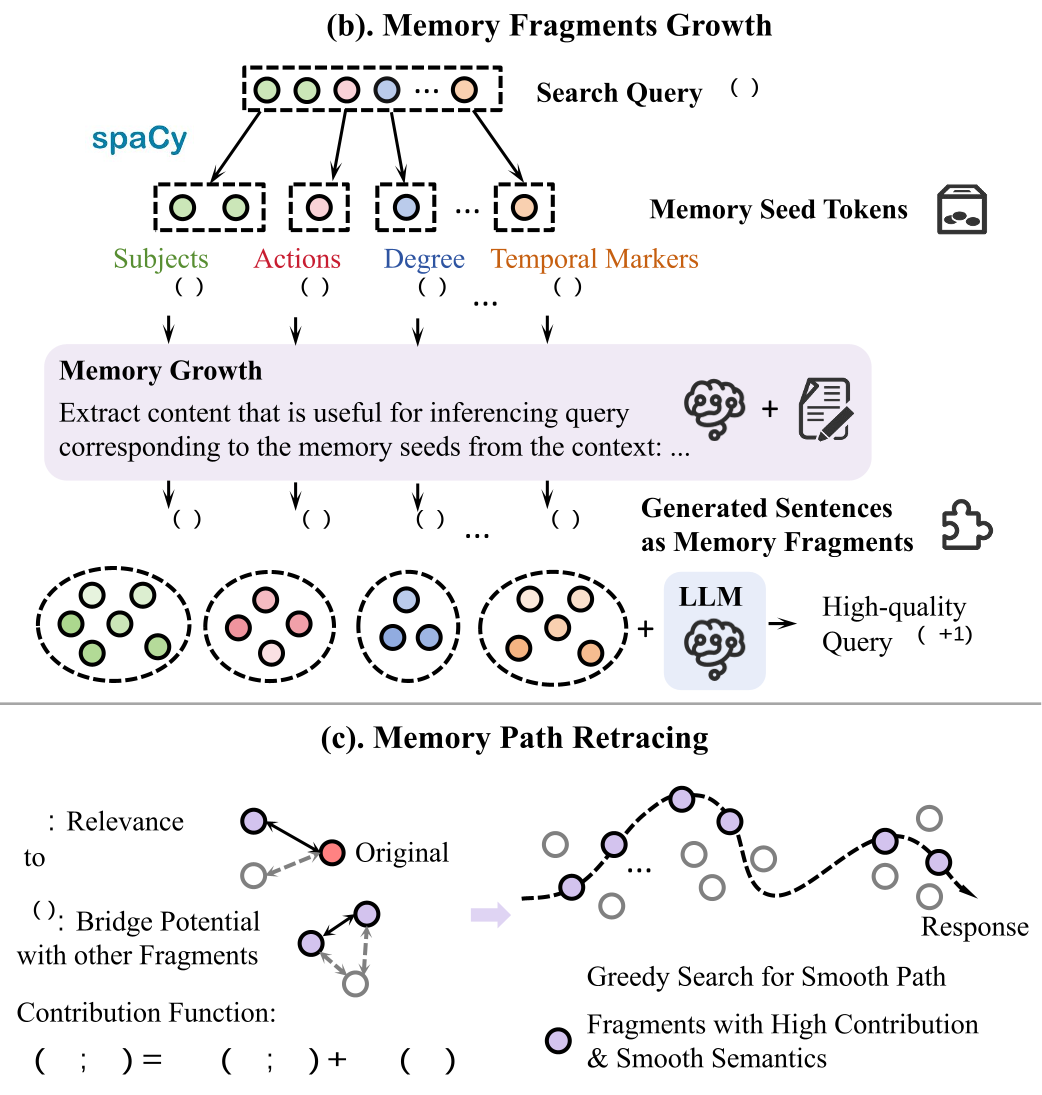
Instead of passing the whole query as a vague semantic vector, MemSearch-o1 uses the spaCy toolkit to decompose the query into Memory Seeds based on parts of speech:
- Subjects: Nouns and pronouns (Who/What).
- Actions: Verbs (What happened).
- Degree Modifiers: Adjectives/Adverbs (How/How much).
- Temporal Markers: Time-based tokens (When).
2. Reasoning-Aligned Growth
The LLM is prompted to expand these seeds into fragments using retrieved documents. This ensures that the context the model eventually "sees" is strictly aligned with the granular components of the query logic.
3. Memory Path Retracing
After several rounds, the agent doesn't just look at all fragments. It applies a Contribution Function that weights:
- Relevance Contribution (): Does this fragment answer the original question?
- Bridge Potential (): Can this fragment connect different reasoning steps?
A greedy search then finds the "optimal path"—a sequence of fragments that is both relevant and semantically smooth—discarding irrelevant search drift.
Experiments & Results: Efficiency Meets Accuracy
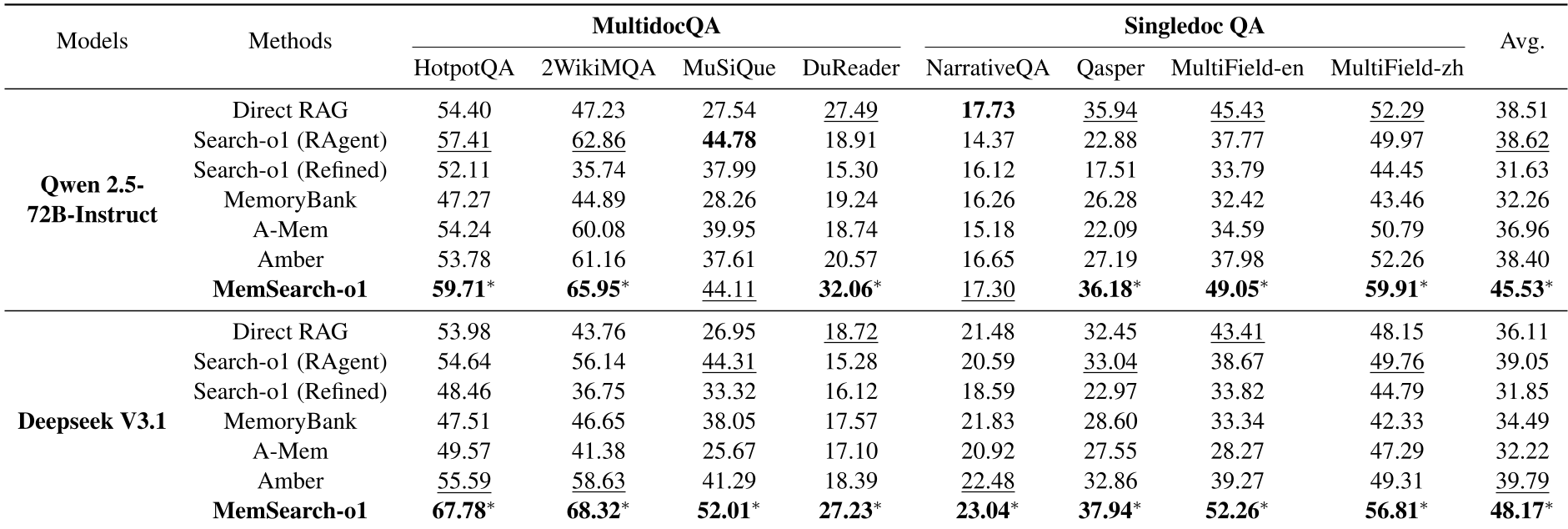
The performance metrics against high-tier backbones like Qwen2.5-72B and DeepSeek-V3.1 are striking.
SOTA Comparison
In complex multi-document reasoning tasks (HotpotQA, 2WikiMQA), MemSearch-o1 consistently outperformed specialized memory agents like Amber and MemoryBank. On MuSiQue, it provided a nearly 17% absolute improvement in F1 score over the strongest baseline.
The Scaling Law of Memory
Interestingly, the authors found that these reasoning capabilities "activate" at specific scales. While smaller models (<3B) struggle to follow the instruction to "grow fragments," models larger than 7B show a rapid acceleration in performance when using MemSearch-o1 compared to standard RAG.
Critical Analysis & Conclusion
Takeaway
MemSearch-o1 proves that how we store and retrieve system memory is just as important as the model's parameter count. By moving to a "graph-like" path of token-level fragments, we allow models to handle vastly larger corpora (as seen in the LongBookQA trials) without the computational overhead of processing thousands of noisy tokens.
Limitations & Future Work
The primary hurdle remains the reliance on the LLM's inherent ability to categorize and expand tokens. If the "seed extraction" phase fails (common in smaller models), the entire reasoning chain breaks. Future work may focus on distilling these memory-growth capabilities into smaller, more efficient 1B-3B models to make agentic search cheaper and more accessible.
In the era of long-context LLMs, MemSearch-o1 provides a blueprint for Memory-Aware Agentic Intelligence.