
Beyond the Self-Report: Real-Time Sociability Monitoring via Context-Aware CEP
Mental Health Ubiquitous Monitoring: Detecting Context-Enriched Sociability Patterns Through Complex Event Processing
2020-07-01
Summary
Problem
Method
Results
Takeaways
Abstract
This paper introduces a ubiquitous monitoring solution for mental health that detects context-enriched sociability patterns using Complex Event Processing (CEP) and Frequent Pattern Mining (FPM). By processing continuous social data streams from smartphones, the system identifies habitual time intervals for social activity, achieving an 86.33% similarity to batch-processing algorithms while operating in real-time.
## TL;DR
Researchers from the Federal University of Maranhão have developed a system that monitors social behavior through ubiquitous devices to support mental health diagnosis. By combining **Complex Event Processing (CEP)** with **Frequent Pattern Mining (FPM)**, the system identifies "sociability patterns"—the habitual times people interact—and distinguishes between normal routine shifts (like sleeping in on weekends) and potential depressive or anxious symptoms.
## The Problem: The Bias of Memory vs. The Reality of Routine
Clinical psychology has long struggled with "Ecological Validity." When a patient tells a doctor they have been "socially isolated" over the past month, that report is filtered through cognitive biases and the patient's current mood. If they are depressed *now*, they may remember the past month as more isolated than it actually was.
While ubiquitous devices (smartphones, wearables) offer a way to collect objective data, most existing models aggregate this data into a single "average" profile. This is problematic: social behavior is highly context-dependent. A lack of social interaction on a Monday morning might be normal for a student with no classes, but on a Friday night, it might be a clinical "red flag."
## Methodology: Learning Habits in the Stream
The proposed solution treats social interactions as a continuous stream of events. The core innovation lies in two areas:
### 1. Incremental Learning through CEP
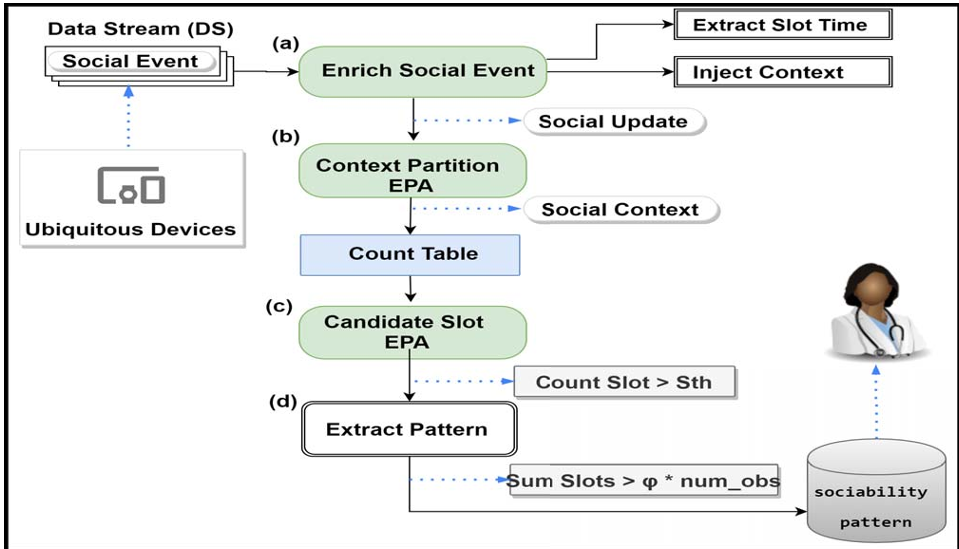
Instead of using "batch" processing (which requires looking at weeks of data at once), the authors use the **Esper engine** to implement declarative rules.
* **Time Slotting**: The 24-hour day is divided into slots (e.g., 30-minute intervals).
* **Candidate Identification**: A slot becomes a "candidate" if the frequency of social activity exceeds a specific threshold (based on the total observations processed so far).
* **Pattern Extraction**: Adjacent candidate slots are merged to form a "sociability interval."
### 2. Context Partitioning
The system doesn't just look at *when* you socialize; it looks at *under what conditions*. By injecting **Context Attributes (CAs)**—such as "Rainy Day," "Workday," or "Weekend"—the algorithm partitions the stream. This allows the system to learn that your "Sunday Routine" is fundamentally different from your "Monday Routine."
## Experiments & Validation
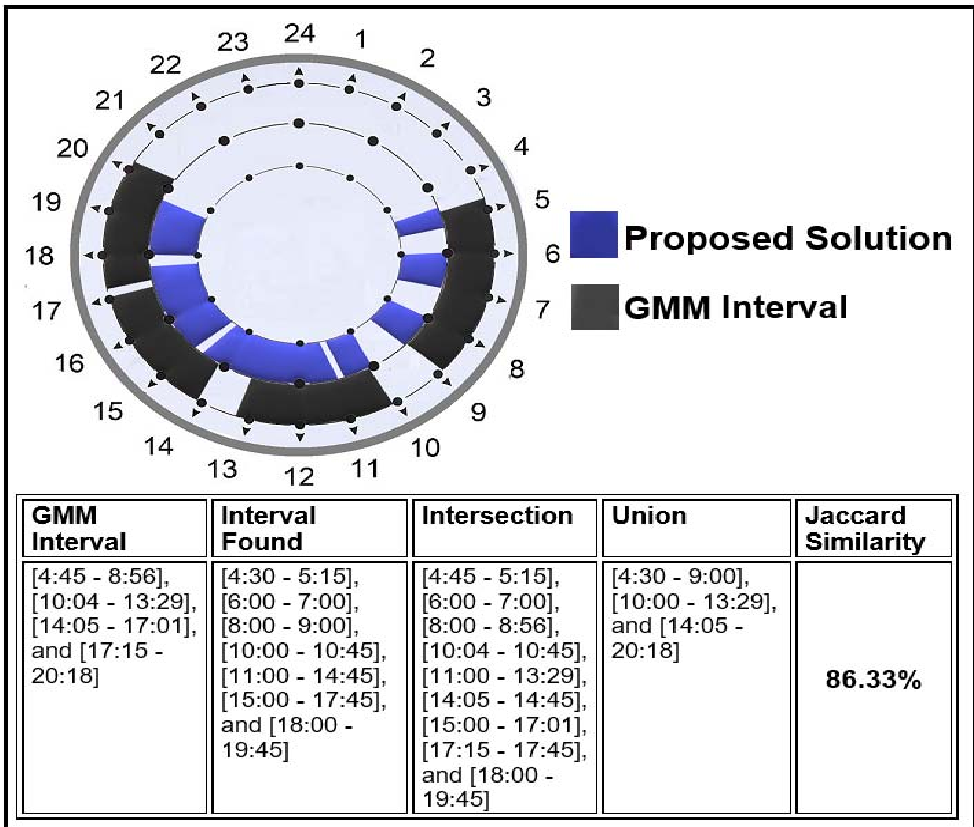
The authors tested their algorithm against the **StudentLife dataset** (66 days of data from 48 students). They compared their real-time approach with a **Gaussian Mixture Model (GMM)**, a powerful but computationally expensive batch-processing algorithm.
### Performance Results:
* **Similarity**: The proposed algorithm achieved an **86.33% similarity** to the GMM results.
* **Granularity**: As seen in the comparison charts, while GMM produced broad, fuzzy intervals, the CEP-based approach identified tighter, more precise "sub-patterns."
### The Power of Context:
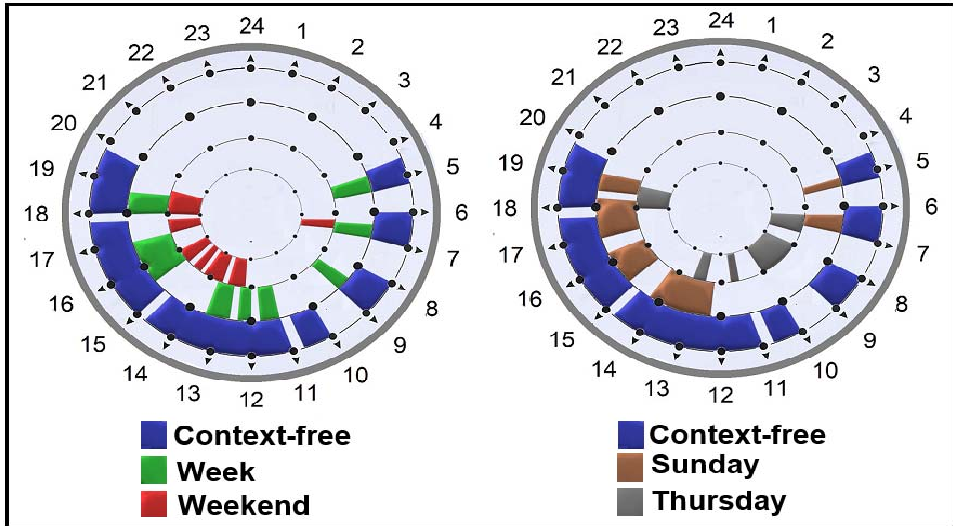
The most striking result came from comparing "Context-Free" vs. "Context-Enriched" analysis. In a context-free analysis, a student's social pattern might look like a messy 4-hour window. However, once broken down by the day of the week, it became clear that the student had very specific, short social windows on Thursdays (consistent with a class schedule) and different, longer windows on Sundays.
## Critical Insight: Why This Matters
This research moves us closer to "Digital Phenotyping"—the ability to create a high-definition digital map of human behavior. The ability to distinguish between **behavioral variation** (normal change) and **behavioral anomaly** (potential illness) is the "Holy Grail" of mobile mental health.
**Limitations**: The algorithm currently requires manual tuning for slot sizes and frequency thresholds ($\phi$ and $ heta$). For commercial scale, these parameters would need to be self-optimizing. Additionally, while the system detects *patterns*, it does not yet automatically alert clinicians to *deviations* from these patterns in real-time, which is the logical next step for this technology.
## Conclusion
By embedding context directly into the event processing stream, this solution avoids the "one-size-fits-all" trap of many behavioral models. It proves that real-time, ubiquitous monitoring can be just as accurate as traditional batch processing, while providing the much-needed nuance required for sensitive clinical applications.