
Mergers and Collusion: Re-evaluating the Ethics of Cooperation in Crowdsourcing Contests
Mergers and collusion in all-pay auctions and crowdsourcing contests
This paper investigates the strategic impact of bidder cooperation in all-pay auctions and crowdsourcing contests. It distinguishes between "mergers" (public cooperation) and "collusion" (secret cooperation), analyzing their effects on bidder utility and auctioneer profit across sum-profit and max-profit models.
TL;DR
Is collaboration always a "cheat code" that harms the contest organizer? According to this research from AAMAS, not necessarily. While mergers (public alliances) mainly benefit the auctioneer, collusion (secret alliances) allows bidders to actually turn a profit in the cut-throat world of all-pay auctions. Surprisingly, under the right conditions, even the auctioneer can come out ahead when bidders secretly team up.
The Problem: The "All-Pay" Trap
In a standard auction, only the winner pays. In an all-pay auction—which models everything from R&D patent races to "Employee of the Month" contests and Netflix-style crowdsourcing—everyone pays. The effort you spend coding a solution or writing a proposal is "spent" the moment you do it.
The mathematical tragedy of these auctions is that in a symmetric Nash equilibrium, the expected utility for any bidder is zero. They spend exactly as much effort as the prize is worth on average. The principal (auctioneer) takes all the social surplus.
Methodology: Mergers vs. Collusion
The authors split cooperation into two distinct logical frameworks:
- Mergers (The Long-Term Equilibrium): Bidders openly declare they are a team. The remaining "lone wolves" adjust their strategy. This effectively reduces the number of participants (), but the "zero utility" rule for bidders usually still holds.
- Collusion (The Short-Term Exploit): Bidders secretly coordinate. The outsiders (non-colluders) continue to play as if everyone is independent. This creates a strategic imbalance that the coalition can exploit.
The Optimization Insight
The core contribution is identifying the Optimal Collusion Bid (). Since colluders only need to beat the highest bid of the outsiders to win, they can optimize their effort to maximize the gap between the probability of winning and the cost of the bid.
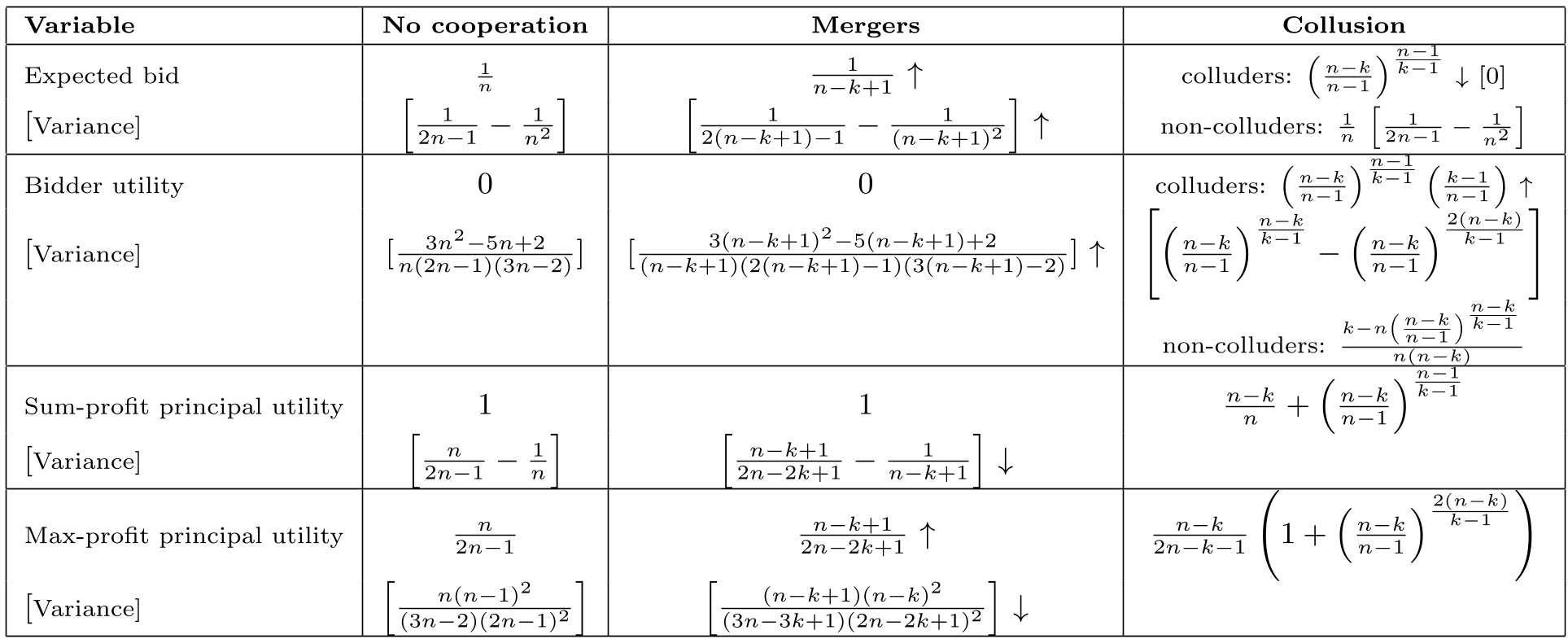 Table 1: The mathematical shifts in bids and utilities across different cooperative scenarios.
Surprising Results: When the Principal Wins
One would assume an auctioneer hates collusion. However, the study reveals two counter-intuitive insights:
- The "Bid Floor" Effect: In the Max-Profit model (where the auctioneer only cares about the best submission), a secret coalition effectively sets a high-quality "floor." As , the colluders' optimal bid approaches ( of the prize value). In some cases, this guaranteed high-quality entry is better for the auctioneer than the volatile results of independent bidders.
- Incentive to Expand: Unlike many games where "too many cooks spoil the broth," the expected profit per colluder actually increases as the coalition grows. This creates a powerful natural incentive for bidders to form large "bidding rings."
Critical Analysis: The Professional Verdict
This paper challenges the traditional view of collusion as a pure market failure. In the context of Multi-Agent Systems (MAS), it suggests that:
- Social Welfare isn't necessarily destroyed by collusion; it is often just redistributed from the principal to the agents.
- Detection is hard: Because the equilibrium is mixed (probabilistic), a secret coalition's single bid can easily blend into the background noise of independent bidding.
Limitations & Future Work
The study assumes a "winner-takes-all" structure. In many modern crowdsourcing contests, there are 2nd and 3rd place prizes. Extending this logic to multi-prize contests would be the next logical step. Additionally, the "short-term" assumption (that outsiders never learn) is a simplification; in reality, agents would likely use Bayesian updates to detect if their winning probability has dropped suspiciously.
Conclusion
For participants in crowdsourcing contests, the takeaway is clear: find a partner, keep it secret, and you might finally see a positive return on your effort. For organizers, the message is more nuanced: total transparency isn't always the goal—sometimes, a little secret cooperation keeps the average quality of your submissions high.