
Merging Opinions: Why Sampling is the Secret to Social Intelligence
Merging opinions by social sampling of posteriors
This paper explores "Merging Opinions by Social Sampling of Posteriors," a framework where a central agent (Calvin) estimates a global parameter by soliciting information from distributed observers (Alice and Bob). It establishes that communicating full posterior distributions is informationally equivalent to sending raw data if observation models are known, and it proposes a sampling-based Monte Carlo approach for large-scale parameter spaces.
TL;DR
How do we combine the opinions of experts when we don't see the evidence they saw? This paper analyzes the transition from sharing raw data to sharing "beliefs" (posteriors) and finally to sharing "samples." It reveals that under certain conditions, seeing a friend's belief is mathematically as powerful as seeing their raw evidence, and provides a way to bound errors when we only receive a few samples of their opinion.
The Motivation: Alice, Bob, and the Black Box
In social networks and distributed sensor systems, we face a fundamental trade-off: Communications vs. Accuracy.
If Alice and Bob see raw data about a parameter , sending that data to Calvin (the aggregator) is the Gold Standard. But what if the data is a 4K video stream or a complex high-dimensional manifold? Alice and Bob usually process this data into a "belief"—a posterior distribution.
The paper identifies a critical failure in current social learning: Local Identifiability. If Alice can only see the "color" of a car and Bob can only see its "brand," neither can identify the specific "car model" alone. Standard averaging of their final guesses often fails to find the truth because it doesn't account for what is missing from their individual perspectives.
Methodology: From Direct Data to Social Sampling
1. The Information Equivalence of Posteriors
The author first proves a surprising result (Proposition 1): If Calvin knows how Alice's brain works (her observation model ), then receiving her posterior distribution is exactly as informative as receiving her raw data.
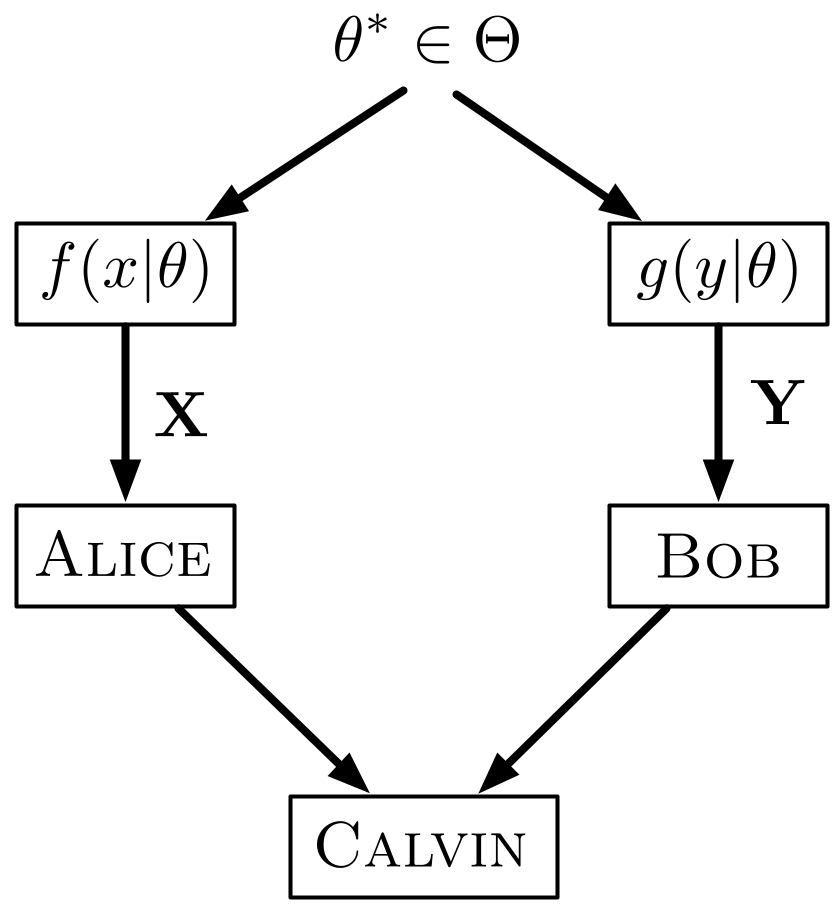
Fig 1: The three-agent setup where Alice and Bob observe data and Calvin merges their inputs.
2. Overcoming Non-Identifiability
When agents can't "see" the whole truth, simple linear averaging leads to stagnation. The paper proposes a correction:
- Partition Knowledge: If the aggregator knows which parameters look identical to Alice (her "partition"), he can post-process her belief to be piecewise constant.
- Consistent Merging: By using the maximum of the sum of these post-processed posteriors, the system achieves Consistency, meaning it eventually hits the true parameter almost surely.
3. Social Sampling for Large Spaces
In the most complex regime (Large , Large ), sending a full distribution is impossible. The paper suggests Monte Carlo Sampling. Alice and Bob send and samples from their respective posteriors. Calvin then forms a weighted estimate: Using the Chernoff-Hoeffding inequality, the paper provides a formal way to guarantee that this social estimate won't drift too far from the functional truth of the parameter.
Experiments & Results: The Cost of Iteration
The paper uses simulations of a 3-node network to show the pitfall of iterative averaging. In a star network where Alice and Bob cannot communicate with each other (only with Calvin), the "wisdom of the crowd" fails to converge because the information doesn't flow between the observers.
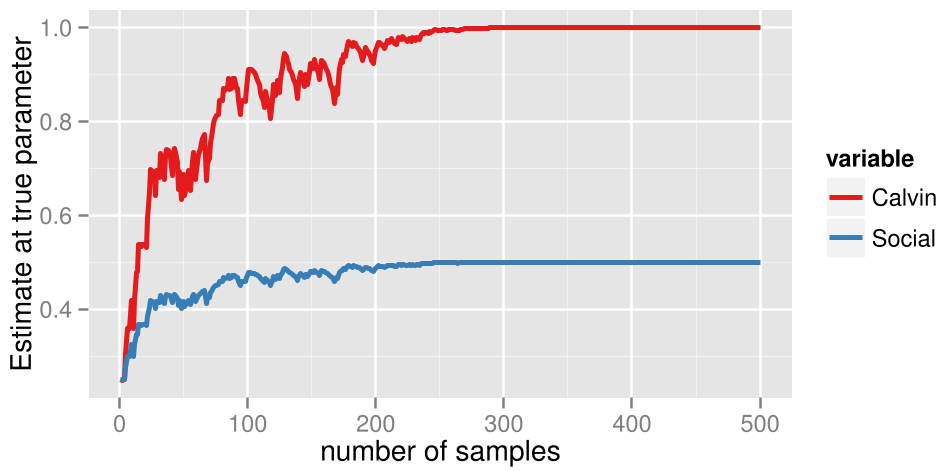
Fig 2: Non-convergence in a non-strongly connected network compared to the centralized learning rule.
However, by treating the problem as a sampling exercise, Calvin can bypass the need for a "strongly connected graph" if he has the right weights and enough samples.
Critical Insights & Takeaways
The most profound takeaway from this work is that merging opinions is not just about averaging numbers; it's about understanding the geometry of ignorance.
- Why it works: By treating beliefs as random variables, the author connects social science (DeGroot models) with rigorous signal processing.
- Limitations: The current model assumes Alice and Bob's observations are conditionally independent. In the real world, "groupthink" (correlated observations) makes merging much harder.
- Future Outlook: This framework is a precursor to modern Federated Learning, where we must update global models using only "samples" or "gradients" (posteriors) from local devices without ever seeing the private data.
This paper serves as a theoretical bridge, showing that even if we are only "sampling" the opinions of others, we can still converge to the truth if we understand the partitions of their knowledge.