
Harmonic Influence Centrality: A Physics-Inspired Breakthrough in Social Influence
A message passing algorithm for the evaluation of social influence
The paper introduces Harmonic Influence Centrality (HIC), a novel node prominence measure for social networks based on opinion dynamics with stubborn agents. It proposes a fully distributed Message Passing Algorithm (MPA) derived from an electrical circuit analogy to efficiently compute HIC across large-scale networks.
TL;DR
This paper introduces Harmonic Influence Centrality (HIC), a metric that quantifies a node's ability to sway the long-term average opinion of a network containing "stubborn" agents. By drawing a mathematical parallel between social opinion dynamics and resistive electrical circuits, the authors develop a distributed Message Passing Algorithm (MPA) that computes influence scores locally, bypassing the traditional need for global topological data.
Problem & Motivation: Beyond Degree Centrality
In the study of social networks, we often ask: “Which node should I influence to change the overall opinion of the group?” Conventional metrics like Degree Centrality (how many friends one has) or PageRank (how important those friends are) are often "blind" to external constraints—specifically the presence of stubborn agents (nodes that never change their minds).
The authors argue that real-world influence is a "harmonic" process. If you have a group of people with fixed opinions (type-0 stubborn agents), and you want to insert a single influential agent (type-1), the best choice isn't necessarily the most connected node, but the one whose position effectively "leverages" the network structure relative to the existing stubborn nodes.
Methodology: The Electrical Analogy
The core innovation lies in the Electrical Network Analogy. The authors treat the social network as a circuit:
- Opinions Voltages.
- Relationship Strengths Conductances.
- Stubborn Agents Voltage Sources (clamped at 0V or 1V).
In this framework, finding the average opinion becomes equivalent to solving the Laplace equation on a graph.
The Recursive Logic on Trees
For a tree structure, the authors utilize the "Series" and "Parallel" laws of resistors to decompose the problem. They define messages ( and ) that represent the "partial" influence and "effective weight" a node carries relative to its neighbor .
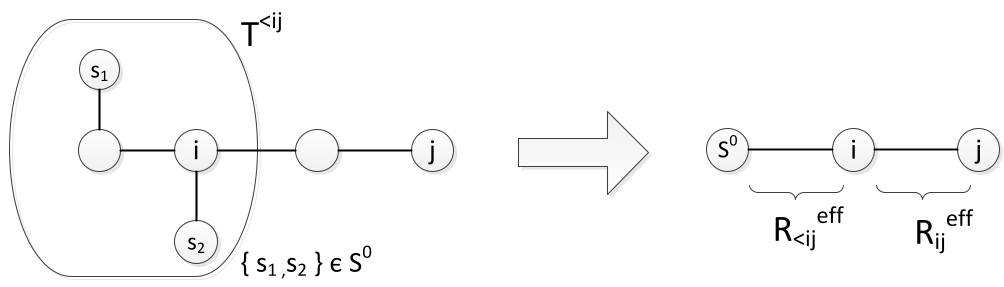 Fig 1: Simplification of a subtree into an equivalent line graph using effective resistance.
The algorithm follows a two-phase flow:
- Inward Pass: Leaves send messages toward a designated root to aggregate resistance and influence data.
- Outward Pass: The root broadcasts back, allowing every node to compute its individual HIC based only on its neighbors' messages.
Experiments & Results
The authors validated their MPA against centralized benchmarks. On tree graphs, the algorithm is mathematically exact and runs in linear time .
Success on General Graphs
Even though the formal convergence proof was limited to trees, simulations on Erdos-Renyi random graphs (which contain many cycles) showed remarkable performance. The algorithm successfully identified the top-3 most influential nodes, even when traditional heuristics like Degree or Eigenvector centrality failed significantly.
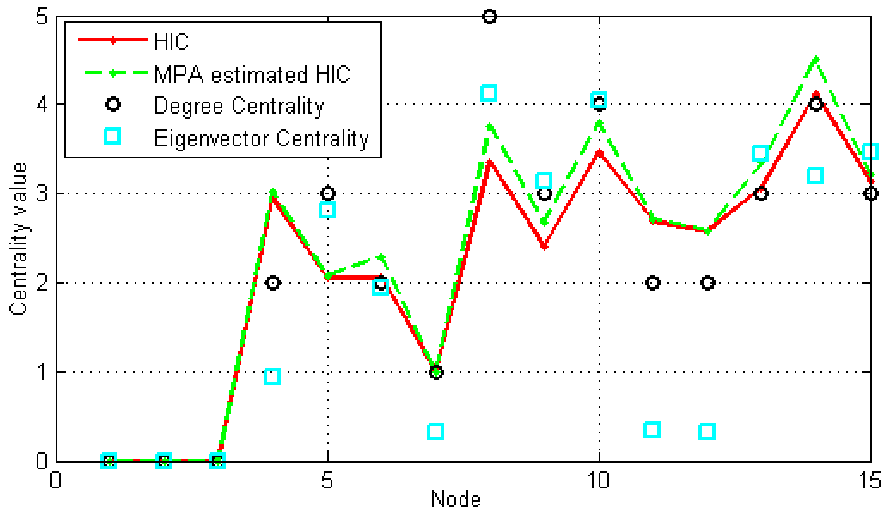 Fig 2: Comparison of HIC (computed via MPA) vs. Ground Truth and standard centrality measures.
As seen in the chart, HIC (blue line) tracks the true global influence (red markers) almost perfectly, while Degree Centrality (green) provides a completely different (and incorrect) ranking of importance for this specific task.
Critical Analysis & Conclusion
Takeaway
The HIC measure is uniquely powerful because it integrates the location of existing influencers into the importance calculation. The MPA makes this scalable, allowing for decentralized influence maximization in massive networks where global coordination is impossible.
Limitations & Future Work
The primary hurdle remains loopy graphs. In networks with dense cycles, the "computation tree" (the path messages take) can diverge. While the simulations are promising, a rigorous theoretical bound for convergence on general graphs is still an open research question. Future applications could likely extend this to directed graphs, modeling social media platforms where influence is often one-directional (e.g., Follower-Following).
Senior Editor's Note: This work is a masterclass in using physical intuition to solve combinatorial optimization problems. By moving from a "counting" perspective (Degree) to a "flow" perspective (Conductance), it captures the true essence of how information permeates a social fabric.