
Selective Propagation: Redefining Proximity Social Networks via Mobility-Assisted Messaging
Message Propagation in Ad-Hoe-Based Proximity Mobile Social Networks
This paper introduces a specialized architecture for message propagation in Proximity Mobile Social Networks (PMSNs), utilizing a mobility-assisted "push" model. The core method centers on a "times-to-send" (TTS) mechanism combined with periodic retransmissions to achieve high reliability and efficiency in high-density environments like dormitories or shopping centers.
TL;DR
In the era before ubiquitous high-speed data, researchers faced a dilemma: how to enable social networking without the battery drain of GPS or the privacy risks of centralized tracking. This paper proposes a Proximity Mobile Social Network (PMSN) architecture that uses a "Times-to-Send" (TTS) retransmission strategy. By leveraging natural human mobility and periodic broadcasting, the system ensures messages (like ads or friend probes) reach nearly 100% of local users with minimal overhead, even in the presence of selfish or malicious nodes.
The Motivation: Why Proximity Matters More Than Location
By 2008, mobile users had already surpassed Internet users, yet location-based services (LBS) like Loopt or GyPSii were struggling. The reasons were three-fold:
- Resource Exhaustion: Constant GPS polling and data updates killed batteries.
- Privacy: Many users were uncomfortable with their absolute coordinates being logged by providers.
- Functional Redundancy: For most local interactions—like finding a sale at a mall or a friend in a dorm—you don't need a map; you just need to reach people nearby.
The authors identified that PMSNs could solve this using an ad-hoc mode. However, existing Delay Tolerant Network (DTN) protocols were too "heavy," requiring nodes to maintain massive lists of encountered neighbors.
Methodology: The TTS-Based Push Model
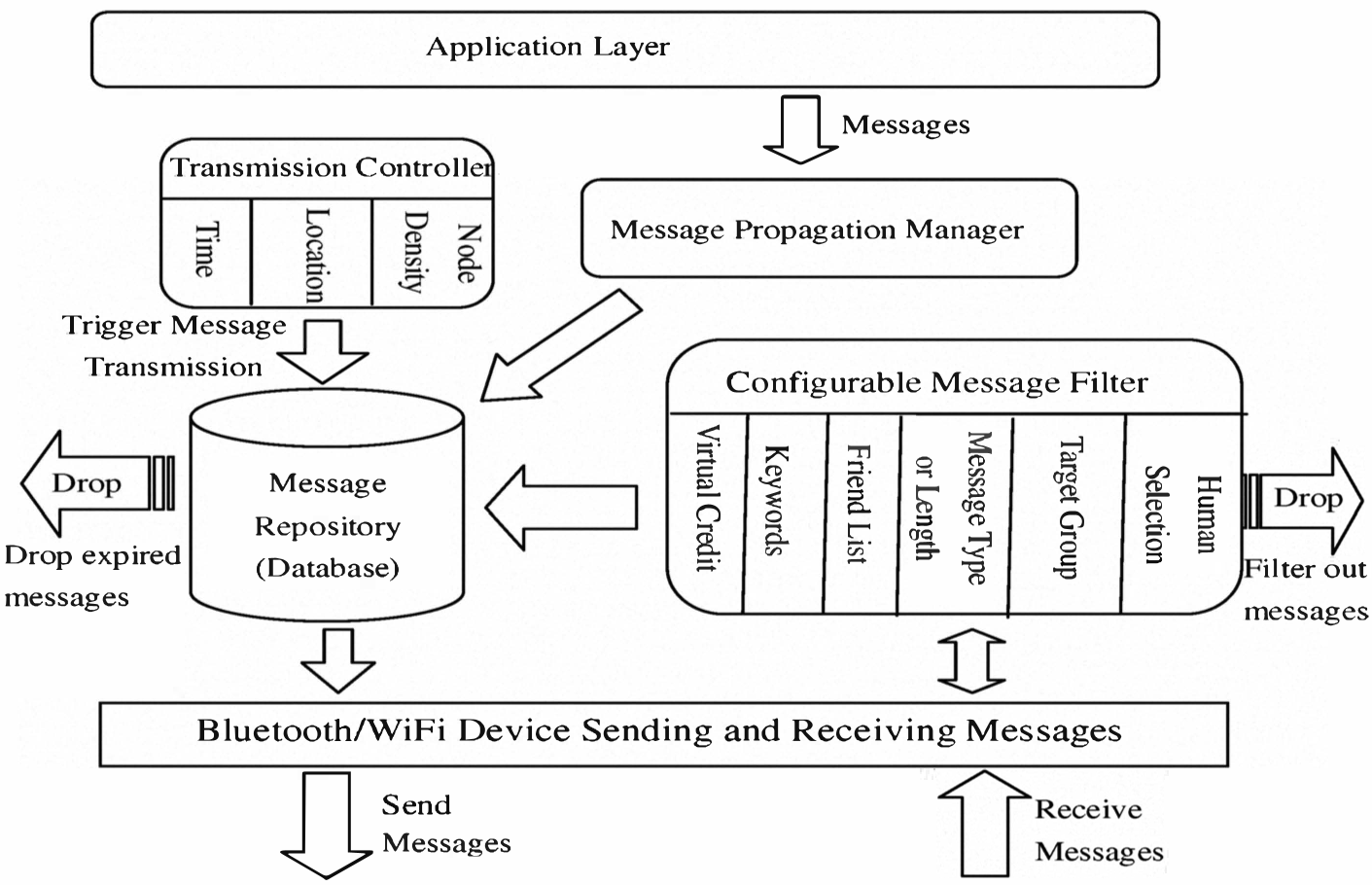
The proposed platform shifts from a "pull" model (querying for info) to a "push" model (disseminating info). The architecture consists of three pillars:
1. The Message Transmission Controller
Instead of flooding the network indefinitely, each message carries a times-to-send (TTS) counter.
- The Logic: Every time a node retransmits a message, it decrements the TTS. When TTS reaches zero, the message is deleted.
- The Timing: Retransmission intervals () are calculated based on the message's expiration time and remaining TTS, ensuring a steady spread over the target duration.
2. Message Filters (The Anti-Spam Shield)
To prevent "nonsense" messages from business owners or malicious actors, the system uses:
- Keywords: Interests-based filtering (e.g., "free pizza," "job fair").
- Friend Lists: Prioritizing known contacts.
- Virtual Credits: An incentive mechanism to reward cooperative nodes and punish selfish ones.
3. Architecture Overview
Performance & Threshold Behavior
The authors conducted extensive simulations using a mix of Random Waypoint, RPGM (Group Mobility), and Manhattan models.
The Threshold Effect
A critical discovery was the "threshold behavior" of the TTS parameter. As seen in the results, reliability is not linear.
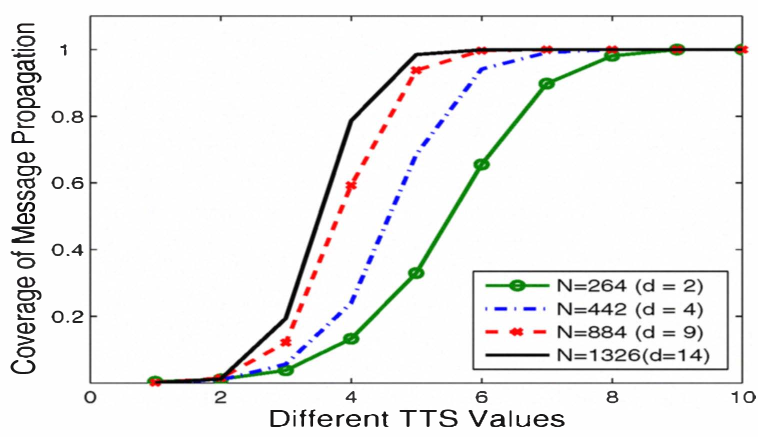 In a network of 600 nodes, a TTS of 5 might reach almost no one, but increasing it to 6 ensures over 98% coverage. This "phase transition" allows system designers to pinpoint the exact amount of energy needed to guarantee message delivery.
Robustness Against Attackers
The system is surprisingly resilient.
- Selfish Nodes: Treated as a "less dense" network; the coverage remains high.
- Malicious Counters: Even if 10% of nodes try to kill a message by setting TTS to 0, the parallel nature of the propagation ensures it still reaches 85-95% of the target group.
Critical Analysis & Conclusion
The genius of this work lies in its simplicity. By ignoring the identity of neighbors and focusing on the count of retransmissions (TTS), it bypasses the computational bottlenecks of previous ad-hoc protocols.
Takeaway: This paper provides a blueprint for decentralized, privacy-preserving local communication. While originally designed for Bluetooth/P2P Wi-Fi, the logic of mobility-assisted propagation remains highly relevant today for IoT mesh networks and edge computing, where centralized cloud coordination is either too slow or too expensive.
Limitations: The study assumes a level of cooperative behavior that may require more robust "Virtual Credit" implementations than those detailed here. Additionally, the heterogeneity of modern mobile OSs (iOS vs. Android) remains a hurdle for real-world peer-to-peer ad-hoc deployment.