
Decoding the Pulse of Mobile Social Networks: Engagingness vs. Responsiveness
Messaging Behavior Modeling in Mobile Social Networks
This paper introduces a quantitative framework to model user behaviors in mobile social networks, specifically focusing on "Engagingness" and "Responsiveness." Utilizing data from the myGamma platform, the authors propose several models (MSGCOUNT, REPLYTIME, SESSIONINIT, SEQUENCE) to distinguish between users who successfully solicit responses and those who promptly react to incoming messages.
TL;DR
Not all active users are created equal. This research investigates the dual nature of mobile messaging behavior: Engagingness (the ability to trigger a response) and Responsiveness (the tendency to reply). By analyzing millions of messages from the myGamma network, the study reveals that these traits are mathematically distinct, drive friendship formation, and determine who controls the "major topics" in a digital community.
Problem & Motivation: Beyond Simple Message Counts
In the era of mobile social networks, simply counting how many messages a user sends is a shallow metric. The real "vibrancy" of a network depends on the dynamics of exchange. Previous work on email or instant messaging (IM) often ignored the unique "hybrid" nature of mobile platforms, which act as real-time chat when users are online and as asynchronous email-like systems when they are offline.
The authors argue that we must distinguish between two roles:
- Engaging Users: The catalysts who initiate sessions and successfully solicit replies.
- Responsive Users: The "reactors" who keep the conversation flowing.
Methodology: The Core Models
To quantify these behaviors without intrusive surveys, the authors developed a multi-layered approach:
1. Determining Online/Offline Status
Since server logs of user status are often unavailable, the researchers used a Gaussian Mixture Model (GMM) to analyze the time gaps between messages. Short gaps represent "Online" bursts, while long gaps represent "Offline" intervals. A threshold () of approximately 4 hours was identified to separate these states.
2. Four Behavioral Dimensions
The paper proposes four distinct ways to measure interaction:
- MSGCOUNT: A simple ratio of messages sent vs. replies received.
- REPLYTIME: Focuses on speed; engaging users get fast replies, responsive users give fast replies.
- SESSIONINIT: Measures who "starts" the conversation.
- SEQUENCE: Uses "out-of-order" replies as a proxy for attention and urgency.
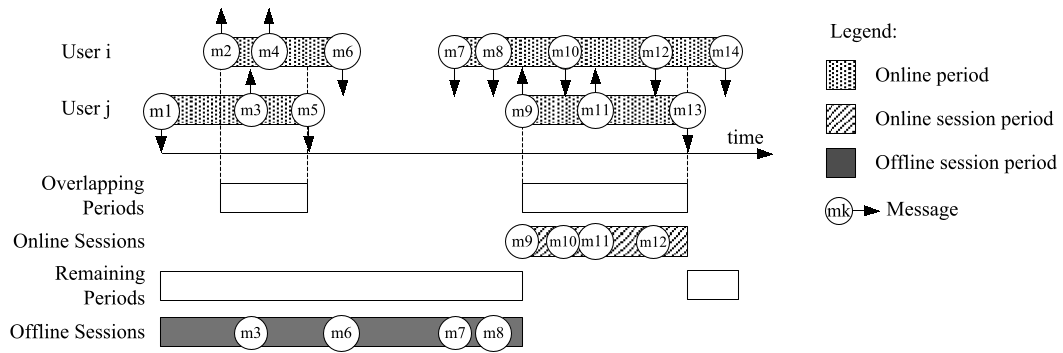
3. Mutual Dependency (The "Prestige" Factor)
Perhaps the most sophisticated part of the method is the mutual dependency extension. Borrowing logic similar to the HITS algorithm:
- You are more engaging if you can get a response from someone who usually never replies.
- You are more responsive if you reply to someone who usually never manages to engage others.
Experiments & Results
Using a dataset of 194,809 users and 2.7 million messages, the study yielded three critical insights:
Distinction of Behaviors
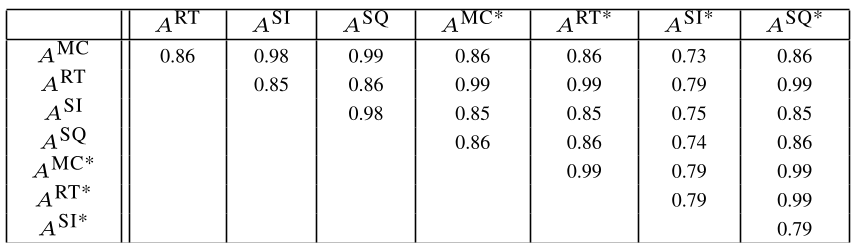
The correlation (Spearman’s rho) between being engaging and being responsive is surprisingly low in online sessions, proving they are different social skills. However, in offline sessions, the distinction blurs, likely due to the inherent delays in asynchronous communication.
Friendship and Social Status
The data shows a clear positive correlation between engagingness and the number of bi-directed friendship links. Engaging users are social magnets; they don't just talk—they attract.
Topic Leadership
Using Latent Dirichlet Allocation (LDA), the authors discovered 20 latent topics. The "Major Topics" (like greetings, gift exchanges, and general socializing) are dominated by the top 10% of engaging and responsive users. These users are essentially the "broadcasters" and "gatekeepers" of the community.

Critical Analysis & Conclusion
Takeaway
This work provides a rigorous mathematical foundation for identifying "influencers" based on communication patterns rather than just follower counts. For product managers and data scientists, these models offer a roadmap for identifying the "core" users who keep a platform alive.
Limitations
The study relies heavily on metadata (headers and timestamps). While this is computationally efficient, it ignores the sentiment of the messages. A user could be "engaging" by being controversial or offensive, which isn't distinguished from being helpful or friendly.
Future Outlook
As mobile networks evolve into "Super Apps," integrating these behavioral models with real-time graph neural networks (GNNs) could allow for highly sophisticated targeted advertising and community health monitoring.