
The Developing Meaning-Maker: A Meta-Analysis of Pediatric Semantic Cognition
A meta-analysis of fMRI studies of semantic cognition in children
This study presents a large-scale coordinate-based meta-analysis of 50 fMRI experiments (N = 1,018) investigating semantic cognition in children aged 4–15. Using Activation Likelihood Estimation (ALE) and seed-based d mapping, the authors identified a consistent cortical network including the bilateral inferior frontal gyri, fusiform gyri, and supplementary motor areas.
TL;DR
How does a child's brain learn to link a word like "apple" to a round, red fruit? This paper provides the first comprehensive meta-analytic map of semantic cognition in children. By pooling data from 50 fMRI experiments involving over 1,000 children, researchers identified a core network (IFG, MTG, SMA, and FG) that is remarkably stable but reveals critical differences in maturity—specifically the late-blooming of the "semantic hub" in the temporal pole.
Problem: The Generalizability Crisis in Pediatric fMRI
Most fMRI studies on children are "islands of data." Due to the high cost and difficulty of scanning children (who move, get distracted, or require mock-scanner training), sample sizes are typically small (N ≈ 30). This leads to two major issues:
- Spurious Results: Statistically significant peaks may just be noise.
- Task Specificity: A single study's results might only apply to its specific "naming" or "matching" task rather than semantic cognition as a whole.
This paper addresses these issues by performing a Coordinate-Based Meta-Analysis (CBMA), effectively "averaging" the results of dozens of studies to find the true signal behind the noise.
Methodology: Mapping the Semantic Architecture
The researchers categorized semantic tasks into three archetypes:
- Semantic World Knowledge: e.g., Naming an object from a description.
- Semantic Relatedness: e.g., Deciding if "dog" and "bone" are related.
- Visual Semantic Object Categories: e.g., Passive viewing of faces vs. tools.
They utilized two distinct algorithms—Activation Likelihood Estimation (ALE), which looks for spatial convergence of peaks, and Seed-based d Mapping (SDM), which incorporates effect sizes—to ensure the results weren't just artifacts of the math.
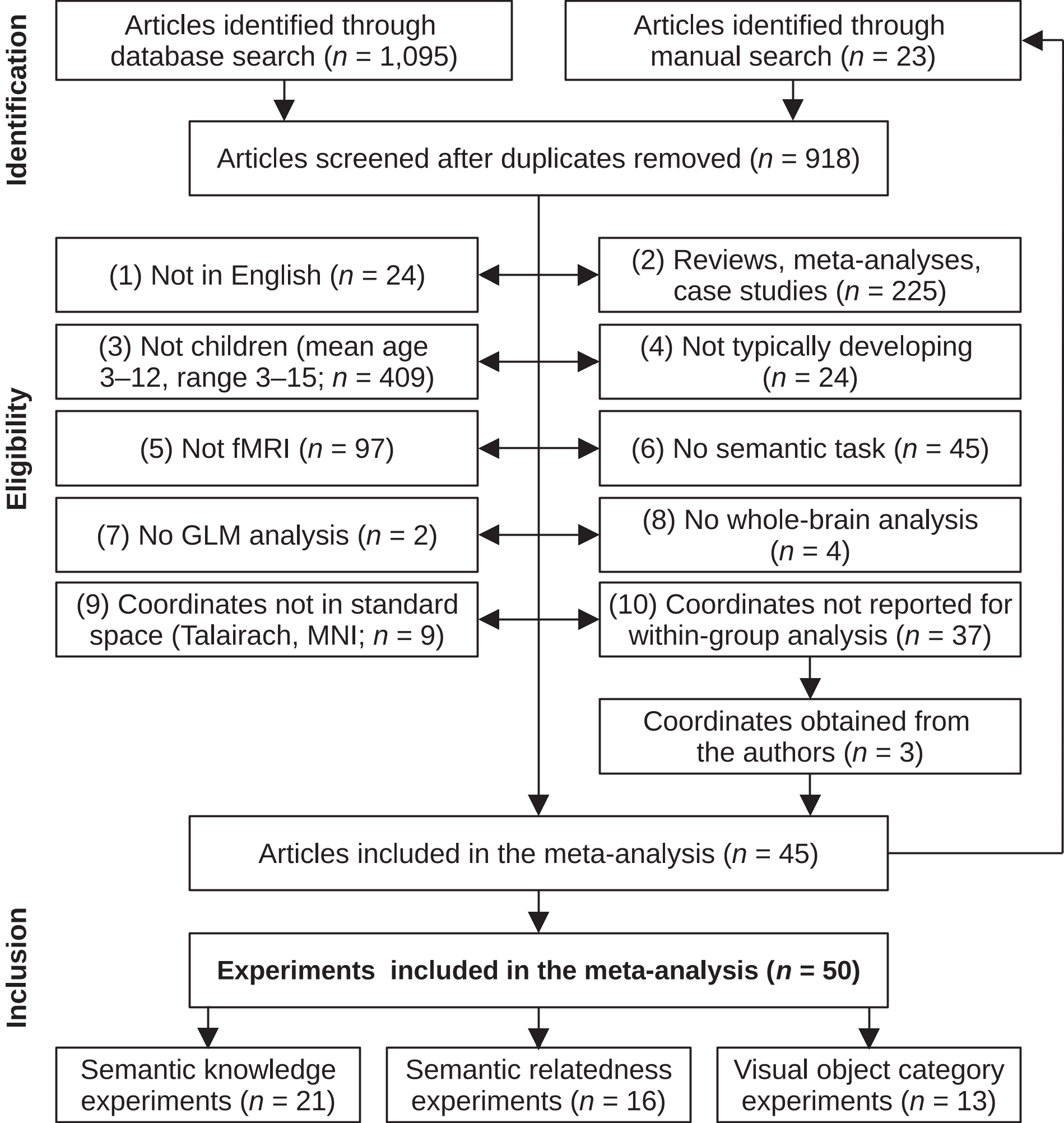 Fig 1: The rigorous selection process yielded 50 independent experiments from 45 articles.
Key Insights: Children vs. Adults
While the "bones" of the semantic system (like the left inferior frontal gyrus) are present early on, the comparison between 1,018 children and 415 adult experiments revealed striking differences:
1. The Missing Hub
In adults, the Anterior Temporal Lobe (ATL) acts as an "amodal hub"—a central switchboard that connects sounds, sights, and words into a single concept. Surprisingly, the meta-analysis found virtually no consistent ATL activation in children. This suggests the ATL hub is a late-developer, only reaching its full functional potential in late adolescence or adulthood.
2. Posterior-to-Anterior Shift
Children showed significantly more activation in posterior regions (occipital and inferior temporal gyri) compared to adults. The authors suggest that children might need to recruit these visual-heavy areas more intensely to distinguish between object categories as they are still building their conceptual libraries.
3. Incomplete Lateralization
While adult language is famously left-hemisphere dominant, children showed more consistent activation in right-hemisphere homologues (like the right insula). This supports the theory that the "language brain" starts out bilateral and gradually prunes itself into the left hemisphere as skills become more efficient.
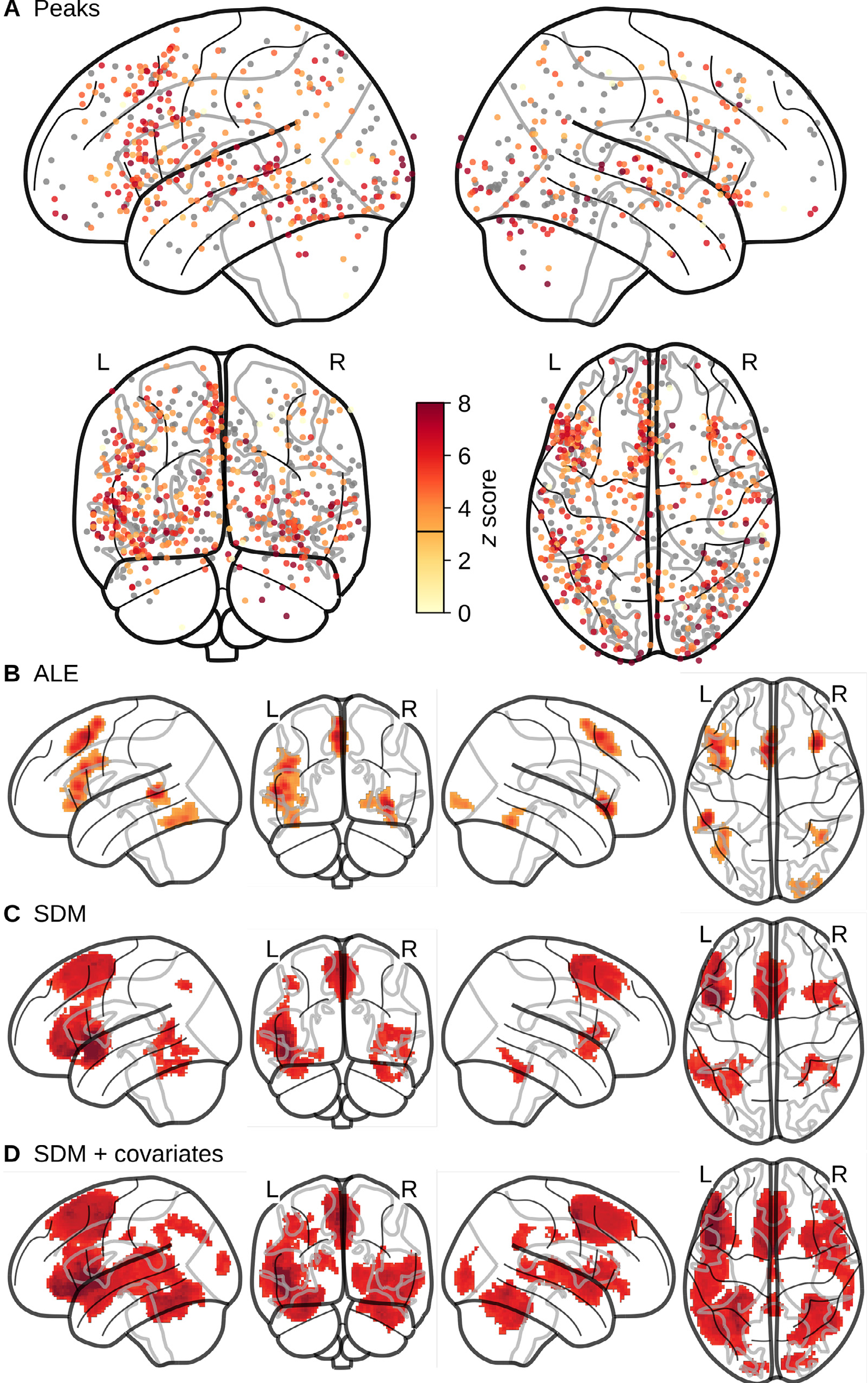 Fig 2: The core semantic network in children, highlighting the Left IFG (Cluster 1) and Bilateral SMA (Cluster 2).
Stability and Robustness
To prove these results weren't driven by a few outlier studies, the team performed a "Leave-One-Out" analysis and a "Fail-Safe N" analysis.
- Leave-One-Out: Even after removing any single study, 96% of the clusters remained significant.
- Fail-Safe N: Specifically, for the core clusters, one would need to add dozens of "unpublished null studies" to the mix to overturn the result, far exceeding the estimated prevalence of the "file-drawer" problem in the field.
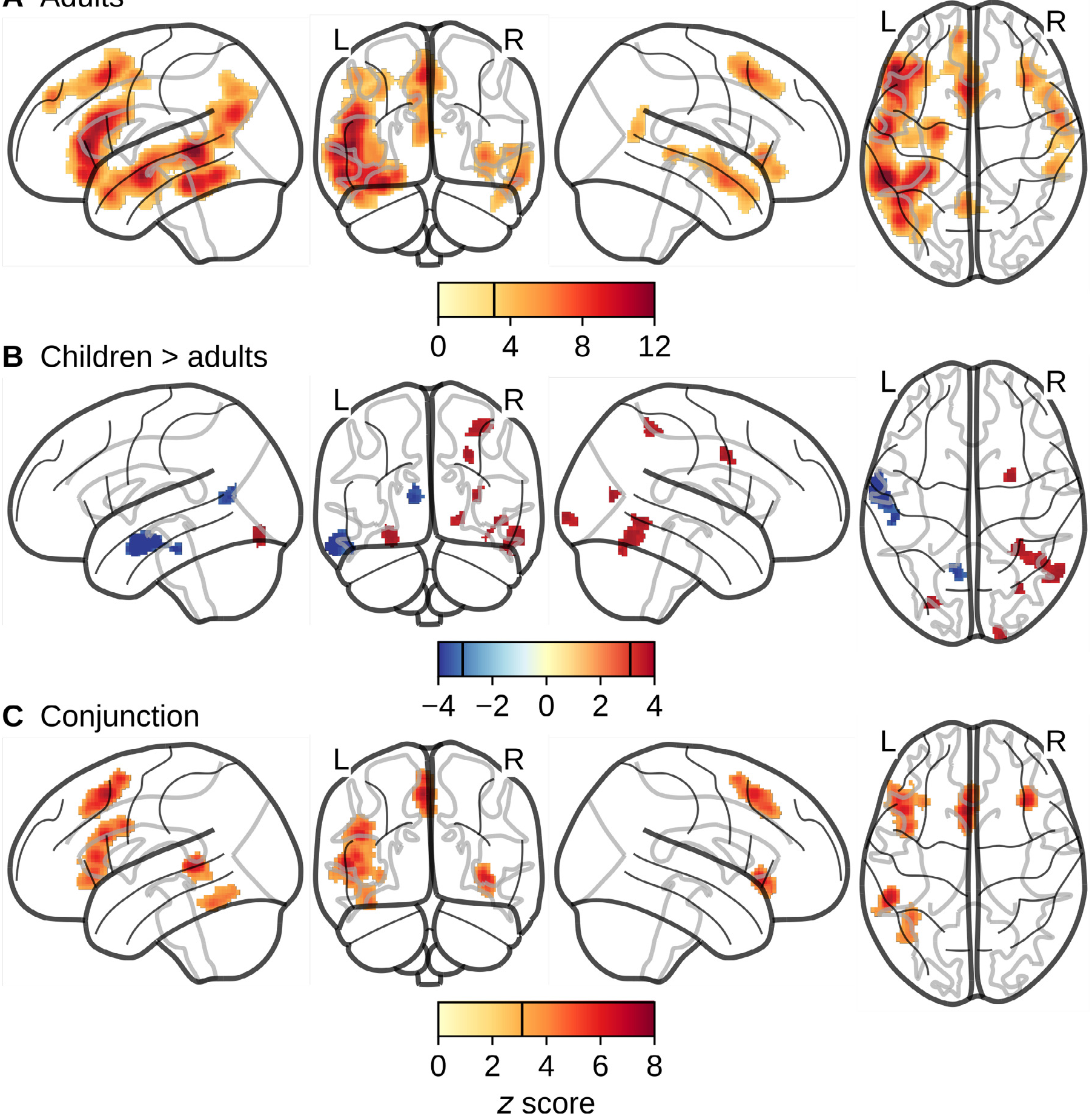 Fig 3: The overlap (visualized in green) between children and adults shows a highly conserved core system despite developmental differences.
Conclusion: A Roadmap for Development
This work provides a foundational "standard map" for pediatric semantic cognition. It confirms that the core machinery of meaning is in place early in childhood but highlights that the transition to an adult-like, a-modally integrated, and left-lateralized system is a decade-long journey. For AI researchers, this serves as a biological reminder that categorization (posterior processing) might be a precursor to conceptual integration (the ATL hub).
Future Work: The "ATL gap" in current literature is a major call to action. Future pediatric studies must use specialized coils and parameters to specifically target the temporal poles, which are notoriously difficult to scan due to signal dropout near the ear canals.