
ActiveIter: Solving Social Network Alignment with Meta Diagrams and Active Learning
Meta Diagram Based Active Social Networks Alignment
The paper introduces ActiveIter, an active learning-based framework for social network alignment that maps shared users across heterogeneous platforms like Twitter and Foursquare. It leverages a novel "meta diagram" concept for feature extraction and an iterative query strategy to handle data paucity and one-to-one mapping constraints.
TL;DR
Connecting user identities across different platforms (e.g., matching a Twitter handle to a Foursquare account) is a cornerstone of social data fusion. This paper presents ActiveIter, a framework that uses Meta Diagrams to capture complex user behaviors and an Active Learning strategy to achieve SOTA performance with 90% less labeled data than traditional iterative methods.
The Challenge: Heterogeneity and Data Scarcity
In the real world, network alignment is plagued by three major issues:
- Network Heterogeneity: Users don't just "follow" each other; they check into locations, use timestamps, and post content. Standard graphs can't handle these diverse relations.
- Label Paucity: Manually verifying if "User A" on Twitter is "User B" on Foursquare is expensive and slow.
- One-to-One Constraints: A single human should not be mapped to multiple identities in a target network, a constraint often ignored by simple classifiers.
Methodology: Beyond Meta-Paths
1. The Power of Meta Diagrams
While previous works used Meta-Paths (linear chains of relations), they failed to capture concurrent relations. For example, two users might visit the same city and post at the same time, but never together. A Meta-Path might see this as a match; a Meta Diagram (a directed acyclic subgraph) can require both location AND time to align, providing much higher precision.
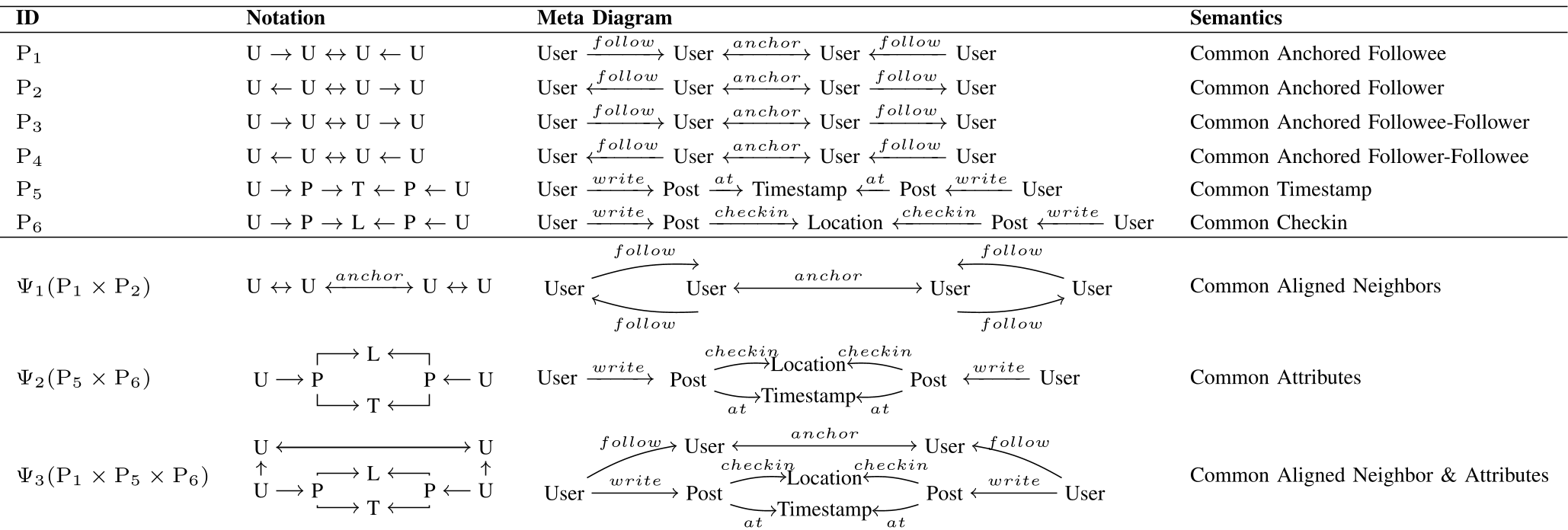
2. Active Iterative Alignment
Instead of asking for random labels, ActiveIter identifies False Negatives. It looks for unlabeled links that have high similarity scores but are currently "rejected" by the model because a different link (likely a false positive) is taking its place due to the one-to-one constraint. By querying these specific conflicts, the model "unblocks" the correct alignment logic.
Experimental Performance
The researchers tested ActiveIter on Twitter and Foursquare datasets. The primary finding was a massive leap in efficiency:
- Data Efficiency: ActiveIter with a budget of 100 queries outperformed the baseline
Iter-MPMDeven when that baseline was given ~1,600 extra training samples. - Metric Superiority: In F1-score and Recall, ActiveIter consistently stayed above random active selection and traditional supervised SVMs.
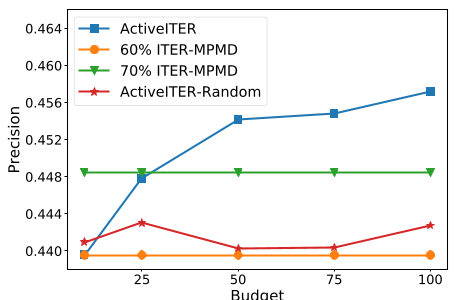 The figure above shows that while random querying (ActiveIter-Rand) stagnates, the targeted query strategy of ActiveIter scales performance rapidly with a very small budget.
Critical Insight & Conclusion
The "Secret Sauce" of this work is the combination of structural expressiveness (Meta Diagrams) and logical conflict resolution (Active Learning targeting the one-to-one constraint).
Takeaway for Practitioners: When alignment labels are scarce, don't just label more data—label the data points where your model’s constraints (like one-to-one mapping) are causing the most internal "confusion." This paper proves that structural "diagrams" are the superior way to describe entities in complex, multi-typed environments.
Note: For a deeper dive into the mathematical optimization of the greedy link selection, refer to the full version of the paper [1].