
[Stanford & MIT] Meta-Harness: Why Your LLM System Needs an Automated Software Engineer, Not Just a Prompt Tuner
Meta-Harness: End-to-End Optimization of Model Harnesses
Meta-Harness is an automated "outer-loop" system designed to optimize the code surrounding LLMs (the harness), covering data retrieval, memory management, and prompt construction. By using an agentic proposer with full filesystem access to prior execution traces and code, it achieves SOTA results on text classification (+7.7 points over ACE) and successfully transfers optimized retrieval strategies across math reasoning models.
Executive Summary
TL;DR: While the AI community has obsessed over model weights and prompt templates, the "Harness"—the complex Python code that governs how an LLM retrieves information and manages memory—remains a manual bottleneck. Meta-Harness changes this by turning harness engineering into an automated search problem. By giving a coding agent (the Proposer) full access to a filesystem of every past failure and success, this system outpaces humans and existing optimizers in classification, math, and coding tasks.
Background Positioning: This work moves beyond "Prompt Optimization" (like DSPy or OPRO) into the realm of Automated System Engineering. It treats the entire LLM wrapper as a mutable codebase, positioning itself as a SOTA "Meta-Learning" framework for the agentic era.
The Motivation: The "Compressed Feedback" Trap
In traditional prompt engineering, we often give an LLM a score (e.g., "Accuracy: 0.7") and ask it to "do better." However, in complex systems like Retrieval-Augmented Generation (RAG) or coding agents, a failure at step 52 might be caused by a retrieval logic error at step 2.
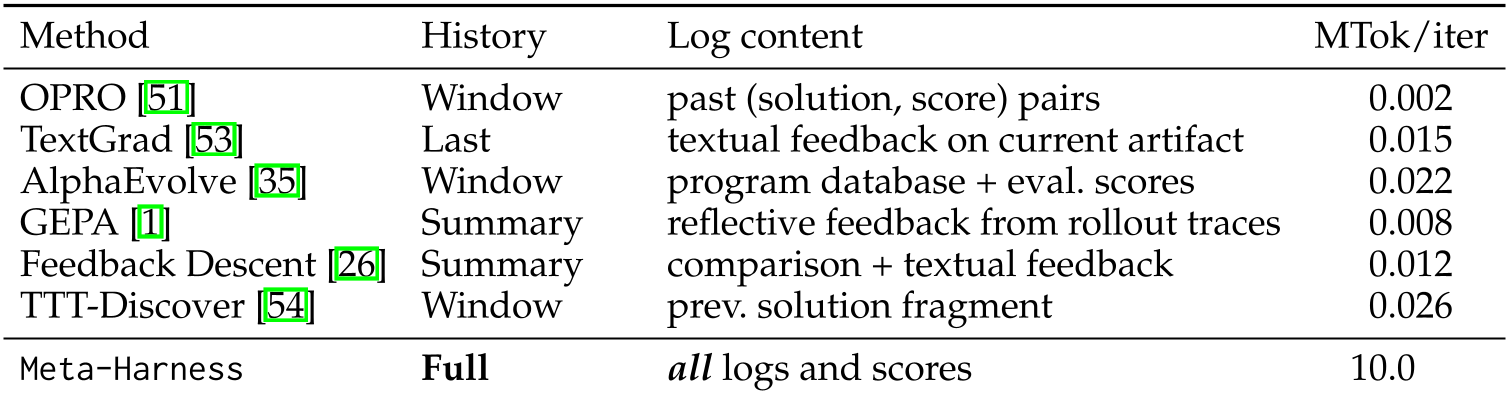
Prior optimizers (see Table 1) typically provide the model with a few thousand tokens of summary. Meta-Harness argues that this is lossy. To truly fix a system, the optimizer needs the "Diagnostic Footprint"—the raw logs, the exact code version, and every model turn.
Methodology: The Outer-Loop Search
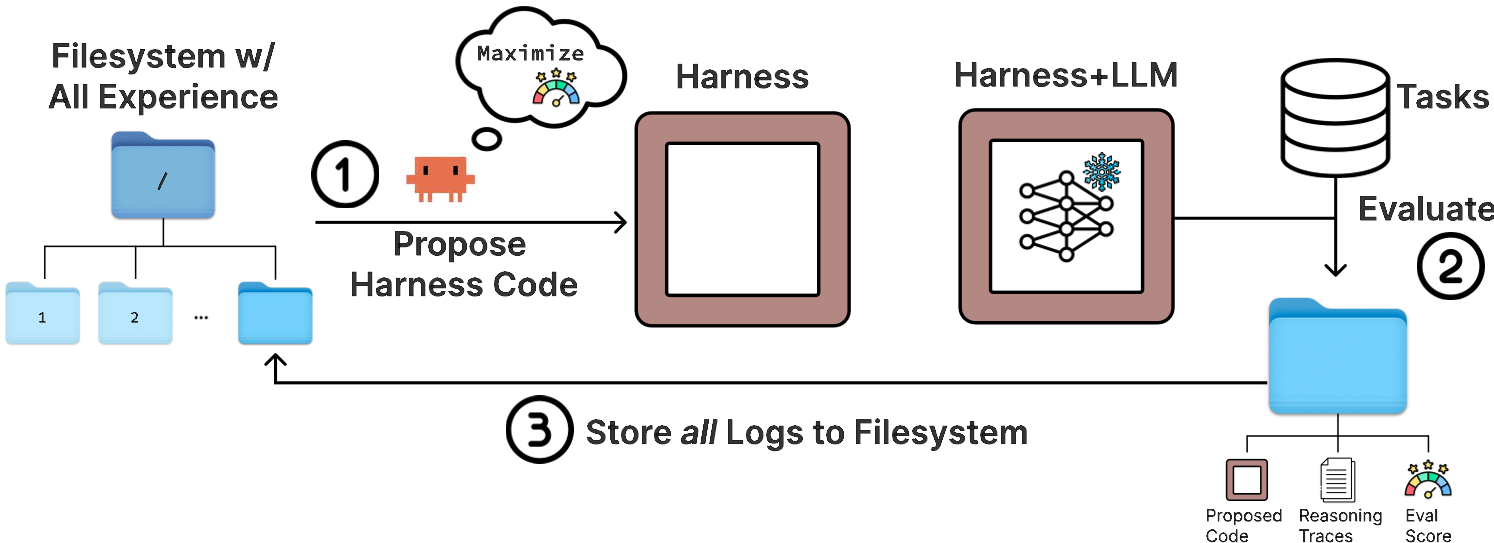
Meta-Harness operates on a simple but powerful loop:
- Propose: A coding agent (e.g., Claude Opus) reads the history of all prior attempts from a filesystem.
- Evaluate: The proposed harness (a Python file) is run against a search set.
- Log: Every single trace, error message, and score is dumped back into the filesystem.
The "Magic" lies in Filesystem Access. Unlike typical LLM prompts that have strict context limits, the agent uses grep and cat to selectively investigate why specific candidates regressed. This allows for Causal Reasoning: the agent can realize, "Candidate A and B both used Prompt X and failed; Candidate C used Prompt Y and succeeded. Therefore, the issue is Prompt X."
Key Results & Insights
1. Online Text Classification: Efficiency at Scale
Meta-Harness achieved a 7.7 point lead over Agentic Context Engineering (ACE) while using 4x fewer tokens. Remarkably, it matched the final performance of other text optimizers in just 4 evaluations, whereas others took 40+.
2. Math Reasoning: Cross-Model Transfer
The system discovered a "Lexical Router" for math problems—automatically deciding when to use different retrieval strategies for Geometry vs. Number Theory. This discovered harness improved performance by 4.7 points even on five "held-out" models the optimizer had never seen.
3. Agentic Coding: Surpassing Human Baselines
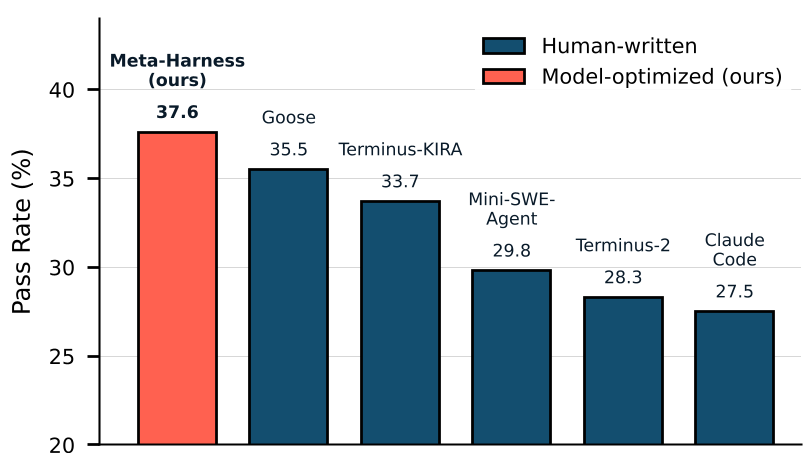
On TerminalBench-2, Meta-Harness discovered a "Bootstrap" strategy: running a shell command to map the environment before the agent starts. This simple structural addition outperformed the best human-engineered agents like Terminus-KIRA.
Critical Analysis & Conclusion
Takeaway: The "Bitter Lesson" of AI continues—general search and meta-learning over raw data consistently beat human intuition. Meta-Harness proves that the "code around the model" is a fertile ground for optimization.
Limitations:
- Proposer Dependency: The system's success relies heavily on the quality of the underlying coding agent (e.g., Claude 3.5/4.6).
- Cost: Processing 10M tokens of execution traces per iteration can be expensive, though the authors argue the 10x speedup in convergence compensates for this.
Future Outlook: We are entering an era where humans will no longer write RAG pipelines or agent loops. Instead, we will write the "Meta-Harness"—the objective function and the search space—and let agentic optimizers build the software.