
Meta-language: Bridging the Micro-Macro Gap in Social Simulations via Symbolic Interaction
Towards a New Approach in Social Simulations: Meta-language
The paper introduces a "Meta-language" framework for social simulations, designed to bridge the micro-macro link through a cultural approach to agent communication. It leverages an algebra of binary oppositions to enable agents to dynamically generate and negotiate meanings, moving beyond static, pre-defined behavioral rules.
TL;DR
Existing social simulations often treat agents like programmable automatons following rigid cultural "rules." This paper challenges that paradigm by introducing Meta-language: a framework where agents don't just follow rules—they negotiate meaning. By using an algebra of binary oppositions, agents build internal "Opposition Maps" to interpret the world, allowing complex social structures like networks and triads to emerge from dynamic sense-making rather than fixed programming.
The Problem: The "Software of the Mind" Trap
For decades, social simulation has relied on the "latent variable" approach to culture, famously championed by Geert Hofstede. In this view, culture is a "collective programming of the mind"—a set of static dimensions (like Power Distance) that dictates agent behavior.
However, the authors argue this is fundamentally flawed for complex systems. Real human society is self-referential: we change our behavior based on how we perceive the macro-patterns emerging around us. If culture is hard-coded, agents cannot be truly reflexive. They cannot "make sense" of a changing world; they can only execute pre-defined scripts. This creates a disconnect between micro-actions and macro-evolution.
The Insight: Culture as Practice and Symbol
To solve this, the authors turn to Sewell’s culture theory and Embodied Cognition. They posit that:
- Meaning is Relational: A symbol (like "Rain") only means something in opposition to other symbols (like "Sun" or "Dark").
- Coherence is "Thin": You don't need to agree on everything to form a society; you just need to share the same "logic of oppositions."
- Reflexivity is Key: Agents must be able to generate multiple interpretations of a situation and use "practical judgment" to see which one works.
Methodology: The Algebra of Oppositions
The core technical contribution is the Opposition Map.
1. Defining the Map
The authors formalize an algebra where an opposition is a binary relation that is:
- Irreflexive: A symbol cannot oppose itself.
- Symmetric: If distinguishes , then distinguishes .
2. Meaning Generation via Graph Theory
A "Meaning" is defined as a set of symbols that contain no opposing pairs. Mathematically, the authors prove (Theorem 1) that for any symbol set and opposition relation, there exists a unique Meta-language Generating Set.
- The Intuition: Finding meanings is equivalent to finding cliques (maximal complete subgraphs) in a non-opposition graph.
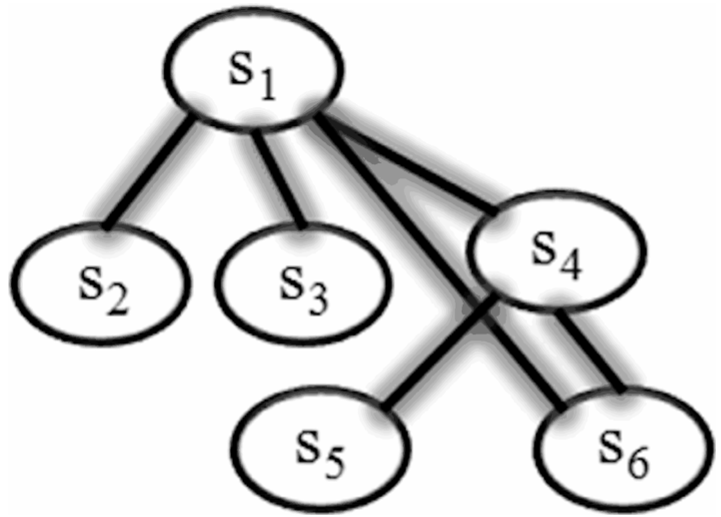 Figure 1: A simple Opposition Map where edges represent symbols that distinguish each other.
Experiments: The Sense-Making Game
The researchers implemented this in a grid-based multi-agent simulation. Agents interact by sending "meaning sets" representing their intentions.
- If the receiver's opposition map finds the message "consistent" (it fits their meta-language), the interaction is successful.
- Reinforcement Learning: Successful meanings gain "reliability" (based on Prospect Theory's value function), while failed ones are eventually discarded or replaced.
Key Results
The study monitored the formation of triads (a classic sociological indicator of stable social groups).
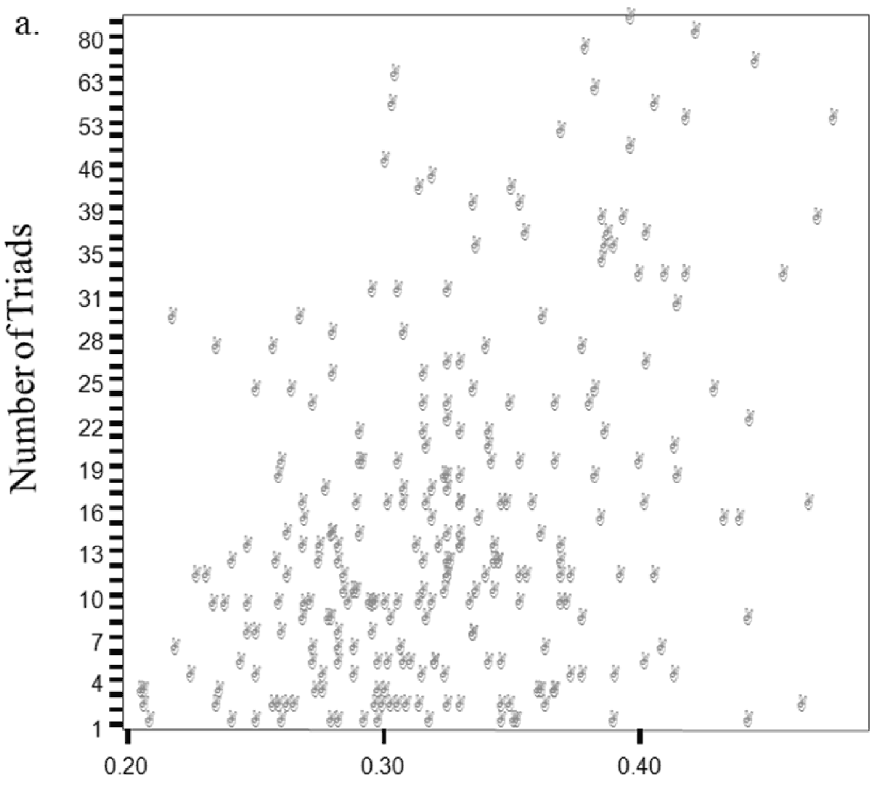 Figure 2: The emergence of social triads relative to cultural coherence.
The transition from a "cloud" of 512 possible meanings to a specialized set of ~5 highly reliable meanings demonstrates how social anchoring occurs. Most importantly, it proved that "thick" cultural agreement isn't necessary for social structure—just a shared framework for negotiating differences.
Critical Analysis & Future Outlook
This work moves social simulation from behavioral mimicry toward cognitive realism. By grounding meaning in graph theory, it provides a rigorous way to model "Common Sense" as a dynamic, emergent property.
Limitations:
- The current model assumes a fixed set of symbols; in reality, new symbols (neologisms, new technology) enter the social space constantly.
- The "rewards" for sense-making are currently abstract; linking these to economic or survival rewards (e.g., in a Prisoner's Dilemma) would be a logical next step.
Future Work: This framework is a goldmine for LLM-based Multi-Agent Systems. Instead of prompting LLMs with static "personas," we could give them "Opposition Maps" to simulate more realistic social negotiation and cultural evolution.
Takeaway: Social order isn't about being programmed the same way; it's about having a shared way to disagree and refine meanings through practice.