
Automated Algorithm Selection: A Meta-Learning Bridge for Non-Expert Miners
Meta-Learning Based Framework for Helping Non-expert Miners to Choice a Suitable Classification Algorithm: An Application for the Educational Field
This paper introduces a meta-learning based framework designed to assist non-expert users in selecting the optimal classification algorithm for specific datasets. By extracting meta-features from 30 educational datasets and training linear regressors, the framework successfully ranks algorithms like Random Forest and J48 based on predicted accuracy.
TL;DR
Choosing the right machine learning algorithm is often a "black art" reserved for experts. This paper presents a meta-learning framework that automates this choice for novices. By analyzing the "DNA" of a dataset (meta-features), the system predicts which algorithm will perform best. Tested on educational data for predicting student success, the framework proves that high-threshold feature selection combined with regression can accurately rank classifiers, making data mining more accessible.
Problem & Motivation: The Expert Gap
The "No-Free-Lunch" theorem reminds us that no single algorithm reigns supreme. For non-experts, the mining phase of Knowledge Discovery (KDD) becomes a bottleneck. Should they use a Decision Tree (J48) or an Ensemble (Random Forest)? Traditional trial-and-error is time-consuming and inefficient. The authors argue that we can learn from past experiments—essentially "learning how to learn"—to provide a data-driven recommendation system.
Methodology: Mapping Dataset DNA to Performance
The core innovation lies in how the framework characterizes datasets. It doesn't just look at the number of rows or columns; it looks at the internal geometry and complexity of the data.
The Framework Architecture
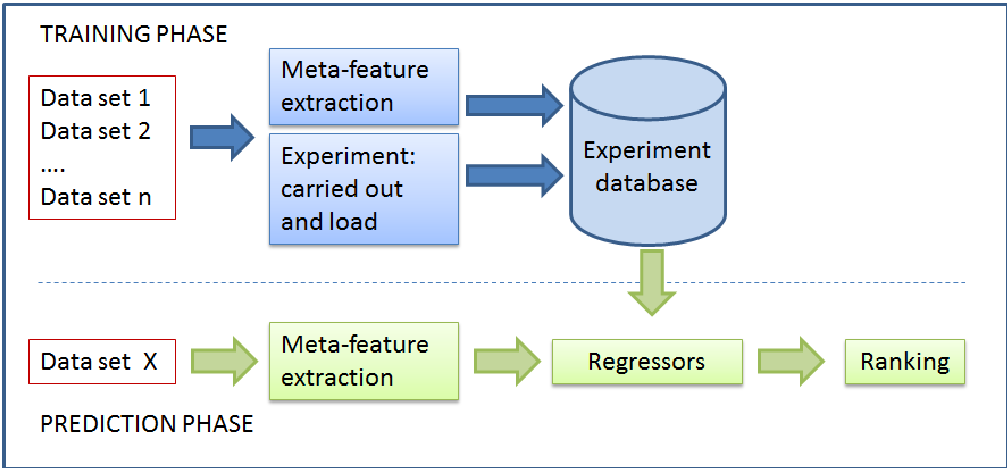
The system follows a four-step workflow:
- Meta-feature Extraction: Extracting simple, statistical, complexity, and landmarker features.
- Database Loading: Storing experiment metadata (accuracy, parameters).
- Regressor Building: Training linear models to predict the accuracy of specific algorithms based on meta-features.
- Prediction & Ranking: When a new dataset arrives, the system extracts its features and outputs a ranked list of recommended algorithms.
Key Insights: What Makes a Good Meta-Feature?
The study categorizes features into several groups:
- Simple/Statistical: Size, dimensionality, skewness, and kurtosis.
- Complexity (DCoL): Measures like Fisher's discriminant ratio (F1) and class boundary overlap.
- Landmarkers: The most "clever" feature type—using the performance of very fast, weak classifiers (e.g., 1-NN or Naive Bayes) to guess how a complex one will perform.
Experiments & Results: Precision through Pruning
The authors tested the system on 30 educational datasets from Moodle platforms. A critical finding was that more data isn't always better. Using all meta-features actually introduced noise, leading to worse predictions than a simple average.
Feature Selection is Crucial
By applying a 70% relevance threshold (FS 70%), the researchers removed "garbage" features. This led to a significant drop in RMSE (Error) across all models.
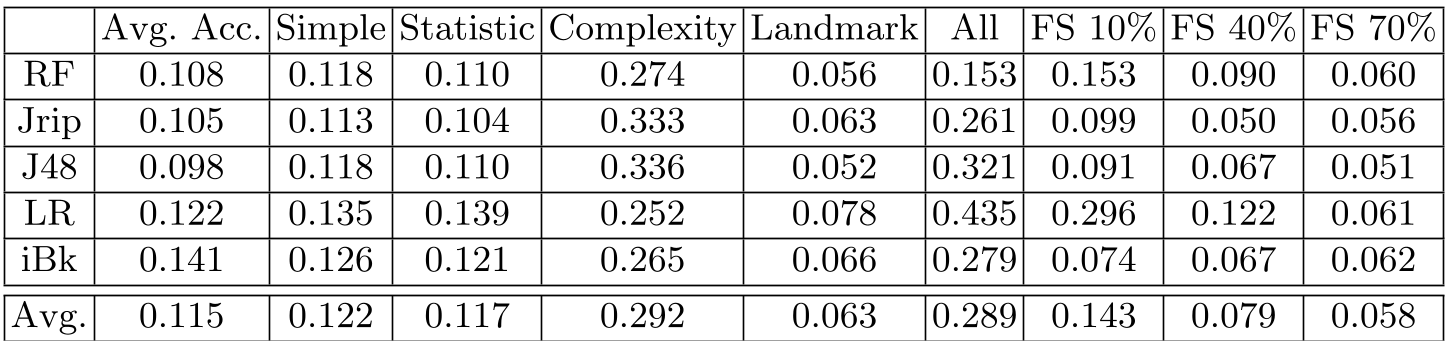
As shown in the table above, the Landmark group and the FS 70% strategy achieved the lowest errors, consistently outperforming the "Avg. Acc." baseline. Notably, Landmarkers (like the performance of a 1-Nearest Neighbor) were selected by the feature selection algorithm 100% of the time, proving their diagnostic power.
Critical Analysis & Conclusion
This work demonstrates that meta-learning is a viable path toward "Democratized AI." For the educational field, where practitioners are often teachers or administrators rather than data scientists, such a tool is invaluable for predicting student performance.
Strengths:
- Identifies Landmarkers and F1 (Fisher's ratio) as the most critical features for student data.
- Provides a practical database schema for building an "organizational memory" of ML experiments.
Limitations:
- The study is currently limited to numerical attributes and binary classification (Pass/Fail).
- Linear Regression might be too simple for complex meta-relationships; future work could explore non-linear meta-regressors like Gradient Boosting.
By bridging the gap between raw data and algorithm selection, this framework moves us one step closer to a fully automated, user-friendly data mining pipeline.