
Beyond Rapid Prototyping: A Meta-level Reductionist Approach to AI & Law
A meta-level approach to the analysis of legal phenomena based on the key concept of reduction
This paper introduces a meta-level epistemological framework for AI & Law based on the concept of "heterogeneous reduction." It redefines the relationship between Legal Science (macro-level) and Computer Science/AI (micro-level) as a process of "downwards explanation" to bridge the gap between abstract legal phenomena and computational procedures.
TL;DR
The intersection of AI and Law is often treated as a mere engineering task—coding rules into software. This paper argues for a shift toward an epistemological meta-analysis, treating AI models as "heterogeneous reductions" of legal phenomena. It provides a formal way to explain how microscopic computational processes can "support" macroscopic legal decisions without losing the essential qualities of legal theory.
Positioning: This is a foundational theoretical work (published in 2003) that seeks to move the AI & Law field from "ad-hoc" prototyping to a rigorous methodological framework.
The Problem: The "Ad-Hoc" Trap
Historically, AI & Law research followed a simplistic path: pick a legal domain, build an expert system, and test it. The problem? This ignores the Cognitive Reality of how law works.
- Law is Macroscopic: It deals with norms, nuances, and social prescriptions.
- AI is Microscopic: It deals with algorithms, data structures, and calculus.
The gap between "calculating a result" and "deciding a case" is wider than most developers admit. The author suggests that we lack a formal explanation for why a specific AI model is a "valid" representation of a legal truth.
Methodology: The Core of Heterogeneous Reduction
Drawing from the philosophy of science (specifically Ernest Nagel), the paper introduces the concept of Heterogeneous Reduction.
1. Macro vs. Micro Levels
The paper establishes a clear hierarchy:
- Macro-level (Main Theory): Law (e.g., "The defendant is guilty of murder").
- Micro-level (Explanatory Theory): AI (e.g., "A specific logic gate or neural output based on statutory code").
2. The Logic of "As" vs. "Because"
Crucially, the author argues that AI and Law lack a bi-conditional relationship. You cannot say "Law IS AI." Instead, a reduction is a downward movement. The AI result serves as an explanation as a justification for the legal phenomenon.
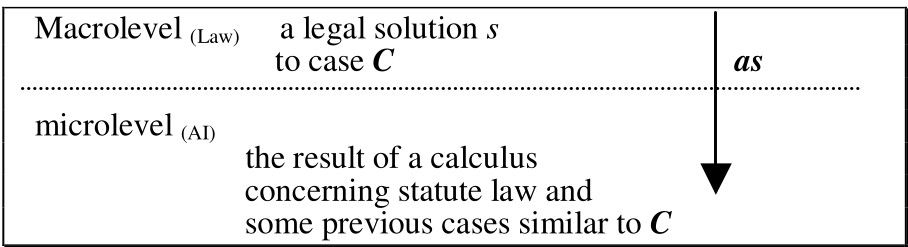 Figure 1: Visual representation of a simple reduction where a legal phenomenon is mapped to a computational micro-statement.
Why Bi-conditionals Fail
A major insight of this paper is the rejection of the formula: Legal Solution ⇔ AI Result.
If this were true, AI propositions would have a legal sense even when taken out of context. However, AI skills (like calculating probabilities) have no inherent "legality" on their own. Therefore, the connection is unidirectional. The micro-configuration explains the macro-assertion, but it does not replace it.
Critical Analysis & Conclusion
Takeaway
The value of this approach lies in the Interdisciplinary Validity Problem. To build a truly intelligent legal system, one must prove that the "reduction" is sound—not just logically, but legally. Every reduction must pass "legal verification controls."
Limitations
While the reduction strategy is logically elegant, the paper acknowledges it is "useful but not complete." In modern deep learning contexts, the "Microlevel" (weights and biases) is often so opaque that "explaining" a macro-level legal norm through a black-box model becomes an even greater epistemological challenge than it was in 2003.
Future Outlook
As we move into the era of LLMs in the courtroom, Smith’s insistence on a "meta-level approach" is more relevant than ever. We must ask: Is a prompt-response a valid reduction of a legal argument, or is it just an ad-hoc imitation? Understanding the accuracy of these reductions is the next frontier for AI & Law.