
One Ontology to Bind Them All: Bridging the Linguistic Metadata Gap with META-SHARE OWL
One ontology to bind them all: The META-SHARE OWL ontology for the interoperability of linguistic datasets on the Web
The paper introduces the META-SHARE OWL ontology, a semantic framework designed to unify disparate linguistic metadata registries into a single, interoperable Web representation. By transforming the XML-based META-SHARE schema into OWL, the authors achieve SOTA harmonization across major repositories like CLARIN VLO and ELRA.
TL;DR
The linguistic research community faces a "data flood" where resources (corpora, lexicons, tools) are scattered across fragmented silos like ELRA, LDC, and CLARIN. This paper presents the META-SHARE OWL ontology, a semantic anchor that transforms legacy XML schemas into a unified Web Ontology Language (OWL) model. By aligning with standard vocabularies like DCAT and ODRL, it enables the first truly federated search for language resources via portals like Linghub.
Problem: The Tower of Babel in Metadata
Computational linguistics relies on high-quality datasets, but finding them is a nightmare of "interoperability friction." Existing solutions like OLAC are often criticized as too reductionist (losing specific linguistic nuance), while CMDI (the Component Metadata Infrastructure) led to "schema proliferation," where every institution created its own incompatible profile.
The authors identify a critical insight: XML-based schemas are too rigid for the Web of Data. To handle the diversity of legacy and crowd-sourced resources, the community needs an open-world model that supports inference, property chains, and cross-domain alignment.
Methodology: From XSD to Semantic Web
The core of this work is the "RDFication" of the dense META-SHARE schema. The authors didn't just perform a 1-to-1 conversion; they restructured the hierarchy to make it "web-native."
1. Structural Simplification
XSD focuses on validation, often leading to "superfluous wrapping elements." The authors identified nodes with a cardinality of 1 (like identificationInfo) and removed them to create a leaner graph.
2. Semantic Mapping and Interoperability
The ontology interfaces with several high-level vocabularies:
- DCAT (Data Catalog Vocabulary): Used for generic dataset and distribution descriptions.
- ODRL (Open Digital Rights Language): Extended specifically to handle the complex licensing requirements of language resources (e.g., attribution duties, non-commercial restrictions).
- FOAF & SWRC: Used for modeling the people, organizations, and research papers linked to the resources.
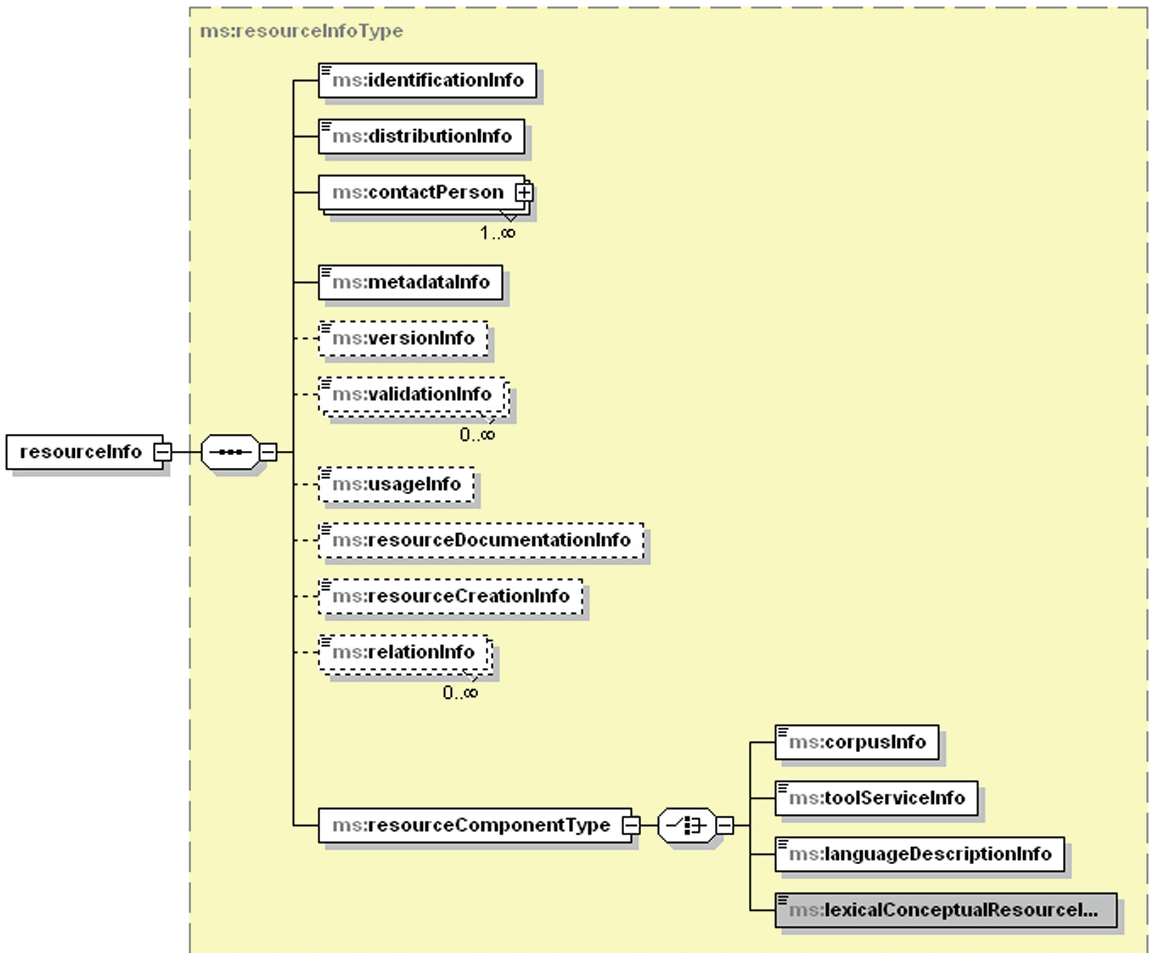 Figure 1: The core components of the META-SHARE schema focusing on the lifecycle of a Language Resource.
Bridging Heterogeneity: The CLARIN VLO Case Study
To prove the ontology's power, the authors applied it to the CLARIN Virtual Language Observatory (VLO). They found that even within one infrastructure, metadata was extremely diverse.
As shown in the table below, tags like "Song" or "Session" from different institutes were previously isolated. The META-SHARE ontology allowed these to be mapped to a common linguistic domain model without losing their original richness.
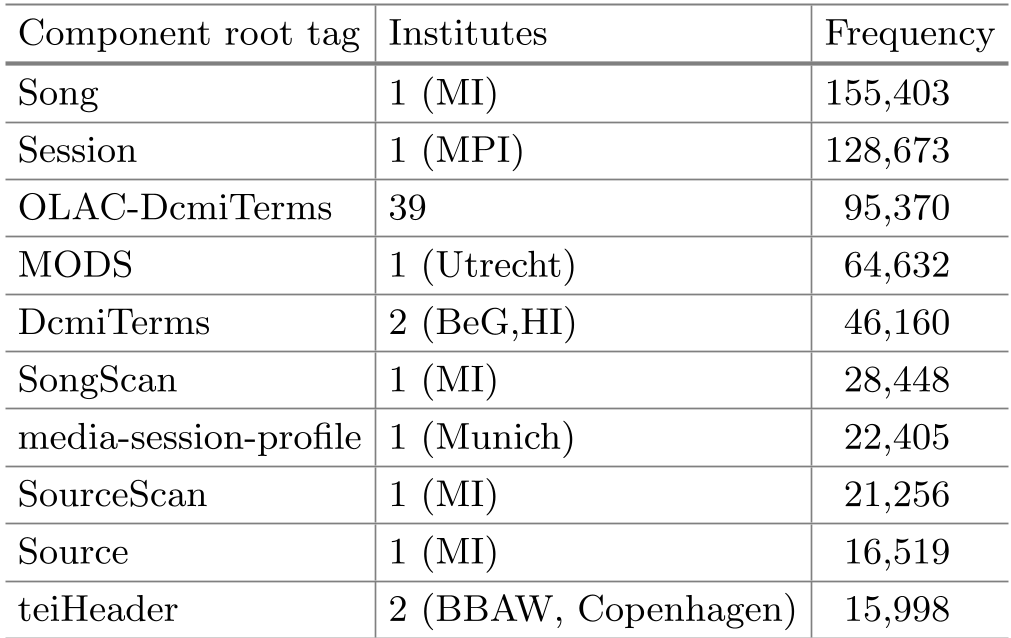 Table 1: Diversity of metadata schemes in the CLARIN VLO infrastructure.
Experiments & Applications
The work is not just theoretical; it powers two live platforms:
- IULA LOD Catalogue: An internal node for UPF enriched with external links to DBpedia and DBLP.
- Linghub: A massive aggregator that allows users to perform SPARQL queries across META-SHARE, LRE-Map, and CLARIN simultaneously.
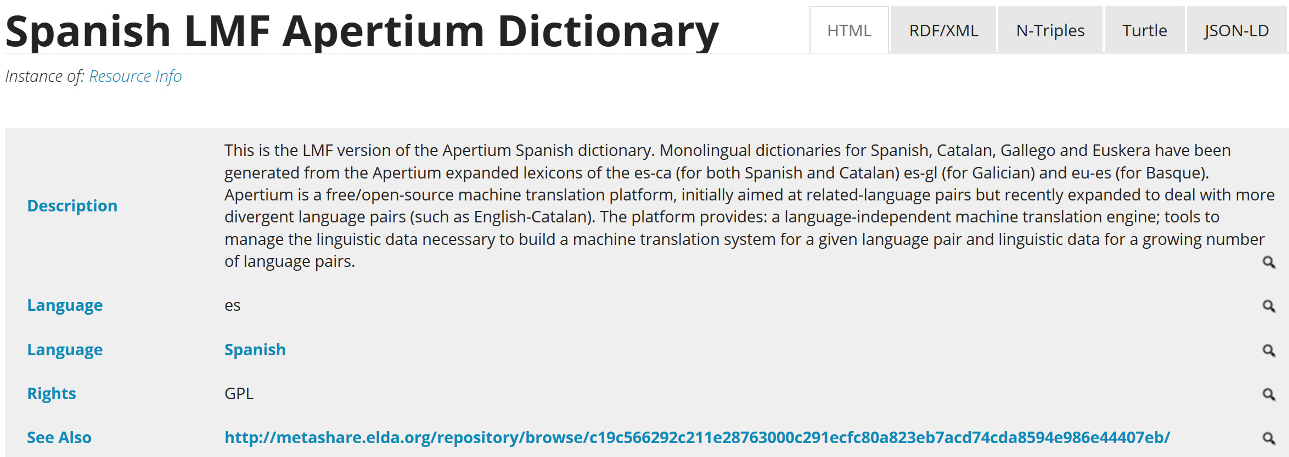 Figure 2: The Linghub portal demonstrating faceted search across harmonized metadata.
Critical Insights & Future Outlook
The "One Ontology to Bind Them All" approach is a significant leap toward Linguistic Linked Open Data (LLOD). By providing a formal semantic bridge, it allows researchers to treat the web as a single, searchable database.
Limitations:
- Mapping legacy schemas still requires significant manual effort and domain-specific knowledge.
- The ontology currently focuses on metadata; the next challenge is ensuring the underlying data (the corpora themselves) adopts similar RDF-based standards like NIF (NLP Interchange Format).
Future Impact: This ontology lays the groundwork for "linked data-aware services," where NLP tools could automatically discover and ingest suitable datasets for training or evaluation based on semantic compatibility.