
Metacognition in LLMs: From "Thinking" to "Thinking About Thinking"
Metacognition in LLMs: Foundations, Progress, and Opportunities
This paper provides the first comprehensive taxonomy and literature review of "Metacognition in LLMs," defining the "Monitoring-Control" loop for AI. It categorizes advancements in measuring self-awareness, benchmarking internal state reporting, and utilizing metacognitive prompting to achieve SOTA performance in reasoning, reliability, and human-AI collaboration.
TL;DR
As Large Language Models (LLMs) reach plateaus in raw knowledge acquisition, the focus is shifting toward Metacognition—the ability of a system to monitor and regulate its own cognitive processes. This seminal paper by Liu et al. provides the first rigorous taxonomy of the field, arguing that true AI intelligence requires a "Metacognitive Loop" of self-monitoring and strategic control.
Problem: The "Confident Idiot" Syndrome
The industry has hit a wall with LLMs that are "unskilled and unaware of it." Even the most powerful models exhibit:
- Overconfidence in Hallucinations: Models often assign 99% probability to factually incorrect claims.
- Rigid Strategy Execution: An agent will continue a failing tool-use chain without "realizing" it is stuck in a loop.
- Metacognitive Myopia: A lack of awareness regarding knowledge boundaries (e.g., not knowing what they don't know).
Methodology: The Metacognitive Loop
The authors define metacognition not just as "self-reflection," but as a functional interaction between two processes:
- Monitoring: Forming judgments of uncertainty, task difficulty, or progress.
- Control: Re-allocating effort, selecting new strategies, or deciding to terminate a reasoning path.
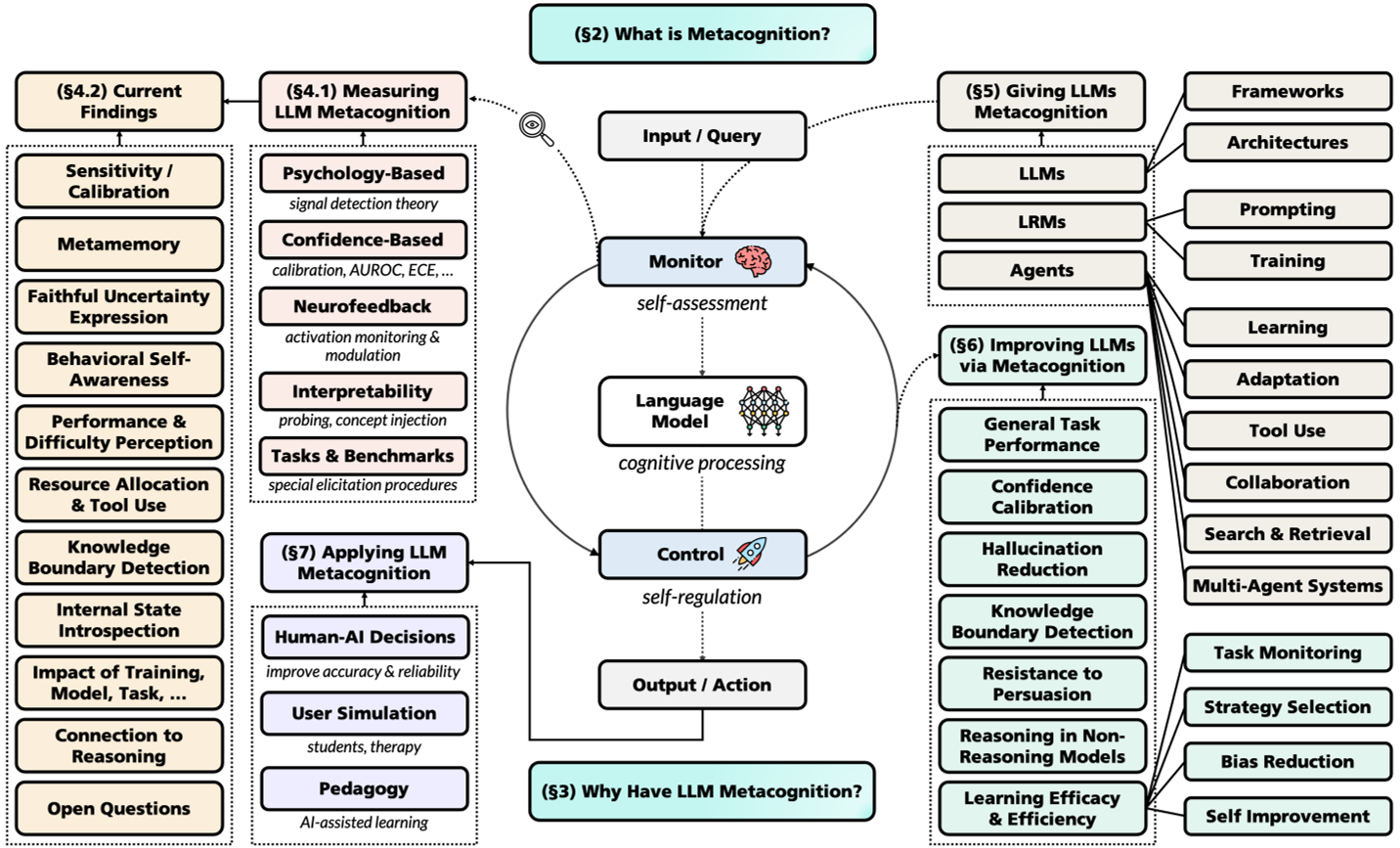 Figure 1: The dual-process loop of Monitoring and Control as applied to LLM architectures.
Measuring the "Self" in AI
How do we prove a model "knows" it is wrong? The paper highlights Signal Detection Theory (SDT). By calculating the M-ratio (Metacognitive Efficiency), researchers can determine if a model's confidence ratings are actually predictive of its accuracy, or if the confidence is just a byproduct of "Type 1" task performance.
Key Insights: Do Models Truly Introspect?
The survey uncovers several provocative findings:
- The 7B Threshold: Models below ~7B parameters often suffer from "metacognitive confusion." When asked to reflect, they actually perform worse because they lack the capacity to process their own errors.
- Reasoning vs. Meta-Reasoning: Interestingly, long Chain-of-Thought (CoT) traces can actually harm metacognitive sensitivity. As the reasoning length increases, the model loses track of its own internal certainty.
- RLMF (Reinforcement Learning with Metacognitive Feedback): Directing optimization toward faithful uncertainty expression (rather than just accuracy) leads to more reliable and trustworthy agents.
Experiments and Benchmarks
The paper reviews new benchmarks like MetaMedQA and CogEdit, which test if a model can filter noisy information or recognize unanswerable medical questions.
| Feature | Cognitive (Type 1) | Metacognitive (Type 2) |
|---|---|---|
| Goal | Solve the math problem | Evaluate if the solution path is likely correct |
| Process | Chain-of-Thought | Self-Critique / Strategy Switching |
| Metric | Accuracy | Metacognitive Sensitivity (meta-d') |
Critical Perspective: Simulation vs. Reality
One of the most debated sections of the paper asks: Are LLMs actually introspecting, or just simulating the language of introspection? The autoregressive nature of LLMs suggests they may just be replicating "reflective patterns" found in training data (like Reddit or Wikipedia discussions). However, neurofeedback studies mentioned in the paper show that models can be trained to modulate their internal activations in response to feedback, suggesting a potential for "Artificial Introspection" that goes beyond surface-level text generation.
Future Outlook: The Self-Improving Agent
The ultimate value of LLM metacognition lies in Autonomous Self-Improvement. If an agent can monitor its own learning progress and identify knowledge gaps, it can proactively "study" or use tools to fill those gaps without human intervention.
Takeaway: We are moving from a world of "Static Models" to "Adaptive Agents" that possess a functional "Cognitive Mirror."
Conclusion
This paper serves as the foundational text for the next era of LLM development. It transitions the conversation from what models know to how they manage their own knowledge. For developers building agents, the message is clear: stop optimizing for raw accuracy and start optimizing for metacognitive sensitivity.