
MetaMap vs. Social Media: Why Professional Medical Tools Fail on Patient Forums
When MetaMap Meets Social Media in Healthcare: Are the Word Labels Correct?
This study evaluates the effectiveness of MetaMap, a standard tool for UMLS concept recognition, when applied to User-Generated Content (UGC) from health forums like HealthBoards. The researchers conducted manual annotation of 100 posts to assess the precision of semantic labeling in informal medical contexts.
TL;DR
Researchers found that MetaMap, the industry standard for mapping text to the Unified Medical Language System (UMLS), achieves a meager 43.75% precision when applied to health forums. The study highlights a massive "domain gap" between professional terminology and layperson communication, where even the word "I" is frequently misidentified as an inorganic chemical.
The "I" is not an Inorganic Chemical: The Motivation
For years, researchers have used MetaMap to preprocess health-related social media data for adverse drug reaction (ADR) detection and disease tracking. However, these tools were built for clinical trials and medical journals.
The author's intuition was simple: patients talk differently than doctors. When a user posts on HealthBoards, they use informal phrasing like "thanks for your advice" or "I have calf pain." MetaMap’s rigid adherence to technical lexicons often leads it to hallucinate medical meaning in everyday words.
Methodology: Auditing the Standard
The researchers didn't just point out flaws; they quantified them. Using 100 posts from HealthBoards, they generated 3,758 labels via MetaMap and had human experts verify every single one.
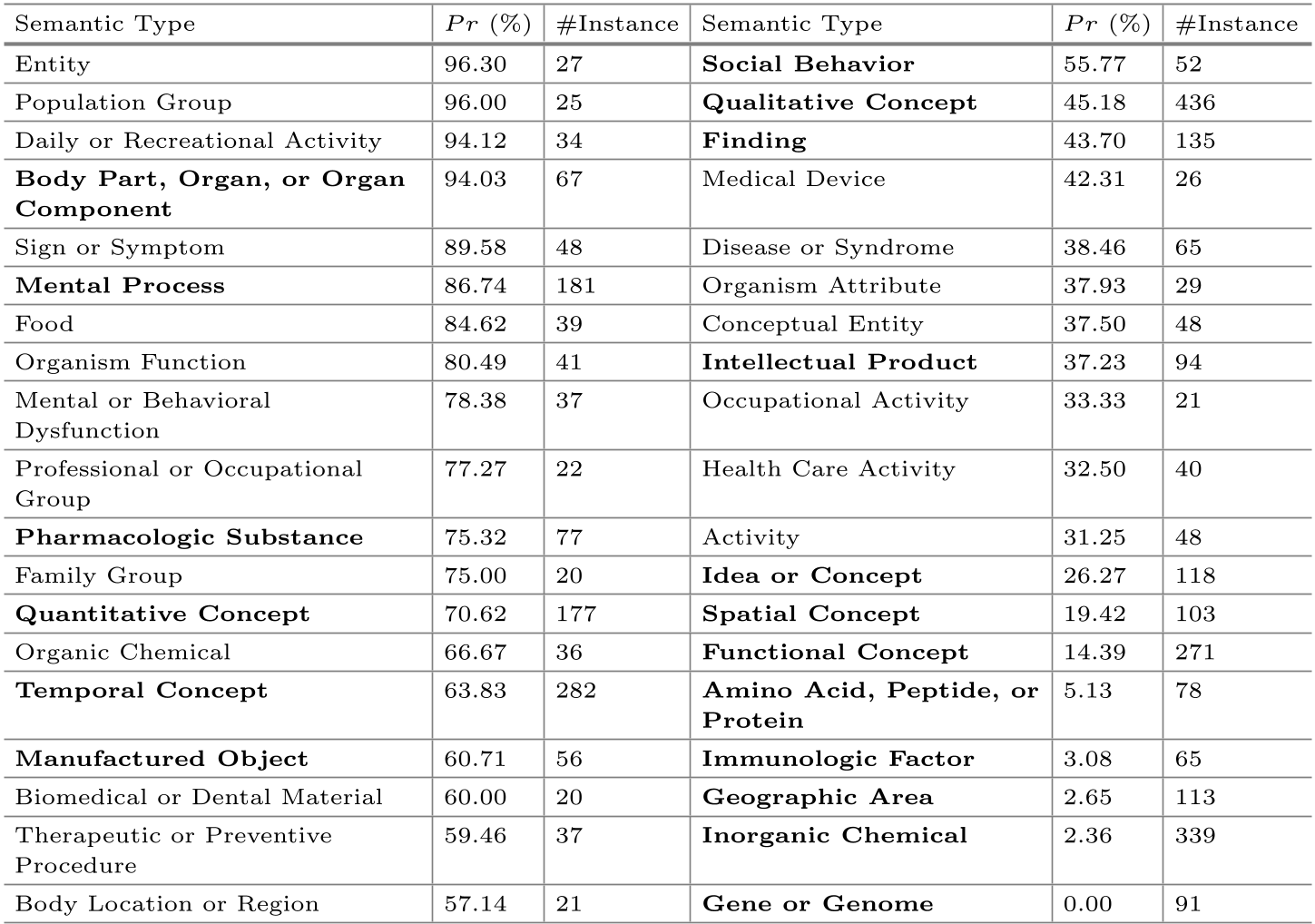 Table 1: Precision breakdown across various Semantic Types. Note the 0.00% precision for Gene or Genome.
The team tested several "common sense" fixes:
- Filtering by Semantic Type: Only looking at highly relevant categories like [Sign or Symptom].
- Frequency Filtering: Removing common words (Stop-words) using Google N-Grams.
Key Insights: Why It Fails
1. The Domain Specificity Trap
MetaMap excels at general categories (e.g., [Body Part] reached 94.03% precision), but it falls apart on technical ones. The most shocking finding was that [Inorganic Chemical] had a precision of only 2.36% because it kept labeling the pronoun "I" as an element.
2. The Context Blindness
The Word Sense Disambiguation (WSD) in MetaMap is not tuned for the "noise" of social media. Words like "hope" or "think" are often shoehorned into [Mental Process] categories that may not be relevant to the actual medical analysis.
3. The Failure of Simple Fixes
One might think removing top-2000 frequent words from Google N-Grams would solve the problem. However, the study showed this only improved precision to 58%. Why? Because patients use common words like "pain," "tired," and "depression" to describe their medical reality. Removing these common words destroys the most valuable data points.
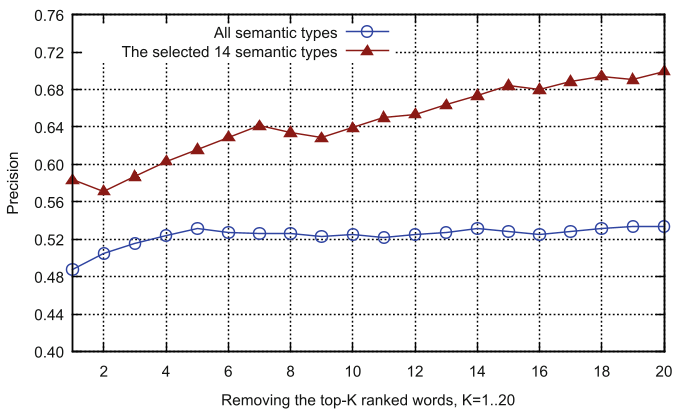 Figure 1: Precision impact when removing top-K frequent words.
Critical Analysis & Conclusion
This paper serves as a vital "cautionary tale" for the medical informatics community.
- The SOTA Reality Check: It proves that high performance on clinical corpora (MIMIC-III, etc.) does not translate to the wild-west of Reddit or HealthBoards.
- Limitation: The study only measured precision, not recall. It’s possible MetaMap is missing a huge portion of "slang" medical terms (e.g., street names for drugs) that aren't even in the UMLS yet.
- Future Outlook: The industry must move toward Instruction-tuned LLMs or specialized Social-Medical NER models that understand the pragmatic context of patient discourse rather than relying on dictionary-matching tools.
Final Takeaway: Don't trust MetaMap out of the box for social media. Without a custom disambiguation layer or a specific semantic filter, your data pipeline is likely 50% noise.