
MetaOn: Bridging the Semantic Gap via Ontology-Driven Multimedia Intelligence
MetaOn - Ontology Driven Metadata Construction and Management for Intelligent Search in Text and Image Collections
The paper introduces MetaOn, an ontology-driven framework designed to construct and manage semantically rich metadata from heterogeneous documents and image collections. By integrating Information Extraction (IE), Content-Based Image Retrieval (CBIR), and Metadata Management, it achieves a unified intelligent search capability, specifically demonstrated on Hellenic historical data.
TL;DR
MetaOn is a comprehensive framework designed to transform massive, disorganized collections of text and images into a structured, searchable knowledge base. By leveraging domain-specific ontologies, it provides a unified layer that understands the relationship between a historical text description and a visual architectural feature, particularly optimized for the complex nuances of Modern Greek and Hellenic history.
Context: MetaOn represents a significant shift from "search-by-keyword" to "search-by-meaning," situating itself as a robust integration of NLP and Computer Vision within a Semantic Web architecture.
Problem & Motivation: The Chaos of Information Overload
We currently reside in an "Information Age" where up to 80% of organizational data remains trapped in unstructured formats like emails, reports, and unindexed images. Standard search engines treat text and images as separate silos. Furthermore, languages with rich morphology, such as Modern Greek (where a single verb can have up to 250 forms), make automated processing a nightmare for traditional systems.
The authors observed that existing Content-Based Image Retrieval (CBIR) systems often lack a "human-like" understanding of what they are seeing. MetaOn was conceived to solve this by using an ontology as the "connective tissue" that provides context to both words and pixels.
Methodology: The Core Architecture
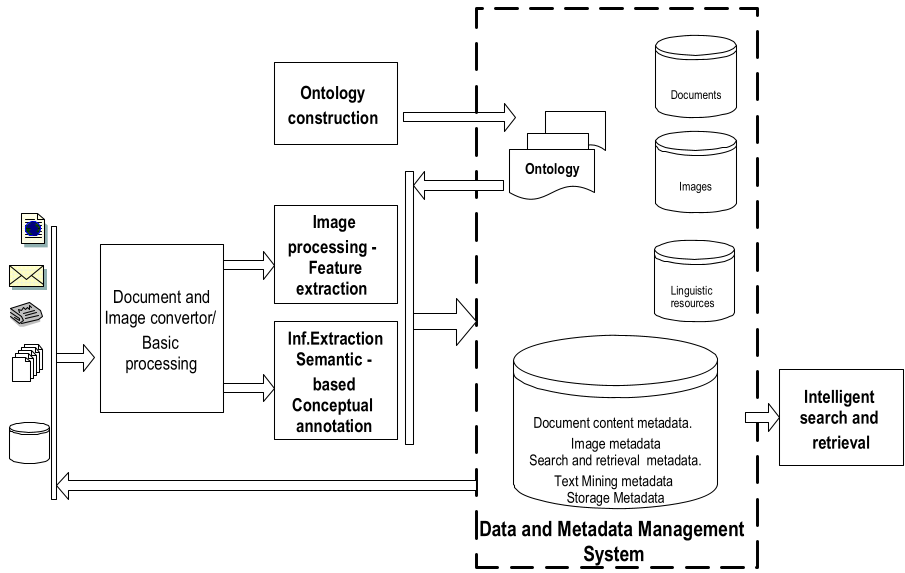
The MetaOn framework is built on four pillars that work in symphony:
1. Ontology-Based Information Extraction (IE)
Incoming documents are converted to XML and annotated. Unlike standard extractors that only look for generic "People" or "Places," MetaOn uses its ontology to identify complex domain-specific relationships. The process is semi-automatic, allowing human experts to validate the semantic links, ensuring high precision.
2. Semantics-Sensitive Image Indexing
For images, the system doesn't just look at global colors. It partitions images into blocks and extracts meta-signatures (statistical moments).
The critical innovation here is the Multi-level Hierarchy (Level-0 to Level-L). Each level corresponds to a different semantic depth defined by the ontology. As an image is processed, it moves up the hierarchy, being classified into increasingly specific semantic categories.
3. Pattern-Base Management System (PBMS)
How do you compare a list of keywords to a vector signature of an image? MetaOn adopts the PANDA framework, which treats both as "patterns." It uses a unified similarity formula:
This allows the system to aggregate structural similarity (the "what") and measure similarity (the "relevance") into a single score.
Experiments & Results: Hellenic History Case Study
The system was tested using the digital archives of the Foundation of the Hellenic World (FHW). The data included 3D monuments, architectural drawings, and GIS maps.
- Unified Querying: Users could formulate queries based on semantic classes (e.g., "Hellenistic Temples") rather than just specific file names.
- Image Refinement: By using the SamMatch measure, the system demonstrated more accurate retrieval of regions of interest compared to standard global histogram matching.
- Linguistic Resilience: The integration of linguistic processing allowed the system to handle the inflectional complexity of Modern Greek, identifying "temple" across various grammatical cases.
Critical Analysis & Conclusion
Takeaway
MetaOn’s true value lies in its Unified Metadata Scheme. By refusing to treat text and images as separate problems, it creates a system where the "concept" of an object (like a Parthenon frieze) acts as the primary key across different media formats.
Limitations
- Expert Dependency: The semi-automatic nature of ontology construction still requires significant input from domain experts, which may limit scalability for domains without dedicated curators.
- Computational Cost: Multi-level image classification and high-dimensional similarity measurements for large-scale databases may require significant GPU optimization not fully detailed in the project overview.
Future Outlook
As we move toward Large Multi-modal Models (LMMs), the principles in MetaOn—specifically the use of structured ontologies to guide feature extraction—remain highly relevant. Integrating these "symbolic" structures with "neural" architectures could lead to even more interpretable and accurate AI search systems.