
MSVL: Rigorous Privacy Policy Verification for the Modern Social Network
A Method Based on MSVL for Verification of the Social Network Privacy Policy
This paper proposes a formal approach for modeling and verifying privacy policies in Social Networking Sites (SNS) using MSVL (Modeling, Simulation and Verification Language). By abstracting core social elements and utilizing Propositional Projection Temporal Logic (PPTL), the authors demonstrate a systematic method to detect privacy loopholes and validate access control rules.
TL;DR
Privacy leaks in social networks often stem from inconsistent policy enforcement. This paper presents a formal verification framework using MSVL (a temporal logic programming language) to model Social Networking Sites (SNS). By defining privacy rules as PPTL (Propositional Projection Temporal Logic) formulas, the authors provide a way to mathematically prove whether a system allows unauthorized data access, backed by a simulation and modeling platform.
Background: The Social Privacy Dilemma
In the era of "Six Degrees of Separation," social platforms like Facebook and Twitter have become ubiquitous. However, privacy remains a fragile construct. The paper identifies three main vulnerabilities:
- User Negligence: Sensitive data leakage during registration.
- Systemic Flaws: Weak access control or unsafe storage.
- Third-party Risks: Malicious code embedded in external applications.
While tools like Poporo and XBook have attempted to address these, the author's argue for a more mathematically rigorous yet executable approach: MSVL.
Methodology: Modeling and Checking with MSVL
The core innovation lies in using Modeling, Simulation and Verification Language (MSVL). Unlike standard programming languages, MSVL is an executable subset of temporal logic. This means the model of the social network is a program that can be formally checked against temporal properties.
1. System Abstraction
To make the complex social graph manageable, the authors simplify the SNS into four core elements:
- User: Personal profiles and friend lists.
- Content: Multimedia objects (text, images, links).
- Friendship: The relationship graph (strong vs. weak relations).
- Operations: Actions like
Upload,Share,View, andRegister.
2. The Verification Pipeline
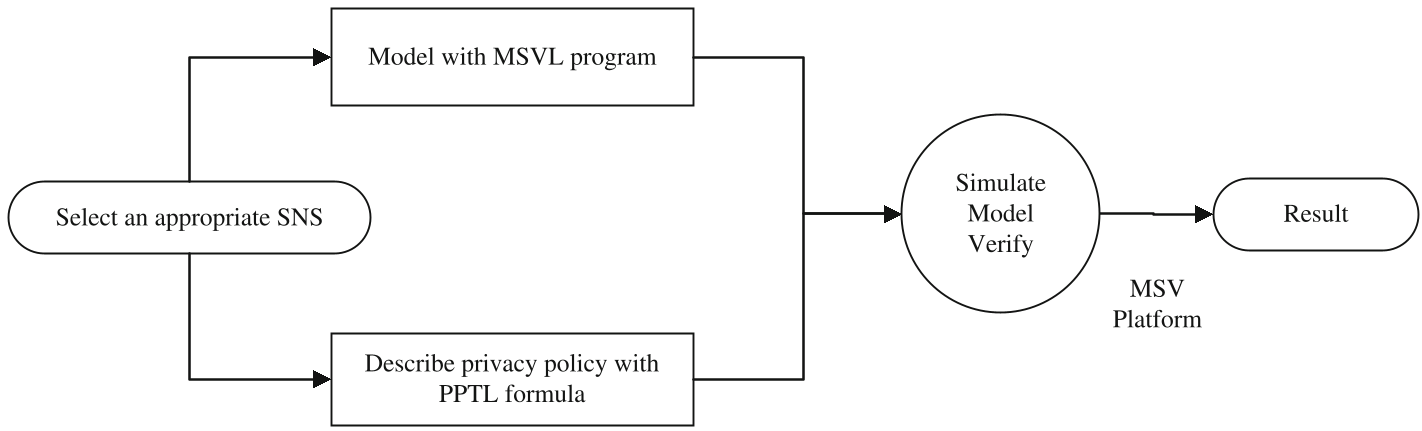
The process follows a strict 4-step workflow:
- Simplification: Abstracting core elements into MSVL
structtypes. - Modeling: Writing the system logic using MSVL functions.
- Policy Specification: Defining privacy "contracts" using PPTL formulas (e.g., ).
- Execution: Running the model in the MSV platform via simulation, modeling, or verification modes.
Application: A "Facebook" Prototype Case Study
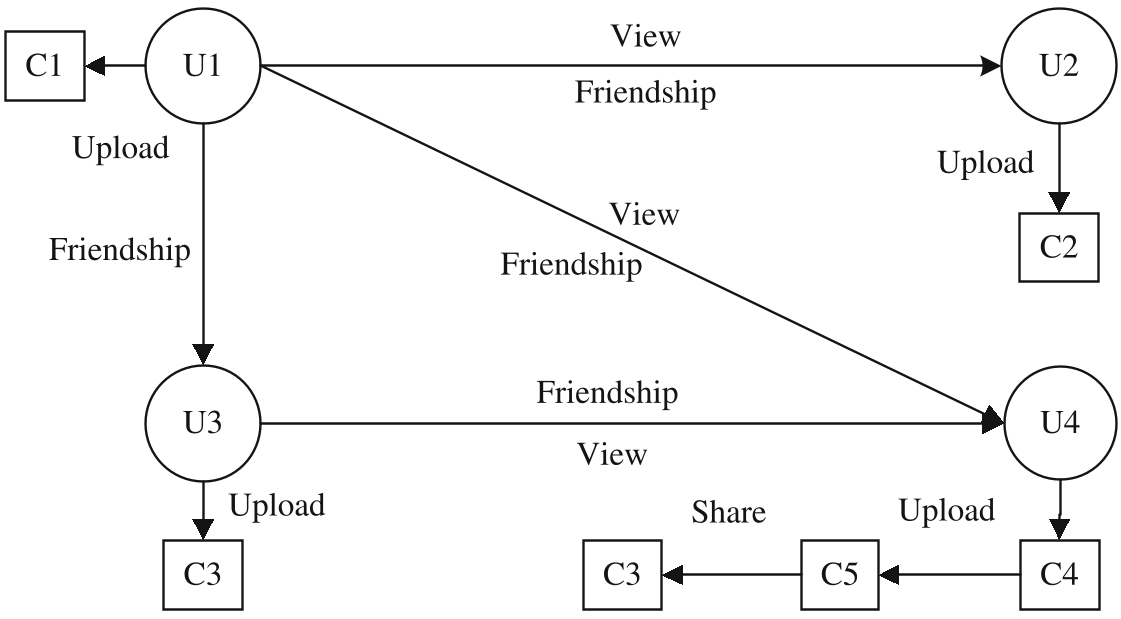
The authors tested their method on a simulated environment consisting of 4 users and 5 content items. The goal was to verify whether the system correctly enforced friendship-based access.
Key Privacy Policies Verified:
- Policy (2): A user can only view content if a friendship exists.
- Policy (3): A user can only share content if they are friends with the owner.
The logic was defined as:
define p: follow_flag = 1 (Friendship)
define q: upload_flag = 1 (Content Existence)
define s: view/share_flag = 1 (Operation Success)
The system verified . If the logic held, the verification returned "Satisfied." If a user without a friendship tried to access data, the platform generated a Normal Form Graph (NFG) as a counter-example to show exactly where the logic failed.
Result Analysis & Insights
The experiments demonstrated that MSVL effectively separates "Simulation" (finding a single path) from "Verification" (checking all possible paths).
- Quantitative Success: The verification platform pinpointed unsuccessful access attempts (e.g., trying to view 's content without a friendship) with formal precision.
- Industry Value: This method allows developers to catch "logical bugs"—errors where the code runs without crashing but violates the intended privacy policy—before the code ever touches real user data.

Conclusion & Future Outlook
The paper concludes that MSVL is a powerful candidate for social network security audits. However, the current model is a simplification. The authors look toward:
- Scaling: Handling the massive data structures of real-world SNS.
- User-defined Policies: Moving beyond "common" policies to allow users to verify their own custom privacy settings.
By converting privacy from a vague "policy document" to a "verifiable mathematical formula," this research paves the way for a more secure and transparent digital social space.