
Bridging the Semantic Gap: Transforming Legal Ontologies into Human-Machine Workflows
A Method for Defining Human-Machine Micro-task Workflows for Gathering Legal Information
This paper introduces a method for defining human-machine micro-task workflows by leveraging domain-specific ontologies. Specifically, it presents the Onto2Flow ontology, which provides a semantic bridge to transform static legal domain knowledge into executable crowdsourcing workflows for information retrieval and conflict resolution.
TL;DR
The paper proposes a novel methodology to turn static domain knowledge (ontologies) into dynamic, executable workflows for crowdsourcing. By utilizing the Onto2Flow framework, the authors demonstrate how complex legal information retrieval can be broken down into micro-tasks that are understandable by both human workers and machine algorithms, ensuring the resulting data is structured and semantically rich.
The Problem: The "Black Box" of Crowdsourcing
Current crowdsourcing platforms like Mechanical Turk are excellent for simple tagging or transcription. However, when tasks become complex—such as legal mediation or conflict resolution—existing solutions like CrowdForge or Jabberwocky face a significant hurdle: the data remains unstructured.
Requesters often receive a pile of natural language responses that machines cannot easily parse. Moreover, there is no formal way to define whether a task should be handled by a human (Person) or an algorithm (Machine). This lack of a shared "language" between human efforts and machine processing creates a bottleneck in scaling collective intelligence.
Methodology: Onto2Flow as the Unified Blueprint
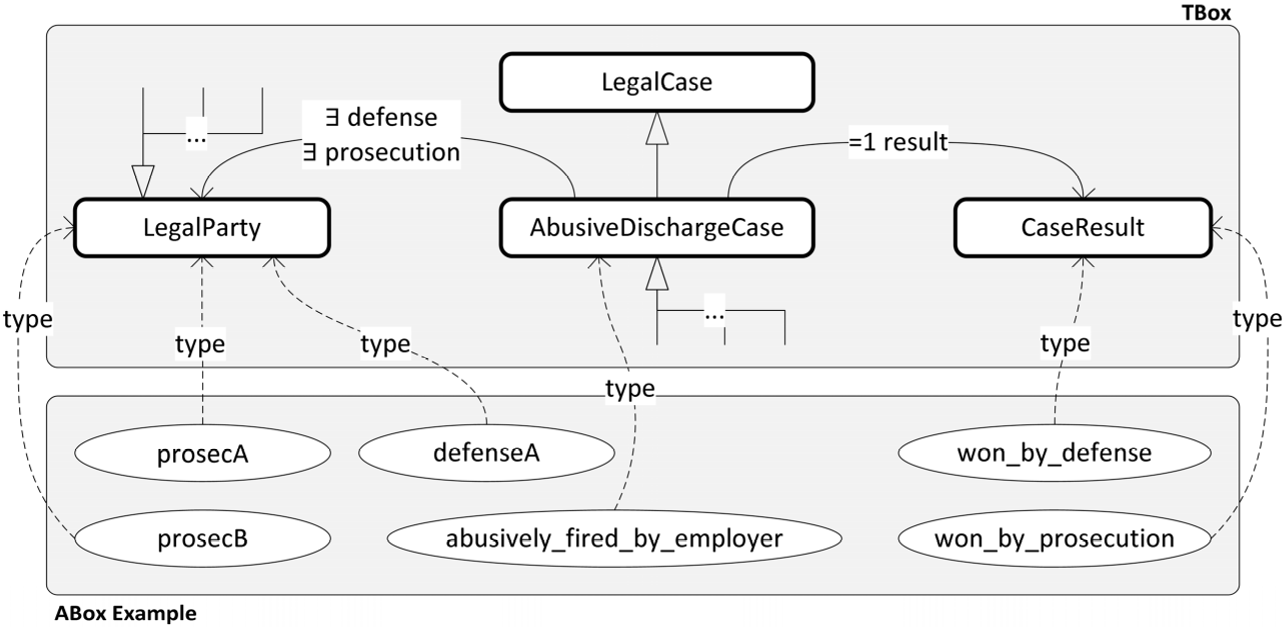
The authors suggest that the solution lies in Description Logics (DL). If we have a domain ontology (a formal map of concepts like "Legal Case," "Plaintiff," or "Evidence"), we can treat every micro-task as a step toward "filling in" that map.
1. The Onto2Flow Ontology
The core of this method is the Onto2Flow ontology. It defines the "Who, What, and How" of a workflow:
- Task Types:
CreateAndFillTask(creating new data),FillTask(adding details to existing data),SelectionTask(choosing between options), andAggregationTask(merging redundant results). - Contextual Constraints: It uses Unit Context Classes (UCC) to give workers the necessary background info and Response Context Classes (RCC) to ensure the output fits the domain rules.
2. Turning Structure into Action
The method follows a simple but powerful logic:
- Input: A portion of the domain ontology (ABox instances).
- Operation: A micro-task defined by TBox axioms.
- Output: New instances or relationships that are automatically compliant with the domain's legal logic.
Experiments: Legal Information Retrieval
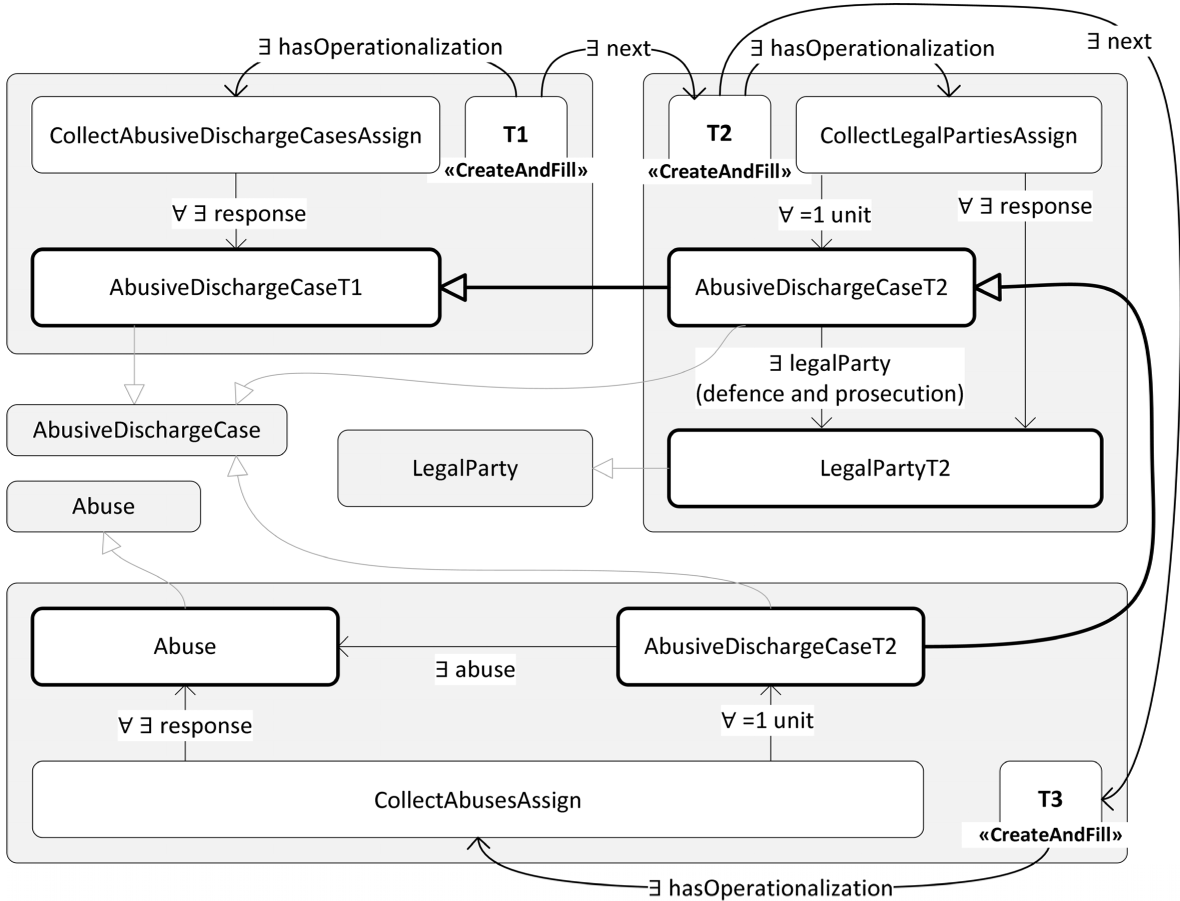
The authors validated this approach within the UMCourt project. In one scenario (Figure 11), a workflow was designed to gather data on "Abusive Discharge" cases.
- Task 1: Crowdsourced workers identify and fill in basic case data.
- Task 2: Workers identify the legal parties involved.
- Task 3: Workers report specific abuses for each case.
Because these tasks are linked via the ontology, the system knows that Task 2 cannot start until Task 1 provides the "Case" instances. This allows for automatic workflow optimization and parallelization.
Critical Insight: Why This Matters
The true value of this work is the explicit definition of Human-Machine Interaction. By using ontologies, a "Machine Worker" (e.g., an NLP script) can participate in the same workflow as a "Person Worker" because they both speak the language of the domain ontology.
Limitations
- Expertise Barrier: Building these ontologies and workflows still requires significant knowledge of Description Logics.
- Manual Setup: The current stage requires manual mapping of domain concepts to Onto2Flow tasks.
Future Outlook
The authors aim to create an assisted construction process that detects patterns in ontologies and suggests workflow structures automatically. In an era where AI (LLMs) is becoming the primary "Machine Worker," this framework provides the exact semantic "guardrails" needed to ensure AI-generated legal data remains accurate, structured, and legally sound.
Takeaway for Researchers
If you are building complex human-in-the-loop systems, don't just pass strings of text. Pass instances of a class. Structuring your task pipeline with an ontology today prepares your data for the automated reasoning of tomorrow.