
Influential Node Extraction in Evolving Social Landscapes: Beyond Static Graphs
A Method for Extracting Influential Nodes while Considering the Development of Social Networks
The paper introduces a novel influential node extraction algorithm designed for dynamic social networks using the Independent Cascade (IC) model combined with a Fitness-based network development model. It extends the classic greedy approach by Kempe et al. to account for temporal changes in nodes and links, achieving more realistic influence estimation in evolving environments.
TL;DR
Most algorithms for finding "influencers" assume the social network is a frozen snapshot. This paper argues that because networks like Twitter or Facebook grow daily, we need a dynamic approach. The author proposes a method that predicts network growth using a Fitness Model while simulating information flow via the Independent Cascade (IC) Model, ensuring that selected nodes remain influential even as the network expands.
Background Positioning
In the hierarchy of Social Network Analysis (SNA), the work by Kempe et al. (2003) is the gold standard for Influence Maximization. However, it is fundamentally restricted to static graphs. This paper acts as a "bridge" work—retaining the proven logic of greedy approximation but shifting the operational environment from static manifolds to dynamic, time-evolving graphs.
The Problem: The "Static Snapshot" Fallacy
In real-world scenarios, a "friend request" or a "new follow" happens every second. Traditional methods calculate influence based on the current state. By the time information actually diffuses, the network structure has changed, potentially rendering the initial "Target Set" suboptimal. The challenge is NP-hard because we are not just optimizing over a fixed set of nodes, but over a moving target.
Methodology: Growth-Aware Diffusion
The author proposes a two-pronged simulation approach:
- Network Evolution (The Fitness Model): New nodes are added, and they form links based on a node's "Fitness" () and its current degree (). This mimics the "rich-get-richer" phenomenon (preferential attachment) seen in real social networks.
- Synchronized Diffusion: Unlike static models where diffusion happens on a fixed graph, here, for every step of information spread, the network is allowed to grow.
The Core Equation
As shown in the paper, the probability of a node receiving a new link is: This ensures that "valuable" nodes (high fitness) and "popular" nodes (high degree) are more likely to grow their influence over time.
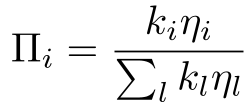 The preferential attachment mechanism used to evolve the network during the simulation.
Experiments & Results
The author compared the proposed method against the standard Kempe method using the Jaccard Similarity Coefficient.
Key Finding: As time () progresses, the similarity between the "Static Top-K" and "Dynamic Top-K" nodes drops significantly. This proves that nodes which look influential now are not necessarily the ones who will command the network in the future.
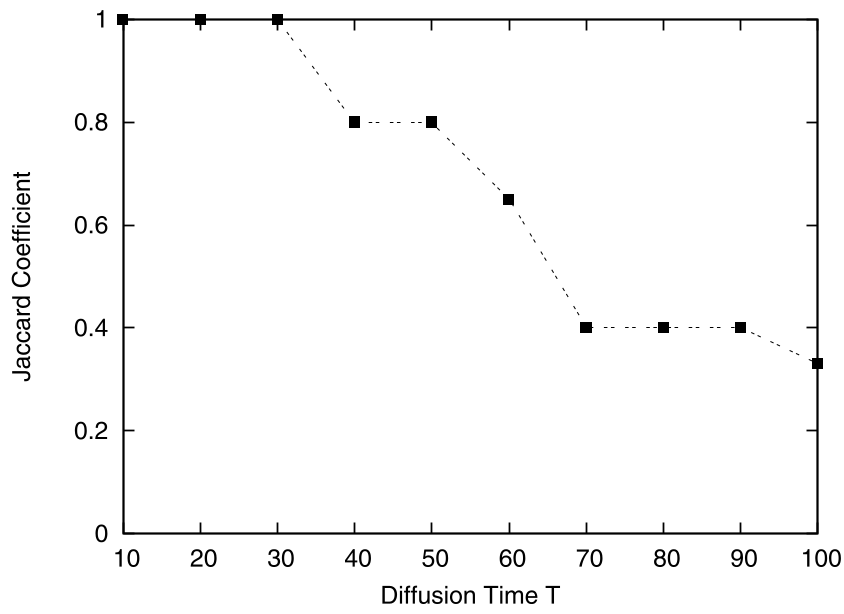 Figure 1: Declining similarity between static and dynamic methods over time.
Critical Insight & Future Outlook
While the method is conceptually sound, it faces a significant bottleneck: Time Complexity. With a complexity of , the algorithm's reliance on 100,000 Monte Carlo simulations per step makes it computationally expensive for massive platforms.
The Takeaway: This paper is a wake-up call for researchers to stop treating social graphs as static entities. The next frontier will likely involve using Graph Neural Networks (GNNs) to learn these evolution patterns, replacing expensive simulations with predictive inference.
Limitations
- Growth Only: The model assumes the network only grows; it does not account for "unfollowing" or account deletions (network degeneracy).
- Scalability: The experiment was conducted on a network of 30 nodes. Real-world applications will require heuristic optimizations or parallel computing.