
Beyond Single Ties: Extracting Groups in Complex Multi-layered Social Networks
A Method for Group Extraction in Complex Social Networks
The paper introduces a novel group extraction method specifically designed for Complex Multi-layered Social Networks (CMSN). It proposes three new metrics—Multi-layered Clustering Coefficient (MCC), and its variations for extended (MCCEN) and reduced (MCCRN) neighborhoods—to identify "strong nodes" as seeds for community discovery across multiple relationship types.
TL;DR
In modern digital ecosystems, "friendship" isn't a single line; it's a bundle of interactions across emails, photo shares, and tag collaborations. This paper proposes a new methodology to extract social groups from Complex Multi-layered Social Networks (CMSN). By introducing three specialized clustering coefficients (MCC, MCCEN, MCCRN), the authors provide a framework to identify "strong nodes" and expand them into meaningful communities that span multiple types of relationships.
Background: The Limits of Flat Networks
Most classic community detection algorithms (like Girvan-Newman or Modularity Optimization) treat social networks as "flat" graphs. However, real-world interactions are hierarchical and multi-faceted. If you only look at Facebook friendships but ignore LinkedIn professional ties or WhatsApp groups, you are seeing a distorted slice of reality.
The authors argue that the "cohesion" of a group in a multi-layered environment cannot be calculated by simple averaging. We need to understand how much a user's social circles overlap or diverge across different interaction layers.
Methodology: The "Strong Node" Expansion
The core of the paper lies in the definition of three types of Multi-layered Clustering Coefficients:
- MCC (Multi-layered Clustering Coefficient): The arithmetic mean of local clustering coefficients across all layers.
- MCCEN (Extended Neighbourhood): Measures clustering within the union of all neighbors across all layers. It answers: "How interconnected is my entire social reach?"
- MCCRN (Reduced Neighbourhood): Measures clustering within the intersection of neighbors (only those who appear in every single layer). It answers: "How dense is my hardcore inner circle?"
The Algorithm Workflow
The group extraction follows a seed-and-expand logic:
- Seed Selection: Identify "Strong Nodes" that exceed thresholds for all three MCC metrics.
- Iterative Expansion: Starting from a strong node, add its Extended Neighbourhood (EN) to a group. Then, recursively check its neighbors; if they are also "reasonably strong" (based on secondary thresholds ), add their neighborhoods too.
- Outlier Handling: Nodes that fail to be swept into any neighborhood expansion are relegated to an outlier group.
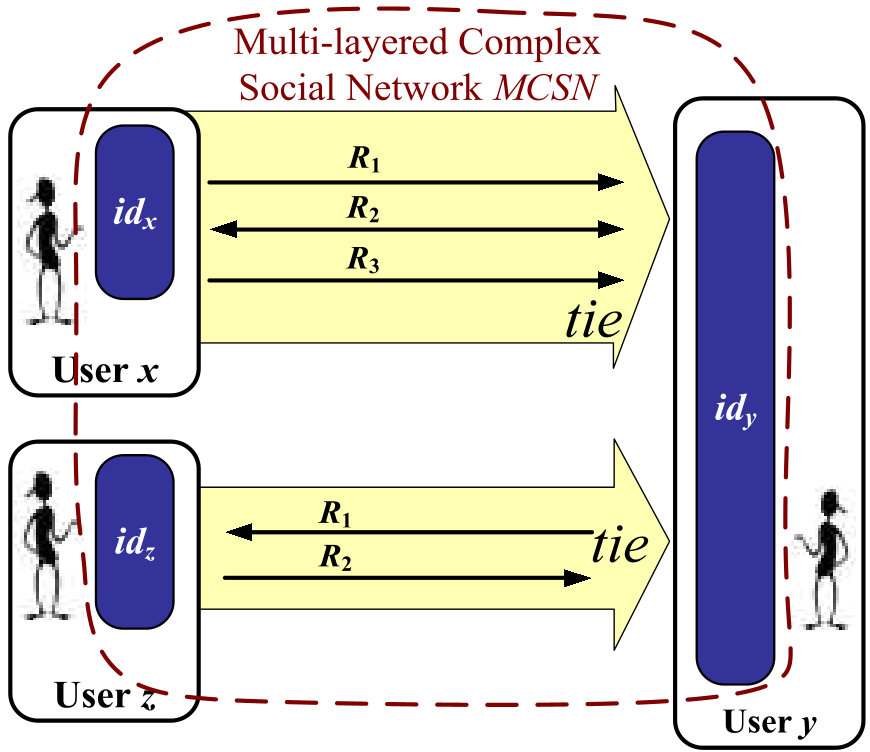 Figure 1: Conceptual structure of a CMSN where different interaction types form distinct layers.
Experiments and Insights
The authors tested their method on a Flickr dataset with 1,000 users and 11 layers (ranging from "photo favorites" to "contact lists").
Key Numerical Findings:
- MCCEN (Extended) vs. MCCRN (Reduced): The MCCEN reached an average of 0.61, while MCCRN was 0 for almost all users.
- Physical Interpretation: This is a profound insight. A zero MCCRN means users almost never interact with the exact same set of people across all channels. Your "tagging" buddies are different from your "photo-favoriting" buddies.
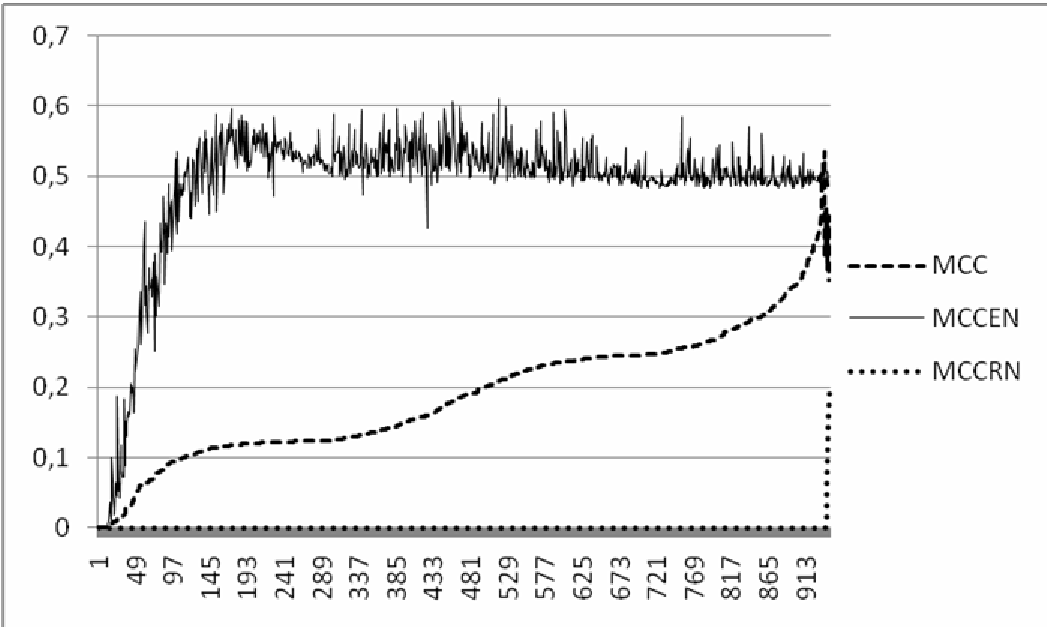 Figure 2: Distribution of MCC metrics across the test population, highlighting the scarcity of high MCCRN values.
Critical Analysis & Conclusion
Takeaway
The paper successfully moves the needle from "flat" analysis to "volumetric" analysis of social structures. The distinction between Extended and Reduced neighborhoods is a vital contribution to Social Network Analysis (SNA), providing a mathematical way to differentiate between "broad" socialites and "focused" niche collaborators.
Limitations
- Threshold Sensitivity: The algorithm relies on six different thresholds ( and their counterparts). The paper does not provide a robust framework for automatically tuning these, which could lead to vastly different results depending on the dataset.
- Computational Complexity: As the number of layers () increases, calculating the intersection (MCCRN) and union (MCCEN) for every node becomes significantly more expensive than standard clustering.
Future Outlook
This work lays the groundwork for Multi-dimensional Recommender Systems. By knowing which layer a group is most "sustainable" in, platforms can tailor notifications and content delivery to the specific type of relationship (e.g., professional vs. casual) that binds a community together.