
RapidMiner: Bridging the Gap Between Raw Social Data and Sentiment Intelligence
The Method of Analysis of Data from Social Networks Using Rapidminer
The paper presents a methodology for sentiment analysis within the Russian-speaking social media environment using the RapidMiner platform. By integrating specialized extensions like Text Mining and Aylien, the authors developed a categorisation workflow to classify tweets into positive, negative, and neutral sentiments.
Executive Summary
TL;DR: This paper outlines a practical methodology for analyzing the emotional tone of social media streams using the RapidMiner ecosystem. By shifting from traditional parametric statistics to a graphical, operator-based Data Mining approach, the authors successfully classified 10,000 tweets with high efficiency, specifically targeting the Russian-speaking digital landscape.
Background Positioning: This work serves as a practical implementation guide (Case Study) in the field of Natural Language Processing (NLP) and Text Mining, demonstrating how integrated software suites can simplify the "unstructured-to-structured" data pipeline.
Problem & Motivation
The explosion of user-generated content has created a "knowledge bottleneck." While we have the storage capacity for massive amounts of data, the ability to discern the tonality (emotional assessment) remains difficult.
The authors argue that traditional statistical methods require "pre-established patterns." In contrast, modern Data Mining is necessary to uncover the hidden nuances of human sentiment. The primary goal here is to provide a reproducible workflow that can distinguish between a reported fact and the public's attitude towards that fact.
Methodology: The Operator-Chain Core
The authors propose a modular workflow designed within RapidMiner, avoiding the "rough work" of manual programming through a chain of functional operators.
1. Integration Extensions
To handle the complexities of web data, four critical modules were utilized:
- Text Processing: For tokenization and filtering.
- Web Mining: To access RSS feeds and live social services.
- WordNet: To leverage semantic relationships (synonyms/hypernyms).
- Aylien API: The primary brain for sentiment extraction.
2. The Twitter-to-Insight Pipeline
The architecture follows a linear graph:
Search Twitter → Connection Authorization (OAuth) → Sentiment Analysis → Excel Export.
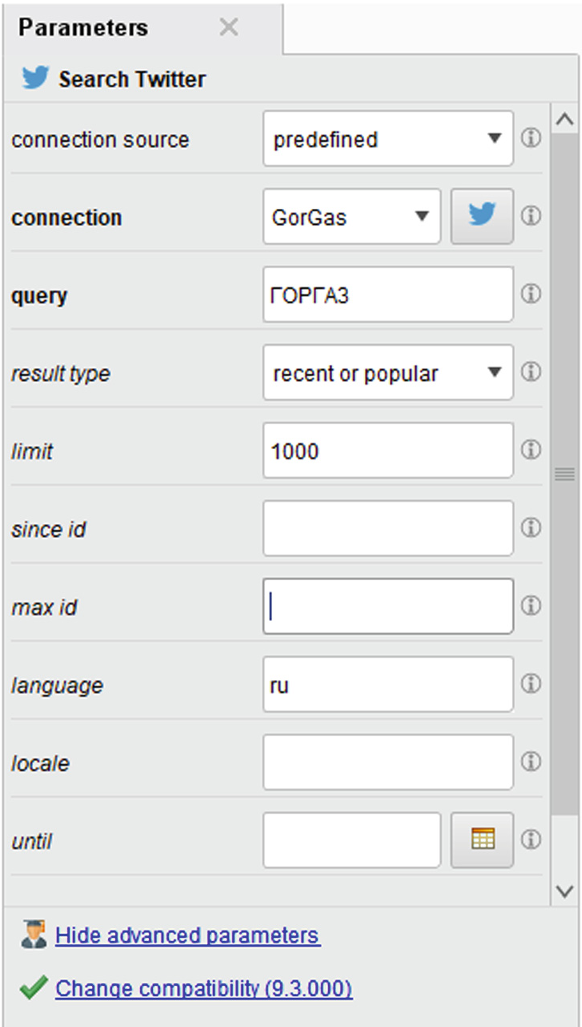 Figure 1: The configuration of the 'Search Twitter' operator used to pull live data streams.
Experiments & Results
The researchers conducted their experiment on a sample of 10,000 tweets within the Russian-language segment. By utilizing the AnalyzeSentiment tool, each tweet was evaluated for Polarity (Positive, Negative, Neutral) and Subjectivity (Objective vs. Subjective).
Key Quantitative Findings:
- Neutral: 50.8% (Majority of the discourse was informative or non-polarized).
- Negative: 36.8%.
- Positive: 12.4%.
The output was structured into a comprehensive data table, allowing for longitudinal tracking of user moods relative to specific timestamps and hashtags.
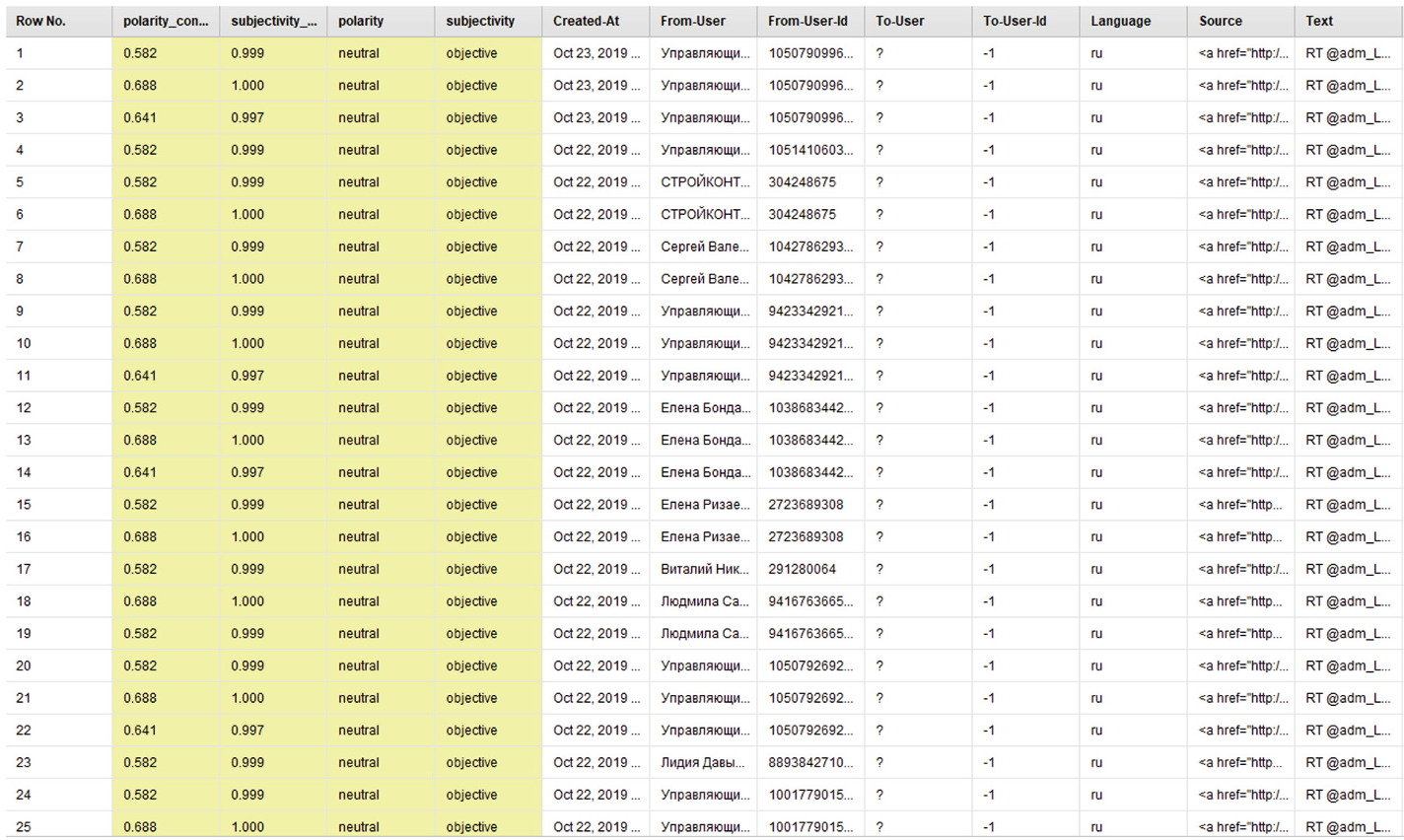 Figure 2: Sample output data showing Polarity and Subjectivity scores for harvested tweets.
Critical Analysis & Conclusion
Takeaway
The study demonstrates that RapidMiner is an exceptionally potent tool for academic and monitoring purposes. Its ability to shield the researcher from "low-level coding" while providing access to professional-grade NLP via the Aylien API makes it ideal for rapid sentiment assessment.
Limitations
A significant limitation of this study is its reliance on third-party APIs (Aylien) without a deep dive into the linguistic nuances of the Russian language, such as sarcasm or complex morphological structures, which often cause "Neutral" misclassifications.
Future Work
The authors intend to expand the dataset size and compare the RapidMiner approach against other frameworks (like GATE or Orange) to establish a universal benchmark for multi-language sentiment analysis.