
Beyond Performance: Eliciting Affective Support in Educational Recommender Systems
A Methodological Approach to Eliciting Affective Educational Recommendations
This paper presents a methodological approach using the TORMES framework to elicit affective educational recommendations by integrating User-Centered Design (UCD) and Data Mining. The study involves 18 educators and 77 learners to design a recommender system that adapts to emotional states like boredom, frustration, and confusion through multimodal sensor data and expert feedback.
Executive Summary
TL;DR: This research addresses the "emotional blind spot" in educational technology. By combining deep data mining of student behavior (keyboard, mouse, and sensors) with expert pedagogical intuition, the authors developed a framework for a recommender system that doesn't just know what you got wrong, but how you feel about it.
Contextual Positioning: This work represents a significant shift from purely cognitive adaptive learning toward Affective Artificial Intelligence in Education (AAIED). It serves as a methodological bridge, moving from theoretical emotional modeling to practical, expert-validated recommendation rules.
The Motivation: Why Cognitive Data Isn't Enough
Current educational recommenders are often "emotionally illiterate." They see a wrong answer and suggest a remedial task. However, if a student is frustrated or has low self-efficacy, a remedial task might actually decrease motivation.
The authors argue that we need to capture the Tacit Experience of educators—the way a human teacher notices a student's nervous smile or frantic mouse movements—and translate that into system logic. The challenge is twofold: accurately detecting these fleeting emotional states and determining the exact "instructional move" that helps a specific type of learner.
Methodology: The TORMES Framework
The researchers employed the TORMES methodology, a specialized version of User-Centered Design (UCD) for educational recommendations. The core innovation lies in their multimodal data mining approach.
1. Data-Driven Elicitation (Multimodal Fusion)
To understand the "Context of Use," the team gathered data from 77 participants using:
- Behavioral Indicators: 42 keyboard and 96 mouse interaction metrics (e.g., time between keystrokes, click duration).
- Physiological Sensors: Heart rate, skin temperature, and Galvanic Skin Response (GSR).
- Computer Vision: Facial expressions and body movements mapped via the CANDIDE-3 model.
2. Expert Validation
They didn't just let the algorithms decide. 18 education experts were involved in a four-stage process to ensure the recommendations (R1 to R10) were pedagogically sound and delivered at the right moment.
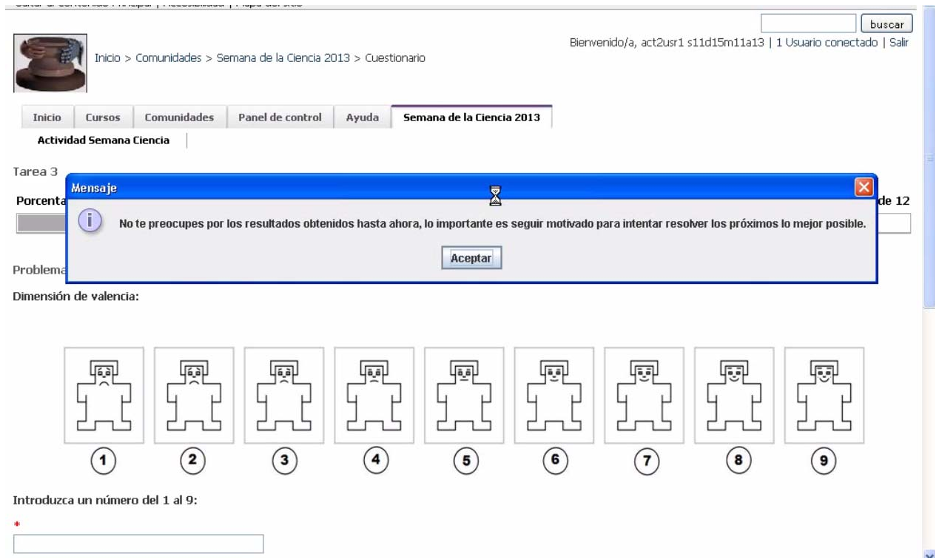 Figure 1: An example of a "Text-D" recommendation delivered to a learner when the system detects high anxiety or low self-esteem.
The "Wizard of Oz" Experiment and Results
In a fascinating turn, the authors used a Wizard of Oz setup—where a human simulates the AI's logic—to test 10 emotion-aware rules.
Key Findings:
- High Predictive Accuracy: By combining sentiment analysis from self-reports with keyboard/sensor data, the system reached an 80% success rate in predicting "Valence" (whether the user feels positive or negative).
- The Personality Barrier: The experiment revealed two distinct user types. "User 2" (high conscientiousness/openness) found the affective recommendations helpful for staying relaxed. "User 1" (low motivation/low self-efficacy) ignored or disliked the system's attempts to help.
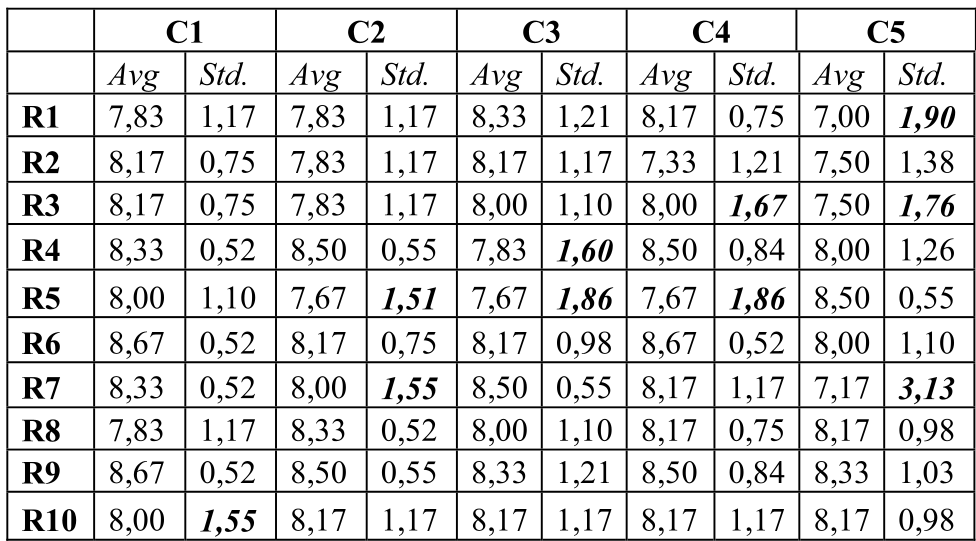 Table 1: Expert evaluation scores (C1-C5) for the 10 proposed recommendations, showing high overall suitability but significant variance in delivery timing (C3).
Critical Analysis & Future Outlook
Deep Insights
The most profound takeaway is that Affective Support is Subjective. The same recommendation ("Don't worry about the results, stay motivated") can be seen as "encouraging" by one student and "interfering" by another. This suggests that future recommenders must include a Personality Profile (BFI) as a primary filter for their recommendation logic.
Limitations
- Small Pilot Size: While the initial data collection was large (77 learners), the Wizard of Oz validation was limited to two extreme personality types.
- System Intrusiveness: Users reported that pop-up recommendations could be distracting, suggesting a need for more subtle, integrated UI/UX for affective feedback.
The Bottom Line
This paper proves that while we can detect emotions with 80% accuracy using multimodal sensors, the real challenge is the Inductive Bias of the recommendation engine. The next frontier is not just "Affective Detection," but "Personality-Aware Adaptation."