
Bridging Ontology and Data Mining: A New Frontier for Product Family Design
A methodology for knowledge discovery to support product family design
The paper presents a novel methodology for product family design that integrates the Techspecs Concept Ontology (TCO) with data mining techniques like Fuzzy C-Means (FCM) clustering and association rule mining. It successfully identified a more efficient shared platform for a power tool family, increasing commonality by 23%.
TL;DR
In the era of mass customization, companies struggle to balance product variety with cost efficiency. This paper introduces a robust methodology that combines Techspecs Concept Ontology (TCO) with Fuzzy C-Means clustering and Association Rule Mining. By moving beyond manual heuristics, the authors demonstrate how to scientifically identify "hidden" commonalities in a power tool family, boosting module sharing by 23%.
Problem & Motivation: The "Fuzzy" Boundary of Design
Product family planning is the art of developing a set of differentiated products from a shared platform. However, traditional design approaches face two major hurdles:
- Semantic Gap: How do we represent a "drill" and a "saw" in a way a computer can compare?
- Overlapping Boundaries: Functional modules aren't always "black and white." A motor might be "mostly" common but requires slight redesigns for different tools.
Existing methods often use "crisp" clustering, which forces components into silos. The authors argue that Fuzzy Membership is essential to capture the nuance of design similarity, allowing a component to belong to multiple potential modules with varying degrees of "fit."
Methodology: The Three Pillars
The methodology is structured into a rigorous three-phase pipeline:
1. Semantic Product Representation
Using the Techspecs Concept Ontology (TCO), the authors decompose products into functional hierarchies (e.g., Description, Input Energy, Output Energy, Operand, Medium). These are then converted into numerical codes, turning abstract engineering concepts into a dataset ready for mining.
2. Module Identification via Fuzzy Clustering
Instead of simple grouping, the team employs Fuzzy C-Means (FCM). This allows them to calculate a "Module Value" and a "Ratio" to categorize components into four quadrants:
- Common: Shared across the platform.
- Unique: Product-specific.
- Redesignable: High potential for commonality if slightly modified.
- Sub-common: Context-dependent sharing.
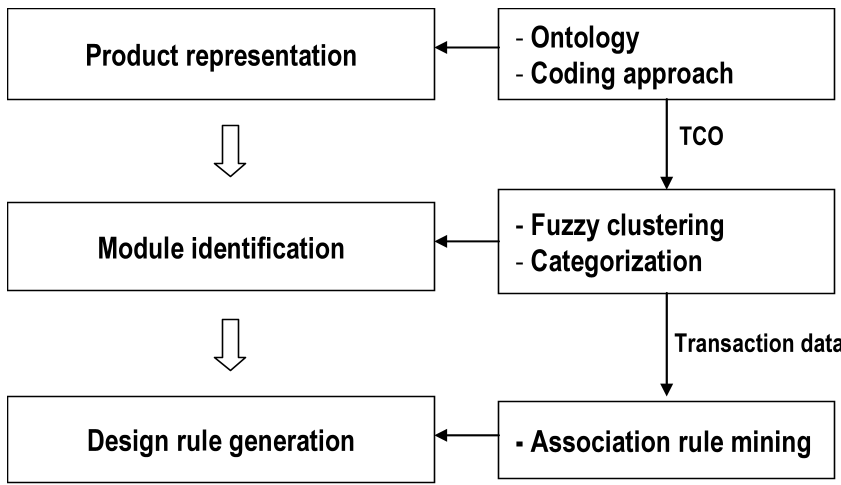
3. Design Rule Generation
By applying the A priori algorithm, the system discovers rules like:
Rule 1: If Energy is Electronic and Module is Battery => Module Category is Common.
These rules provide designers with actionable insights to standardize parts across different products.
Experiments: Validating with Power Tools
The case study involved five distinct tools: a jig saw, circular saw, sander, drill, and brad nailer.
SOTA Comparison: The Power of 13
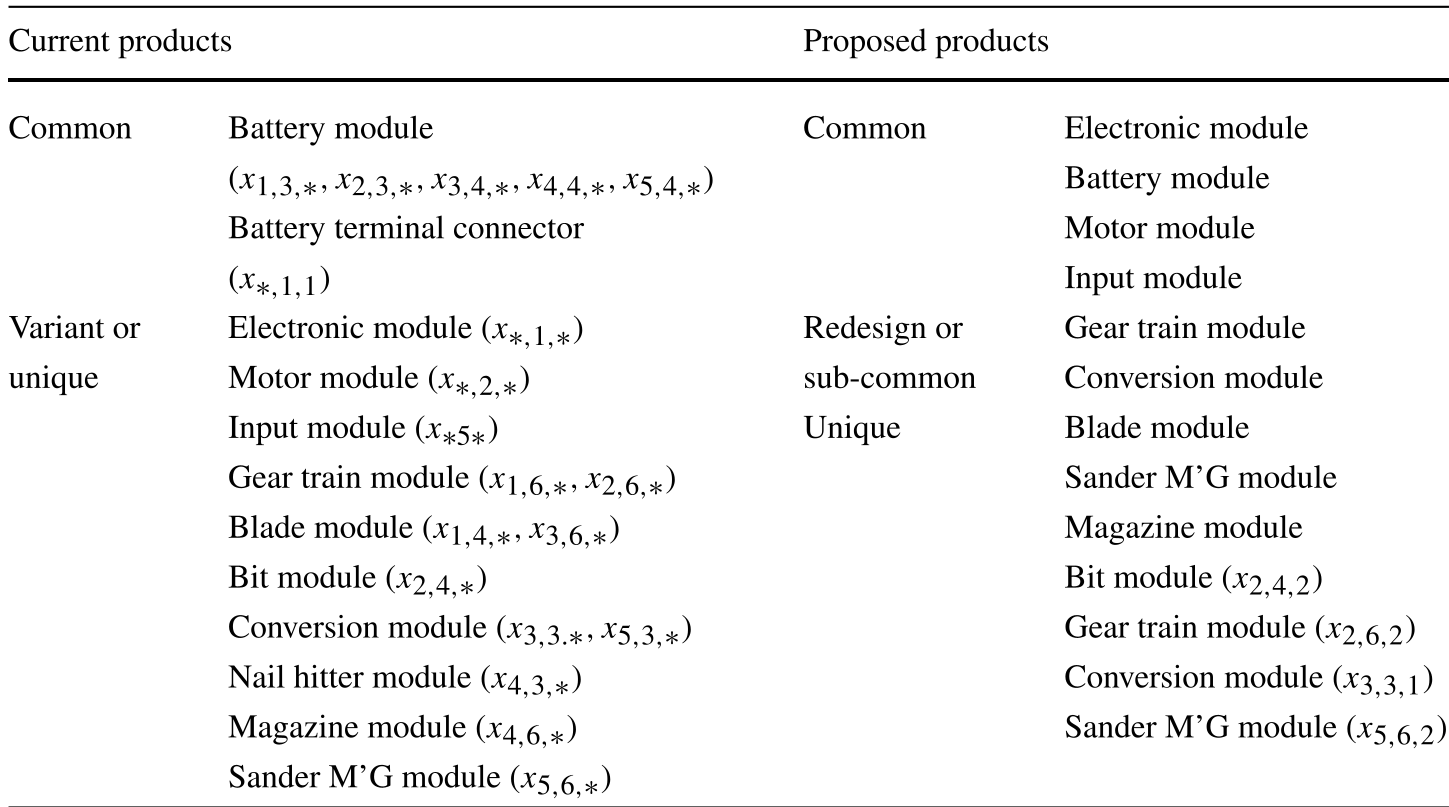
By utilizing the Partition Coefficient (PC) to find the optimal number of clusters (c=13), the researchers identified that the motor and input modules—previously treated as product-specific—could actually be unified into the shared platform.
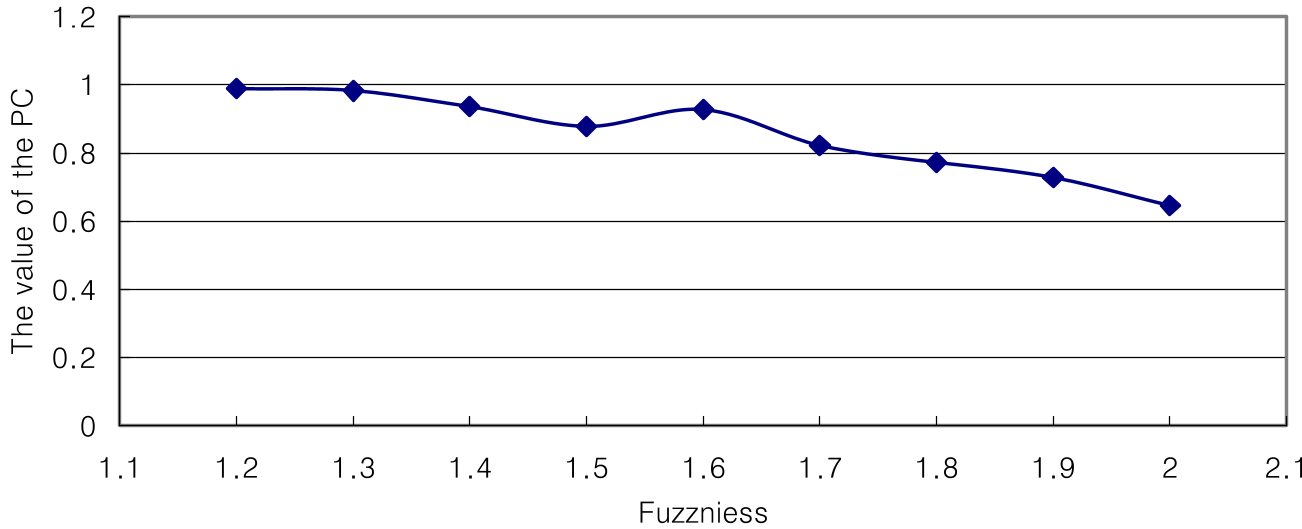 The scatter plot above visualizes how modules are mapped into the four categories (Common, Redesignable, etc.) based on their similarity scores.
Key Results:
- Commonality Increase: The proposed platform increased the count of common modules by 23%.
- Actionable Redesign: Identified that "Mechanical Energy Transfer" components were prime candidates for redesign to become part of the platform.
Critical Insight & Conclusion
The real value of this work lies in its Inductive Bias. By assuming that design is inherently "fuzzy," it provides a mathematical pathway to "Redesignable" modules—a category often ignored by rigid clustering algorithms.
Takeaway: For R&D leaders, this means moving from "intuition-based" platforms to "data-driven" modules. The methodology not only identifies what is shared but highlights what should be shared through targeted redesign.
Future Outlook: The next step is integrating linguistic design data (Natural Language Processing) directly into the ontology, allowing the system to "read" engineering manuals and automatically suggest platform optimizations.