
Metric Convergence: Why Your Social Network Sample is Likely Lying to You
Metric convergence in social network sampling
This paper investigates the representativeness of partial social network crawls by analyzing the convergence of six topological metrics using Breadth-First-Search (BFS), Depth-First-Search (DFS), and Random-First-Search (RFS) on a complete dataset of Digg.com. The study demonstrates that common crawling methods lead to significant over- or underestimation of network properties, requiring substantial sample sizes for metric stability.
TL;DR
In the world of Social Network Analysis (SNA), we often assume that a large enough sample acts as a faithful mirror of the whole. This paper rigorously debunked that myth. By crawling a complete snapshot of Digg.com, the authors show that standard algorithms like BFS and DFS systematically distort network metrics. To get a reliable estimate, you often need to crawl upwards of 30% of the entire network—a feat impossible for platforms like Facebook or X.
The "Boon and Bane" of Big Data
Social media platforms offer a population-scale laboratory for human behavior. However, their sheer size (billions of nodes) and defensive rate-limiting mean researchers almost always work with "partial crawls." The critical question is: When does a sample stop being a collection of biased nodes and start representing the system's true topology?
The Mechanics of Bias: BFS vs. DFS
The authors categorize the bias based on the "search trajectory" of common algorithms:
- BFS (Breadth-First-Search): Operates like a circular wave. It typically hits the high-degree "core" of a network early and gets stuck there, processing the dense cluster of neighbors. This leads to a massive overestimation of graph density and average degree.
- DFS (Depth-First-Search): Operates like a probe. It pushes quickly through the core into the long chains of the periphery (leaf nodes). Consequently, DFS underestimates density and provides a skewed view of the network's extremities.
- RFS (Random-First-Search): By picking the next node randomly from the discovered set, it manages to balance between the core and periphery more effectively than the standard deterministic traversals.
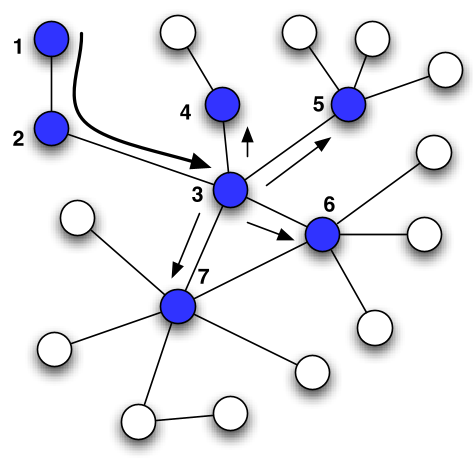 Figure 1: Conceptual difference in how BFS and DFS explore the network space, highlighting the core-periphery bias.
Methodology: The Digg.com Ground Truth
The researchers used a complete trace of Digg.com (circa 2009) with 950,000 users. Because they had the entire graph, they could simulate crawls and compare the "estimated" metrics against the "true" values. They tracked six key metrics, including Assortativity (do similar degree nodes hang out together?) and the Power-law Exponent.
Crucial Findings: The Long Road to Convergence
The most striking result is how slowly metrics converge. Even at a 10% sample size—which is considered "large" in many peer-reviewed studies—the error rate remains staggering.
- The 20% Hurdle: For most combinations of metrics and algorithms, the results stayed outside a ±20% error margin until at least 20-30% of the graph was known.
- Average Degree Distortion: BFS estimates for average node degree started an order of magnitude too high and only asymptotically approached reality after 40% of the graph was sampled.
- The RFS Advantage: RFS proved to be the "hidden gem." It approached the true power-law exponent and average degree much faster than BFS or DFS (see Figure below).
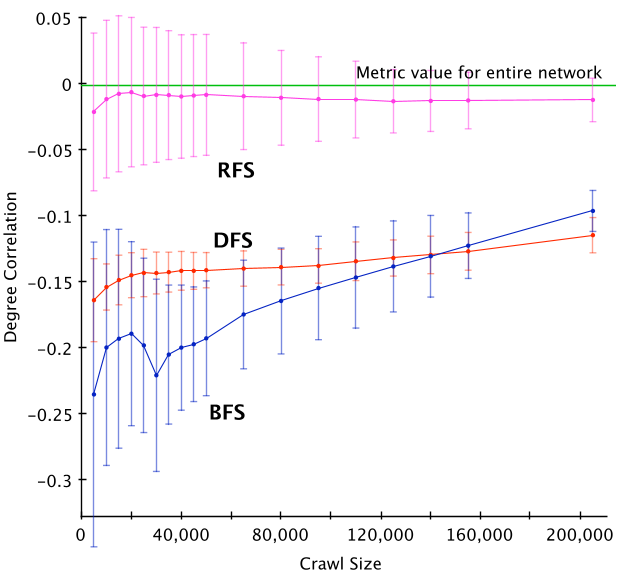 Figure 2: Convergence of (a) Assortativity and (b) Average Degree. Note how RFS (purple) typically stabilizes closer to the green "true value" line faster than BFS (blue).
Deep Insight: Choosing the Right Tool for the Metric
The paper concludes that there is no "one-size-fits-all" crawler. Instead, the strategy must be "metric-aware":
- For User Attribution/Privacy Studies: BFS is better because it gathers "coherent" community clusters.
- For Global Topology (Degree, Density): RFS is superior as it mitigates the gravitational pull of high-degree hubs.
- The Reality Check: If you only have a 1% sample of a network, your topological metrics are likely artifacts of your crawling algorithm, not the social system itself.
Critical Analysis & Conclusion
This work serves as a sobering warning to the SNA community. The "representativeness" of a crawl isn't just about size; it's about the interaction between the algorithm's inductive bias and the network's scale-free nature.
Limitations: The study is based on Digg.com, a media aggregator. While it shares scale-free properties with Facebook or Twitter, the "social" nature (friendship vs. content-interest) might influence lead-links differently. Future work should investigate if these convergence constants hold across different types of social graphs (e.g., professional networks vs. dating apps).
Future Outlook: As platforms become even more restrictive with APIs, the industry must move toward "Bias-Correction" models—mathematical frameworks that can reverse-engineer the true metric from a demonstrably biased BFS crawl.