
Metric Embedding, Hyperbolic Space, and Social Networks: Why Geometry Matters
Metric embedding, hyperbolic space, and social networks
This paper explores the theoretical foundations of embedding undirected graphs into k-dimensional Hyperbolic space. It introduces the concept of "Quasi-cyclicity" to establish lower and upper distortion bounds, ultimately proving that graphs with small quasi-cyclicity (such as social networks) can be embedded with only constant additive distortion.
TL;DR
Why do social networks and the Internet seem to "fit" so naturally into hyperbolic space but struggle in Euclidean space? This paper provides the mathematical answer through Quasi-cyclicity. It proves that while rigid structures like grids and cycles are hyperbolic-allergic (suffering distortion), graphs with low quasi-cyclicity—like most real-world social networks—can be embedded with near-perfect accuracy using a new linear-time randomized algorithm.
The Motivation: Moving Beyond Euclidean Comfort
For decades, the Johnson-Lindenstrauss Lemma gave us comfort: we could squash high-dimensional Euclidean data into low-dimensional spaces with minimal loss. However, the Internet and social networks are not Euclidean. They are "negatively curved."
Empirical researchers noticed that hyperbolic embeddings (like the Poincaré disc) were far more accurate for network routing and distance estimation. Yet, we lacked a worst-case theoretical bound. This paper bridges the gap: When does a graph fail to embed in , and why do social networks succeed?
The Core Concept: Quasi-Cyclicity
The authors define Quasiness as the structural property that prevents a good hyperbolic fit.
- The Cycle Problem: An -node cycle is easy to embed in a circle (Euclidean), but in hyperbolic space, distances between "opposite" points on the cycle grow much faster than the paths through the "middle" of the hyperbolic space.
- Quasi-cycles: These are cycles that might have shortcuts, but the shortcuts don't reduce the distance by more than a constant factor .
The Discovery
The paper proves a striking lower bound: any graph with high quasi-cyclicity (like a simple lattice) requires a multiplicative distortion of: This explains why "man-made" grids (Euclidean) are fundamentally different from "organic" social networks (Hyperbolic).
Methodology: The Path to -Hyperbolicity
The technical heavy lifting of the paper relates quasi-cyclicity to -hyperbolicity. A space is -hyperbolic if all geodesic triangles are "thin"—meaning any point on one side of a triangle is close to the other two sides.
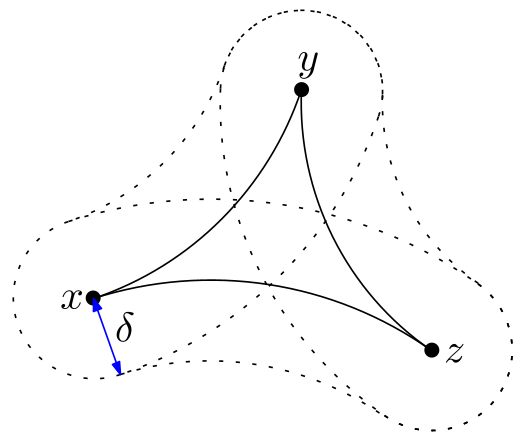
The authors prove that if a graph is strictly -hyperbolic, it must contain a large quasi-cycle. This allows them to use the machinery of Gromov boundaries to build an embedding strategy.
The Linear-Time Algorithm
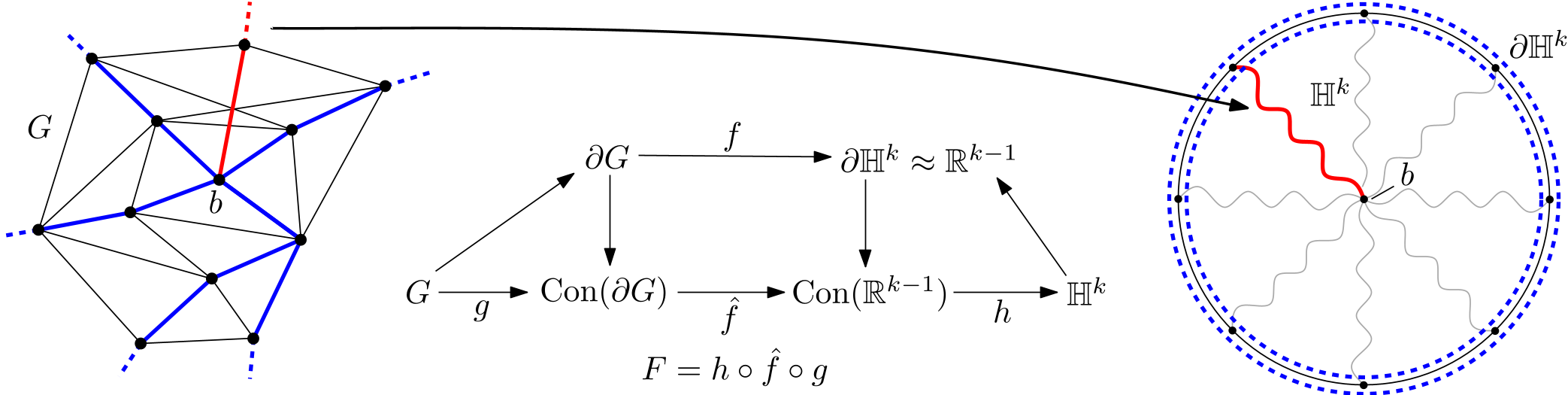
To make this practical for massive social graphs, the authors propose a Beacon-based approach:
- Gromov Boundary: Treat the "leaves" of the graph's shortest-path tree as the boundary.
- Beacons: Randomly select a constant number of nodes (beacons).
- Coordinate Mapping: Use the distances to these beacons to project the boundary into and then extend it back into the manifold.
Empirical Insight & Results
The breakthrough here is the Additive Distortion guarantee. While multiplicative distortion is hard to squash, the authors show that for most node pairs , the error is just a constant :
This "good enough for most" approach is what makes hyperbolic geometry viable for real-world friend recommendations and influence measurements in networks with millions of nodes.
| Graph Type | Euclidean Distortion | Hyperbolic Distortion |
|---|---|---|
| Grid / Lattice | Constant | |
| Cycle () | Constant | |
| Social Networks | High | Constant (Additive) |
Critical Analysis & Conclusion
Takeaway: Social networks embed well not just because they are "sparse," but because they lack the large-scale grid-like structures (quasi-cycles) that define Euclidean geometry.
Limitations: The algorithm's performance is tied to the degree of the nodes. If a graph has an unbounded degree (a massive "star" hub), the scaling factor λ must increase logarithmically with , which could degrade accuracy in very dense clusters.
Future Outlook: Using quasi-cyclicity as a "diagnostic" tool for datasets could tell engineers before they start training whether a hyperbolic or Euclidean neural network is the right choice for their graph embeddings.