
The Geometry of Social Limits: Why Hyperbolic Space Fits Networks Best
Metric embedding, hyperbolic space, and social networks
This paper introduces a theoretical framework for embedding undirected graphs into hyperbolic space with minimum distortion, proposing the concept of Quasi-cyclicity. It establishes rigorous lower and upper bounds for distortion and provides a linear-time randomized algorithm suitable for large-scale social networks.
TL;DR
Why do social networks and the Internet "fit" so naturally into the curved geometry of hyperbolic space, while rigid grids like city maps (lattices) struggle? This paper by Verbeek and Suri identifies Quasi-cyclicity as the key. It proves that while cycles and lattices are distorted heavily in hyperbolic space, social networks—which avoid large cycles—can be embedded with near-perfect accuracy in linear time.
Background: Beyond the Euclidean Flatland
For decades, researchers used Euclidean space to map data. However, the Internet and social networks are hierarchical; they grow exponentially, much like the branches of a tree. In a flat Euclidean plane, there isn't enough "room" to fit this growth without pushing points too far apart (high distortion). Hyperbolic space, with its negative curvature, offers the volume needed.
But there was a missing piece: What exactly makes a graph "unfold" well in a curved space?
The Core Insight: Quasi-Cyclicity
The authors introduce a metric called Quasi-cyclicity.
- The Problem: A standard -node cycle () is the enemy of hyperbolic embedding. In a cycle, you have to loop back to the start. In hyperbolic space, the "shorter" paths through the interior of the space are so much shorter (exponentially) than the path along the circumference that the original cycle distances are crushed.
- The Lower Bound: The authors prove that an -node cycle or a square lattice incurs a multiplicative distortion of at least in .
- The Social Network Connection: Real-world social networks tend to be "tree-like" at scale. They have low quasi-cyclicity, meaning they don't rely on massive, rigid cycles.
Methodology: From Boundaries to Embeddings
The paper bridges the gap between abstract topology and practical algorithms using the Gromov Boundary.
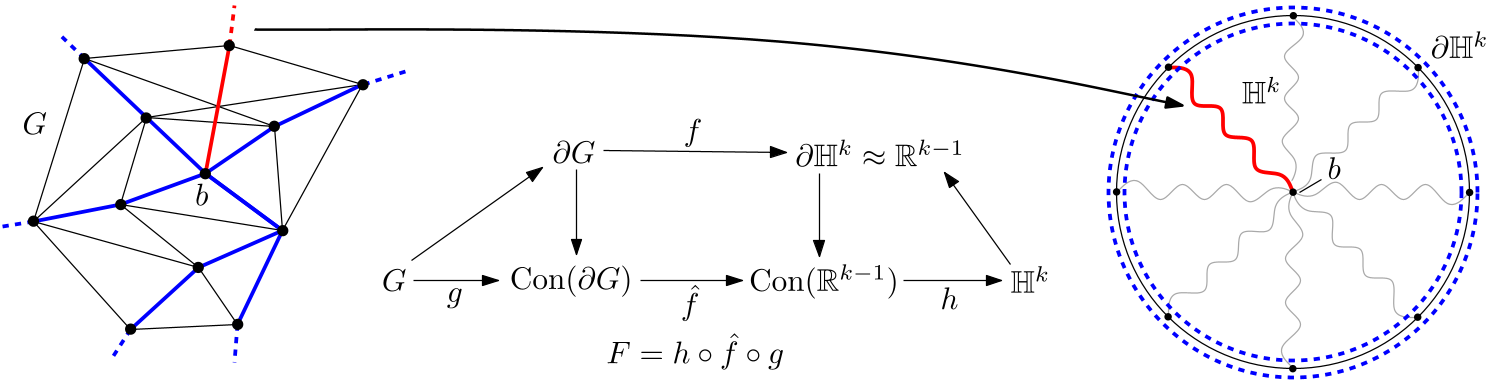
The Two-Step Execution:
- Defining the Boundary: For a -hyperbolic graph, the "boundary" represents points at infinity (end of paths). The authors show that this boundary is "doubling" (a property that allows for efficient mapping).
- Beacon-Based Mapping: They use a small set of "beacons" (landmark nodes) to triangulate positions. By embedding the boundary into Euclidean space and then "extending" it back into the hyperbolic interior (the manifold), they achieve constant additive distortion.
Experiments and Theoretical Proofs
The authors provide a rigorous proof that -hyperbolicity (a measure of how "thin" triangles are in a graph) is essentially the inverse of quasi-cyclicity.
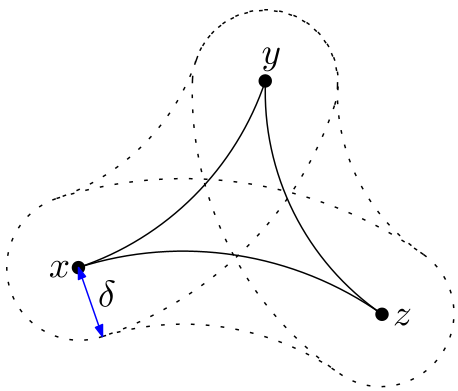
In a -hyperbolic space, any point on one side of a triangle is "close" to one of the other two sides. The paper proves that if a space is strictly -hyperbolic, it must contain a quasi-cycle of size proportional to .
Linear Time Performance
Crucially for Big Data, the proposed randomized algorithm runs in time. By sampling beacons based on the size of the "geodesic rays" they represent, the algorithm ensures that with high probability, of node-pairs have constant additive distortion.
Conclusion and Outlook
This work provides the mathematical "Why" for the observed success of hyperbolic embeddings in network science.
- Takeaway: If your data is "tree-like" (low quasi-cyclicity), stop using Euclidean coordinates. Hyperbolic space is its natural home.
- Limitation: The algorithm still requires a bounded degree for nodes to maintain the growth constant, which might be challenged by "super-nodes" in power-law distributions.
- Future Path: Can we use these quasi-cycle bounds to automatically detect the "curvature" of a network before we even attempt an embedding?
The research solidifies the transition of hyperbolic geometry from a mathematical curiosity to a foundational tool for social graph analysis.