
MF-toolkit: Revolutionizing Multifractal Analysis with Automation and High Performance
MF-toolkit is a high-performance Python library for Multifractal Detrended Fluctuation Analysis (MFDFA) featuring automated crossover detection via CDV-A and SPIC algorithms. It achieves significant computational speed-ups through Numba-based parallelization and provides built-in source identification using IAAFT surrogate data.
TL;DR
Multifractal Detrended Fluctuation Analysis (MFDFA) is the gold standard for characterizing complexity in non-stationary signals, but it has long been plagued by subjectivity in "crossover" identification and high computational costs. MF-toolkit is a new Python library that solves these issues using Numba-accelerated parallelization and automated detection algorithms (CDV-A and SPIC), allowing researchers to objectively distinguish between physical signals and instrumental noise in massive datasets like LIGO.
Context: The Fractal Nature of Chaos
From the turbulence of financial markets to the ripples of gravitational waves, complex systems exhibit scale-invariant structures. While the Hurst exponent () describes simple monofractals, real-world data is often "multifractal," requiring a whole spectrum of exponents to describe different scales of fluctuations. However, finding the right "regime" (scaling range) has traditionally been more of an art than a science, leading to reproducibility issues in physics research.
Problem: The Subjectivity Trap and Computational Walls
Current MFDFA workflows face three major bottlenecks:
- Crossovers: Physical systems change dynamics at different scales, creating "breaks" in the scaling curves. Choosing where these breaks occur is usually done via visual inspection, which is prone to human bias.
- Ambiguity of Origin: Does your signal look complex because of its internal correlations (memory) or because it has extreme outliers (fat tails)? Disentangling these is mathematically intensive.
- Performance: Calculating fluctuation functions for thousands of segments across multiple moments is slow, making it impossible to process long, high-frequency signals efficiently.
Methodology: Automation Meets Performance
MF-toolkit introduces a rigorous, automated pipeline to move MFDFA into the era of big data.
1. Automated Scaling Detection
The library implements two cutting-edge algorithms:
- CDV-A: Uses the variance of slope differences to find valleys that indicate a structural break. It is exceptionally fast and suitable for exploratory analysis.
- SPIC: An iterative hypothesis-testing procedure based on Monte Carlo permutations. It can detect multiple crossovers and remains stable even under 30% additive noise.
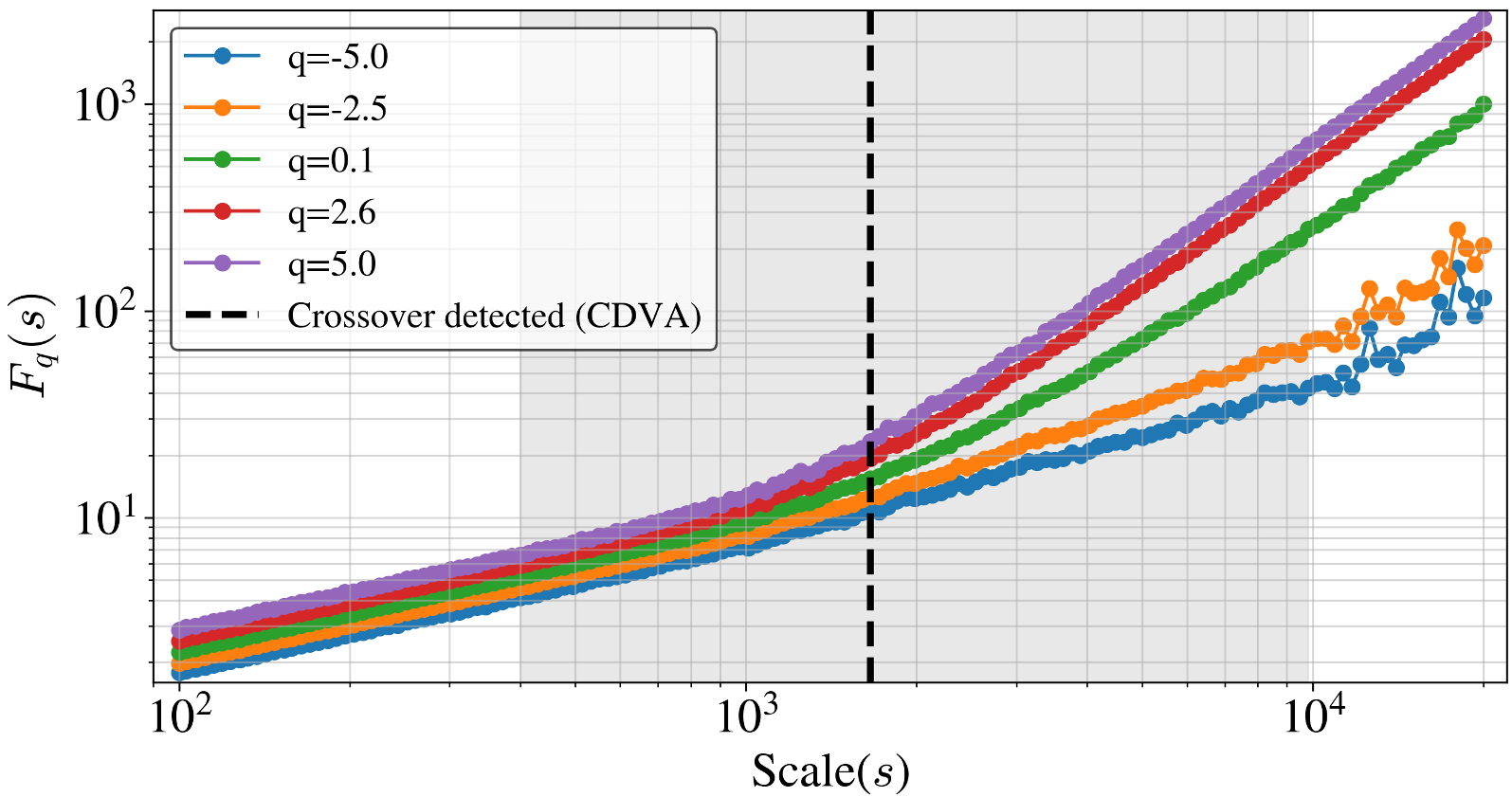 Figure: Automated crossover detection using the CDV-A method, identifying the transition between different scaling regimes.
2. High-Performance Architecture
By leveraging Numba's Just-In-Time (JIT) compilation and Python’s multiprocessing, MF-toolkit parallelizes the calculation of the -th order fluctuation functions. This allows for near-linear scaling when moving from sequential execution to multi-core environments.
3. Source Disambiguation
The toolkit includes built-in methods for Shuffling and IAAFT (Iterative Amplitude Adjusted Fourier Transform). By comparing the original series against these surrogates, the library tells you if your multifractality is "real" (correlations) or "apparent" (PDF distribution).
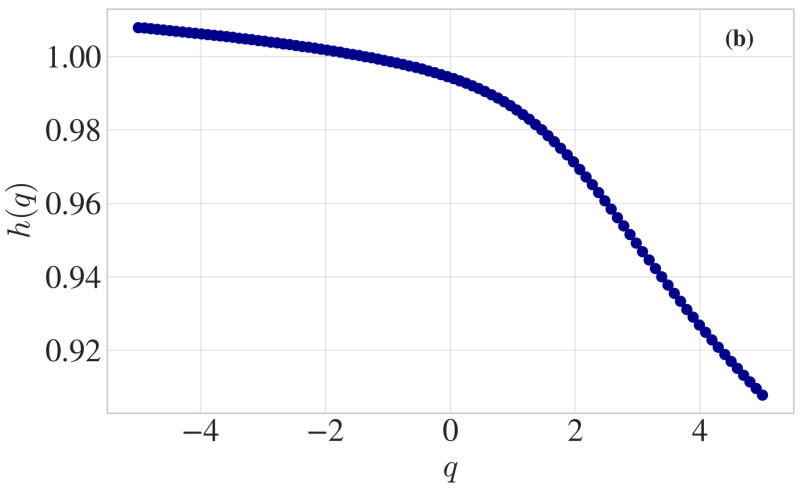 Figure: The complete MFDFA workflow within MF-toolkit, showing the generalized Hurst exponent h(q) and the singularity spectrum f(α).
Experiments: Real-World Stress Test on LIGO Data
The authors applied MF-toolkit to LIGO strain data—high-frequency (16k Hz) data where astrophysical events (like black hole mergers) are buried in non-stationary noise.
The Clue: They analyzed "Event" windows (mergers) and compared them to "Pre-event" windows (noise). The Finding: The multifractal signatures of the detector noise and the mergers were nearly identical. The Verdict: Using the surrogate test tools, MF-toolkit proved that the observed multifractality stems from nonlinear temporal correlations (colored noise) inherent to the detector hardware, not the gravitational waves themselves. This insight is crucial for engineers building the next generation of noise-cancellation filters.
 Table: Speed-up results demonstrating how MF-toolkit significantly outperforms existing single-threaded implementations.
Critical Insight & Conclusion
MF-toolkit isn't just a solver; it’s a validator. By integrating theoretical checks (like verifying the downward concavity of the singularity spectrum) directly into the code, it prevents researchers from over-interpreting numerical artifacts.
Limitations: While the SPIC algorithm is robust, it is computationally more expensive than simple geometric methods. Users must balance the number of permutations () against their time constraints, though the authors suggest as a sweet spot.
Future Outlook: As we move toward more complex time series in biology and fusion energy research, tools like MF-toolkit that combine mathematical rigour with HPC capabilities will be indispensable for turning raw data into objective physical insights.