
MFRep: Synchronizing Users and Employers Across the Social Graph
MFRep: Joint user and employer alignment across heterogeneous social networks
This paper introduces MFRep, a Matrix Factorization-based representation learning framework for joint user and employer alignment across heterogeneous social networks. By leveraging a mutually reinforcing mechanism, MFRep achieves state-of-the-art performance in identifying anchor links for both individual users and organizational entities.
TL;DR
In the fragmented landscape of modern social media, a single person exists as multiple digital shadows. MFRep is a sophisticated framework that aligns these identities by looking not just at the users, but at the companies that employ them. By treating user-employer associations as a "mutual promotion" signal and using multi-step relational matrices, it solves the "structure mismatch" problem where traditional alignment methods fail.
The Alignment Gap: Why "Structure" Isn't Enough
Most existing network alignment algorithms operate on a fundamental (and often flawed) assumption: if Alice is friends with Bob on Twitter, their corresponding accounts on LinkedIn must also be connected.
In reality, social structures are heterogeneous. You might follow a colleague on LinkedIn but only have an indirect, two-step connection (a friend of a friend) on Facebook. This structural drift makes simple topology-based matching ineffective. Furthermore, while we have some "seed" anchor users (known accounts), we almost never have a pre-mapped list of "anchor employers," which represents a massive untapped data source for refining user identity.
The Core Insight: Mutual Reinforcement
MFRep’s "Secret Sauce" is the realization that users and employers are tethered. If two accounts share the same employer properties and the same social circles (even if those circles are structured differently), the probability that they belong to the same person sky-rounds.
1. Multi-Step Relational Propagation
To bridge the gap between different social structures, MFRep doesn't just look at direct friends. It constructs a comprehensive user relational matrix () using random walks to capture -step transition paths. This allows the model to find "latent" structural proximity even when direct links are missing.
2. Employer-User Co-Embedding
The framework builds three types of relations:
- User-User: Social friendships and attribute similarities.
- User-Employer: Employment associations.
- Employer-Employer: Property similarities (company names, descriptions, search result rankings).
 The figure illustrates how multi-entity relations are integrated into a unified representation space.
Methodology: From Matrices to Embeddings
The authors formulate the alignment as a matrix factorization problem. Instead of expensive node sampling used in DeepWalk or Node2Vec, they utilize a scalable eigen-decomposition solution.
The objective function is optimized to ensure that entities across different networks are mapped to nearby coordinates in a latent -dimensional space if they are likely to be the same real-world entity.
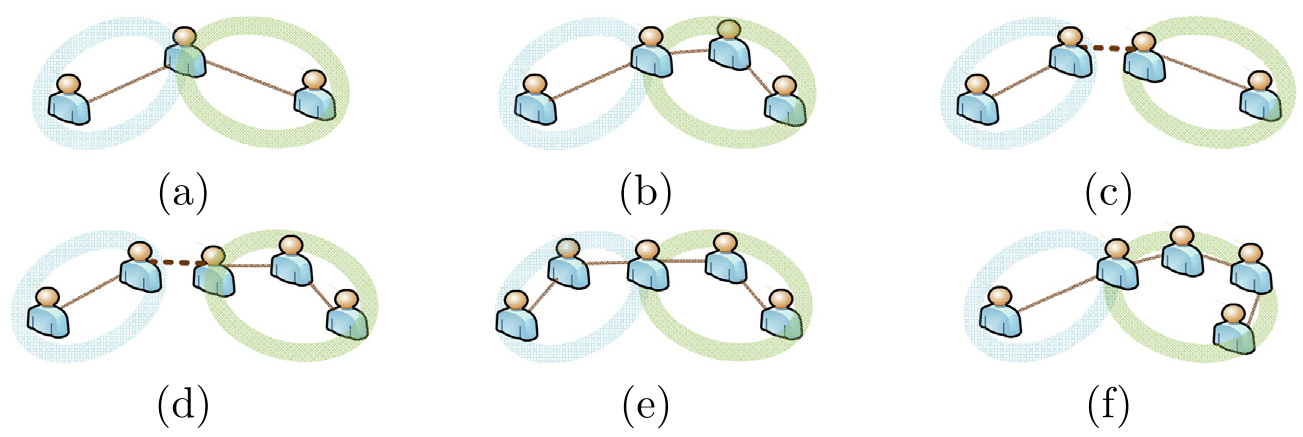 Visualizing the propagation of identity information through multi-step inter-network relations.
Experimental Battleground
MFRep was tested against heavyweights like FINAL, REGAL, and GraphUIL on a LinkedIn-Facebook dataset.
- Accuracy: MFRep achieved a Precision@30 of nearly 0.80, significantly higher than the ~0.70 of its closest competitors.
- Robustness: Even when noise was added to the user similarity scores, MFRep's performance declined much more gracefully than traditional methods, thanks to its integration of structural information and employer properties.
- Efficiency: The distributed version of MFRep (MFRep-D) allows for parallel processing of user and employer matrices, maintaining sub-quadratic complexity.
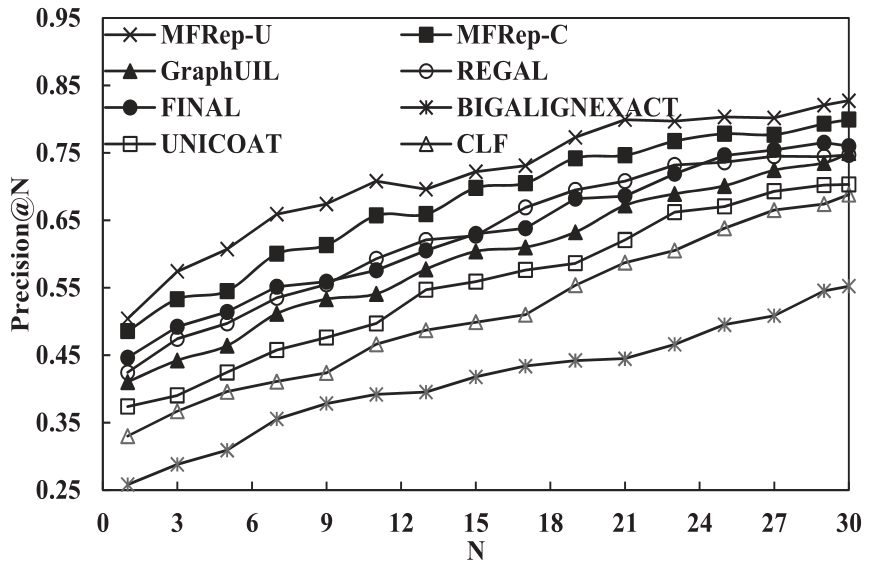 Experimental results showing MFRep consistently outperforming baselines across different ranking thresholds.
The "Dark Side": Social Engineering
The paper concludes with a sobering case study. By successfully aligning users and employers, an attacker can map out the entire "attack surface" of a company. By identifying employees' personal accounts (leisure-oriented) and professional roles (business-oriented), attackers can craft highly personalized phishing emails, using "accentuator" data like hobbies or photos harvested from private Facebook accounts.
Conclusion and Future Outlook
MFRep proves that in the world of big data, the sum is greater than the parts. By jointly aligning users and their professional environments, we can overcome the noise and structural differences of individual social platforms. For researchers, this opens the door to multi-entity alignment (including locations, groups, and interests); for practitioners, it serves as both a powerful tool for data integration and a warning for privacy protection.