
MH-TRACE: Redefining Energy Efficiency for Real-Time Multihop Broadcasting
MH-trace: multi-hop time reservation using adaptive control for energy efficiency
MH-TRACE (Multihop Time Reservation Using Adaptive Control for Energy Efficiency) is a hybrid MAC protocol designed for energy-efficient real-time packet broadcasting in mobile ad hoc networks (MANETs). It utilizes a dynamic two-hop clustering algorithm and cyclic superframes to coordinate channel access, achieving SOTA performance in throughput and energy conservation compared to IEEE 802.11 and SMAC.
Executive Summary
TL;DR: The paper presents MH-TRACE, a hybrid MAC protocol that bridges the gap between fully centralized and distributed wireless networks. By utilizing internal scheduling within dynamic "soft" clusters and Information Summarization (IS) packets, it provides deterministic QoS for voice traffic while slashing energy waste from idle listening and collisions.
Context: Within the academic landscape of MANETs (Mobile Ad Hoc Networks), MH-TRACE sits as a cornerstone work that transitions from basic contention-based access (like CSMA) to a more sophisticated, traffic-adaptive reservation system tailored for energy-constrained mobile radios.
The "Idle Listening" Crisis and Motivation
Prior to MH-TRACE, mobile ad hoc networks relied heavily on IEEE 802.11 or early energy-saving variants like SMAC. These protocols faced a fundamental dilemma:
- Distributed Chaos: CSMA-based protocols suffer from exponential increases in collisions as node density grows, leading to throughput collapse.
- Energy Hemorrhage: Radios waste immense energy "listening" to the air even when no relevant data is being sent, or worse, overhearing transmissions intended for others.
- QoS Failure: Real-time traffic like voice requires periodic access and low jitter, which random backoff algorithms cannot guarantee.
The authors' insight was that clustering should not be about membership, but about coordination. By organizing nodes into fuzzy, overlapping 2-hop clusters, they could implement local TDMA scheduling without the overhead of global network management.
Methodology: The Logic of MH-TRACE
The protocol organizes time into Cyclic Superframes, synchronized to the generation rate of voice packets (e.g., 25ms).
1. Hybrid Cluster Architecture
Unlike traditional clustering where a node belongs to one "boss," MH-TRACE nodes are transient participants.
- Clusterheads (CHs): Choose the "quietest" frame based on interference measurements.
- Control Subframe: Contains Beacons, Clusterhead Announcements (CA), and the vital Information Summarization (IS) slot.
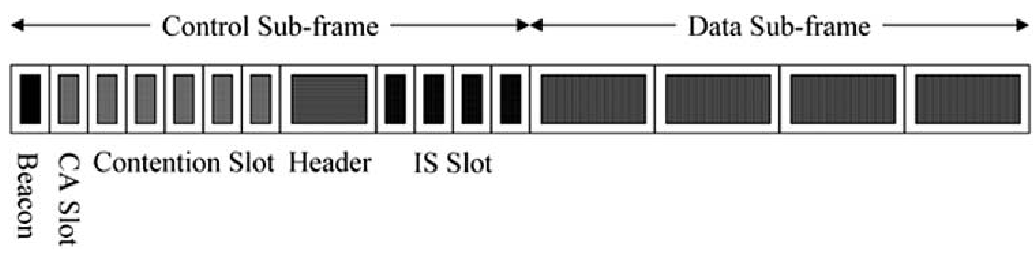 Fig 1: The MH-TRACE Frame Format, showing the separation of control, summarization, and data subframes.
2. The Power of Information Summarization (IS)
This is the "secret sauce." Before large data packets are sent, nodes broadcast a tiny IS packet. If a node hears an IS and realizes the sender is too far away or the signal is corrupted, it immediately shuts down its radio for the duration of the data slot. This avoids the "reception of irrelevant data" problem that plagues 802.11.
Experiments & Performance Leap
The authors compared MH-TRACE against 802.11 and SMAC using ns-2 simulations with voice traffic modeled as periodic "spurts" and "gaps."
SOTA Comparison
As node density increases, 802.11 throughput plateaus and then drops due to instability. MH-TRACE, however, tracks the theoretical maximum throughput closely.
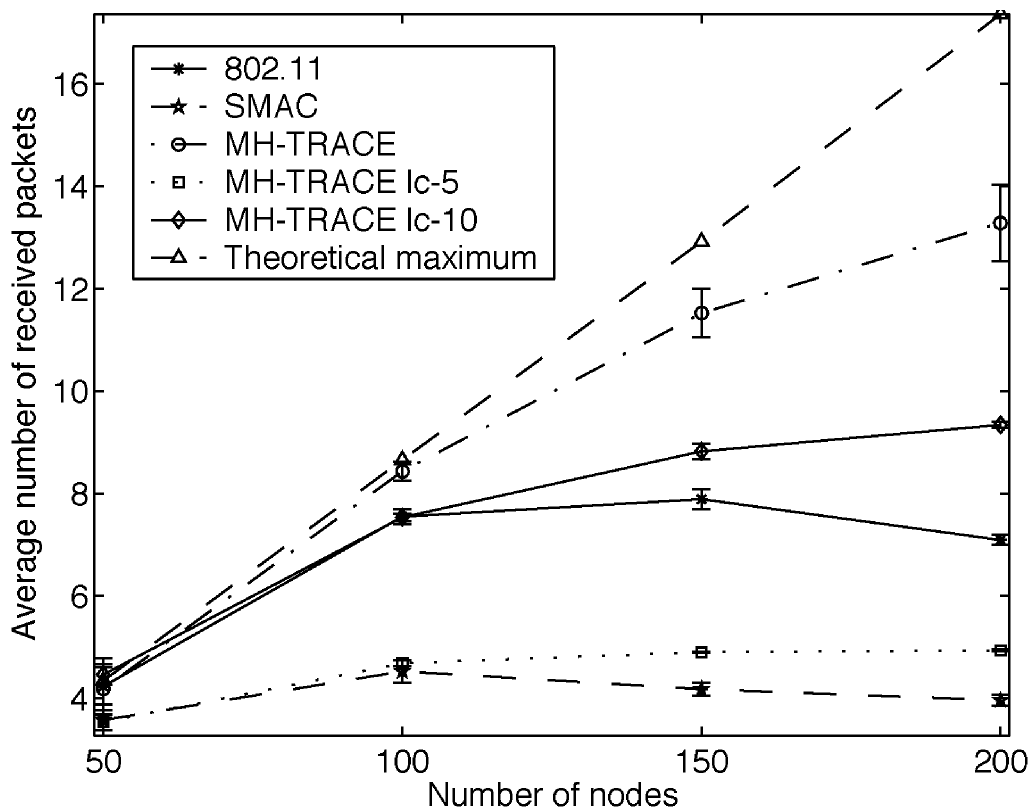 Fig 2: Average number of received packets. Note how MH-TRACE maintains stability at high density while 802.11 falters.
Energy Mastery
The most striking result is the energy efficiency. At 200 nodes/km², MH-TRACE dissipates significantly less energy while delivering nearly double the throughput of 802.11. This is attributed to:
- Eliminating Intracluster collisions via scheduling.
- Minimizing Idle listening via the superframe sleep cycles.
- Data discrimination through Listening Clusters, where nodes only wake up for the strongest (closest) signals.
Critical Analysis & Conclusion
Takeaways
MH-TRACE proves that centralized coordination within a distributed framework is the optimal path for MANETs. The use of interference-level sensing to dynamically shift frames is a robust alternative to complex routing-based clustering.
Limitations
- Synchronization Dependency: The protocol requires nodes to be synced within 16 microseconds (one IFS). While GPS or specialized algorithms can handle this, it adds a layer of hardware/software complexity.
- Uniformity Assumption: Performance may degrade in highly non-uniform topologies where "hotspots" overwhelm localized cluster capacities.
Future Outlook
This work lays the groundwork for modern Cross-Layer Design. Future extensions could integrate MH-TRACE with Directional Antennas or Cognitive Radio to further enhance spatial reuse and battery life in the era of IoT and massive machine-type communications.