
Micro-Blog: Turning Billions of Phones into a Virtual Information Telescope
Micro-Blog: Sharing and Querying Content Through Mobile Phones and Social Participation
Micro-Blog is a pioneering participatory sensing system that allows mobile users to create, geotag, and share multimedia content ("microblogs") via smartphones. It integrates social participation with sensory data, enabling Internet users to query physical locations and receive real-time human or automated responses, achieving a SOTA balance between localization accuracy and energy efficiency.
TL;DR
Micro-Blog is a landmark 2008 study that envisioned the modern "crowdsensing" era. By using mobile phones as "virtual lenses," the system enables users to geotag multimedia content and answer location-specific queries. Its primary technical breakthrough is an energy-aware multi-modal localization scheme that solves the battery-drain problem inherent in GPS-dependent mobile applications.
Background Positioning
Published at MobiSys 2008, this work appeared just as smartphones (like the Nokia N95) began integrating diverse sensors. It transitioned the "Wireless Sensor Network" (WSN) paradigm from specialized hardware to human-centric, participatory platforms.
The "Energy-Accuracy" Crisis
In the early days of mobile sensing, researchers hit a wall: The Localization Paradox.
- GPS provides precision (~8m) but kills the battery in <8 hours.
- GSM is energy-efficient but offers "neighborhood-level" accuracy (~600m), which is useless for finding a specific street-side cafe.
- WiFi Positioning sits in the middle but depends on dense urban AP scans.
Micro-Blog’s authors recognized that an application shouldn't be "always-on" high precision. Instead, it should adapt to the user's state (stationary vs. moving).
Methodology: High-Resolution Sensing via Multi-Modal Switching
The core of Micro-Blog is its interpolation heuristic. Instead than keeping the GPS radio active, the system monitors the environment using low-power WiFi/GSM fingerprints.
1. The Architecture
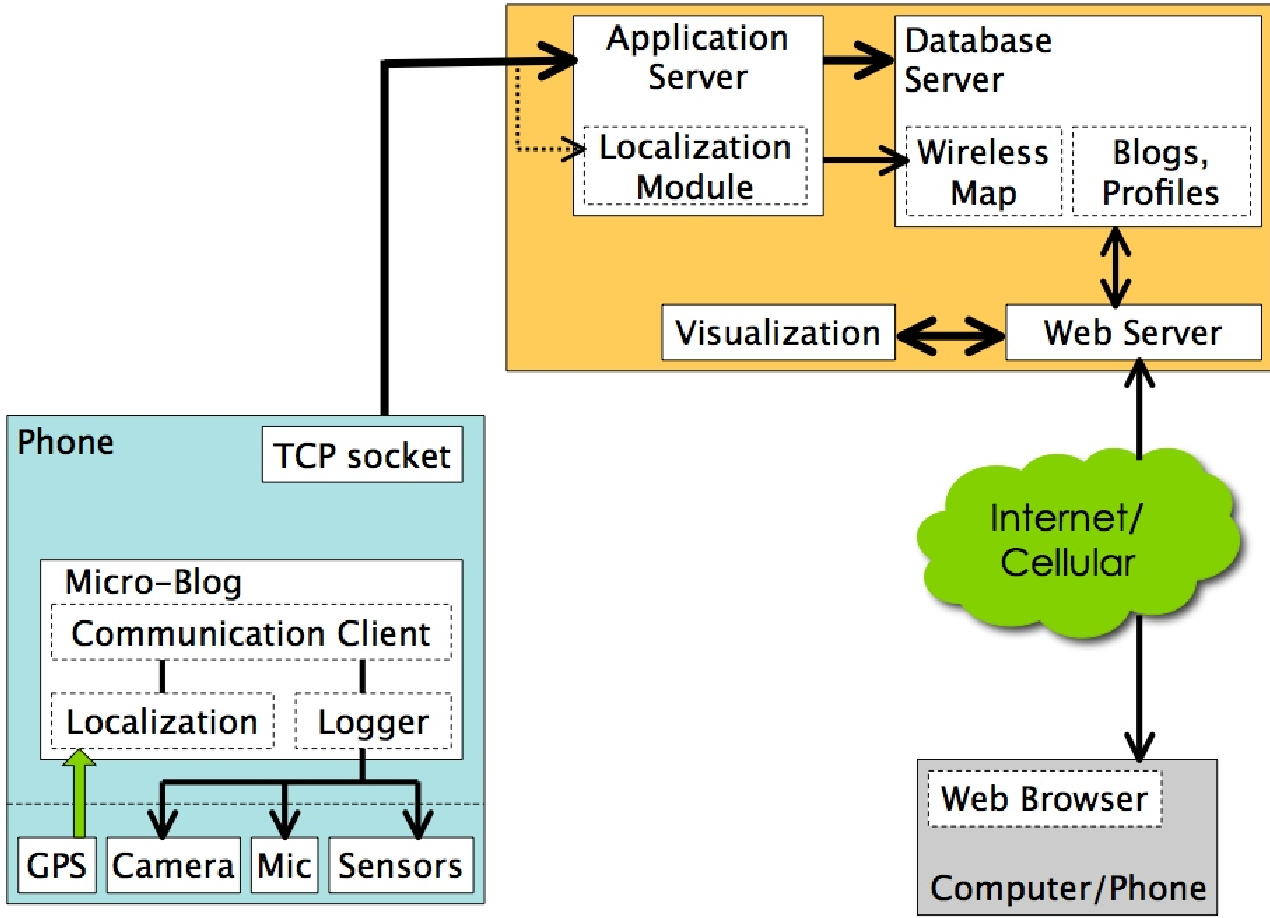
The system uses a client-server model where the phone logs sensory data (accelerometers, WiFi SSIDs, signal strengths) and uploads it to a central server that visualizes the "Micro-blogs" on a spatial platform (like Google Maps).
2. The Interaction Loop
- Querying: An Internet user selects a region on a map.
- Routing: The server finds phones currently in that square.
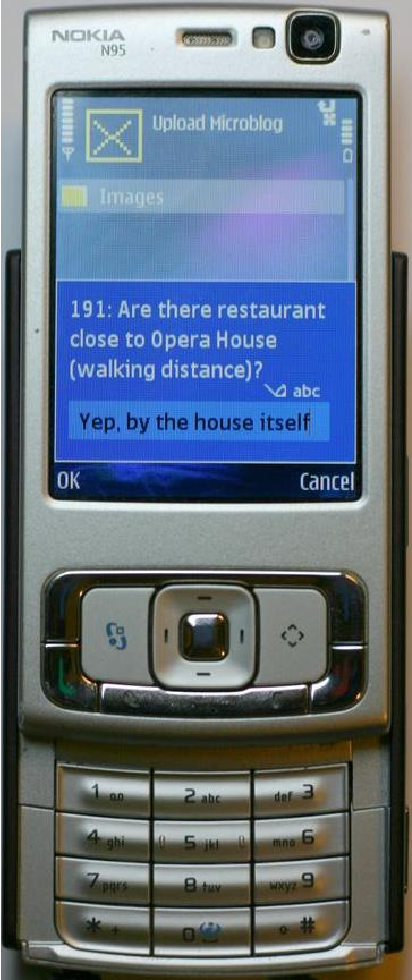
- Human-in-the-loop: The phone user receives a notification and can reply with text or a photo, providing "subjective" data (e.g., "Is there parking available?") that automated sensors cannot capture.
Experiments & Results: Efficiency Gains
The evaluation focused on the Battery vs. Error trade-off. By switching between GSM and WiFi (with periodic GPS corrections), the authors demonstrated that a phone could survive for 21+ hours while maintaining enough accuracy for social collaboration.
| Method | Battery Life | Approx. Error |
|---|---|---|
| GPS (Always on) | 7.8 hours | 8m |
| WiFi (PlaceLab) | 20 hours | 25m |
| GSM (Default) | 63 hours | 600m |
The study found that users were most active between 5:00 PM and 9:00 PM—a crucial insight showing that participatory sensing is a "leisure-time" activity and that users are more willing to expend battery when they know a recharge is imminent.
Critical Analysis & Conclusion
Takeaway
Micro-Blog successfully demonstrated that the mobile phone is the ultimate sensor. The "Participatory" aspect—allowing humans to filter and contextualize data—is more powerful than raw sensor streams alone.
Limitations
- Privacy: The system requires users to trust the central server with their real-time location.
- Incentives: While the paper suggests "query credits" (K-factors), the social dynamics of why a stranger would help another stranger remain complex and under-explored in the initial prototype.
Future Outlook
This work laid the foundation for modern apps like Waze (traffic crowdsourcing) and Instagram (geotagged multimedia). Today, the integration of AI could automate the responses that Micro-Blog once relied on humans to provide, truly fulfilling the vision of a "Virtual Information Telescope."