
Engineering the Social Graph of Microbes: How Topology Controls Consortia
Role of interaction network topology in controlling microbial population in consortia
This paper introduces a network control framework to regulate fractional populations in spatially distributed microbial consortia using a toxin-antitoxin sequestration circuit. By mapping reaction-diffusion dynamics to a linearized network model, the authors establish how topological properties like symmetry, locality, and connectivity dictate tracking performance and control costs.
TL;DR
In the world of synthetic biology, "who you are" is often less important than "where you sit." This paper by Ren and Murray explores how the spatial arrangement (topology) of microbial colonies determines the success of population control circuits. By moving beyond "well-mixed" assumptions, they prove that symmetry and connectivity in the cell-cell interaction network are the secret ingredients to stable, low-cost biocontrol.
Background: Beyond the Well-Mixed Flask
Engineering microbial consortia—teams of different bacteria working together—is the next frontier for gene therapy and biofuel production. However, most existing designs assume a "well-mixed" environment where every cell talks to every other cell equally. In reality, spatial heterogeneity (where cells are physically located) changes everything. Signals diffuse, concentrations drop over distance, and the "social network" of the microbes becomes sparse and structured.
The Problem: The Cost of Asymmetry
When cells are spatially distributed, the feedback loops meant to balance their populations begin to fail. The paper identifies that if the interaction network between two strains (Cell1 and Cell2) is not perfectly balanced, the system drifts away from its target population ratio. Correcting this drift requires "control effort"—usually in the form of adding extra chemical inducers—which can be metabolically expensive or technically difficult.
Methodology: From PDEs to Graph Theory
The authors bridge the gap between biological chemistry and network science through a three-step reduction:
- Reaction-Diffusion Model: Capturing how AHL (quorum sensing) molecules diffuse and how toxin-antitoxin pairs sequester each other.
- Linearization: Simplifying the growth dynamics into a set of linear equations.
- Network Representation: Representing the consortium as a weighted graph where edge weights move based on physical distance.
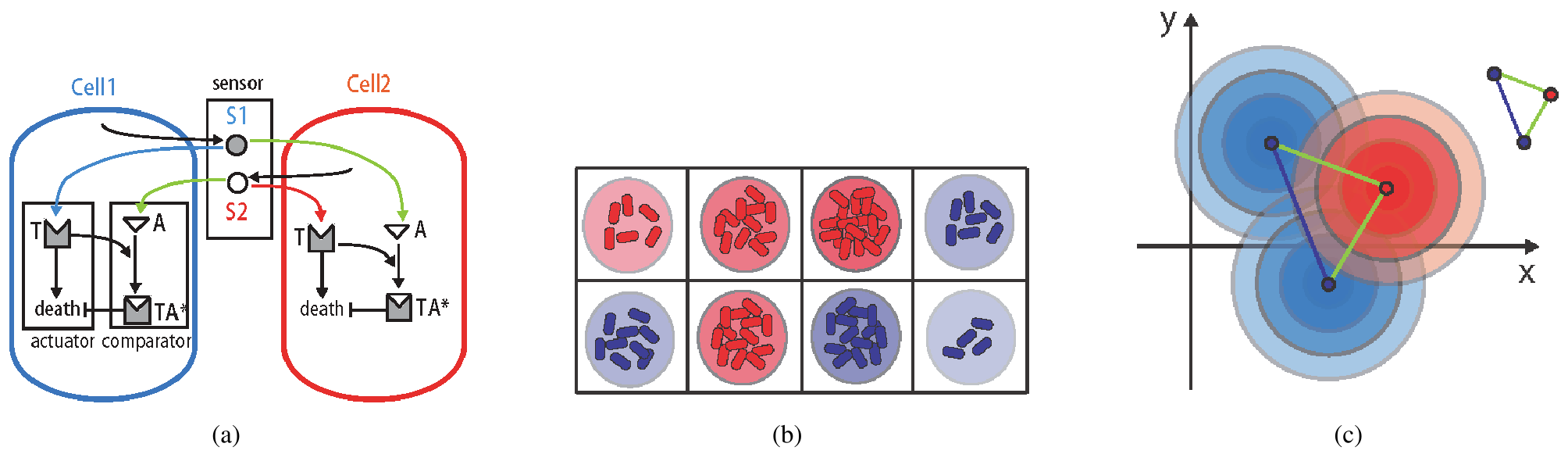 Fig 1. The sequestration-based circuit (a) and the 2D spatial arrangement of microcolonies (b, c).
The Core Insight: Locality and Connectivity
The researchers defined three critical metric for the "Microbial Graph":
- Symmetry: Is the physical layout of Strain A a mirror of Strain B?
- Locality: How strongly does a strain talk to itself?
- Connectivity: How strongly do different strains talk to each other?
Key Results: Where to Place the Controller?
The study provides a mathematical proof for several intuitive but previously unquantified behaviors:
- Symmetry is Free: If the network is perfectly symmetrical, the system tracks the target population ratio perfectly with zero external control cost.
- The "Energy-Favorable" Node: If the system is asymmetrical, you shouldn't just pick any colony to act as the "controller." Placing the control input (e.g., inducing more AHL production) at the central node—the one with the highest contribution to locality and connectivity—can reduce costs by 20%.
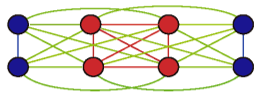 Fig 2. Simulation tracking performance. High symmetry leads to near-perfect reference tracking.
Connectivity as a Shield for Robustness
Finally, the paper demonstrates that strongly connected networks (where strains are highly mixed) are far more robust to "metabolic burdens"—random drops in growth rate caused by environmental stress. Isolated populations, by contrast, are fragile; a small perturbation in one strain can lead to a total collapse of the desired population ratio.
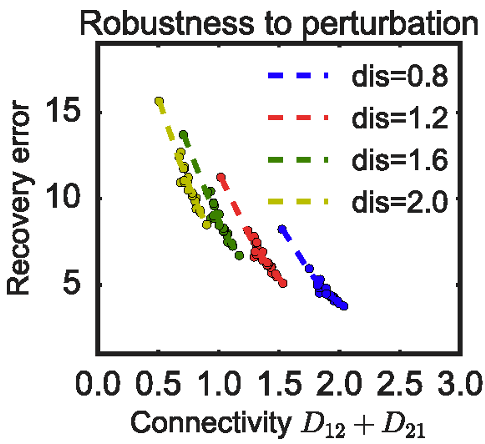 Fig 3. Recovery error vs. Connectivity. High connectivity minimizes the impact of external growth perturbations.
Critical Insight & Practical Value
This research shifts the focus from intracellular engineering (DNA/RNA) to intercellular engineering (Spatial Layout).
Takeaway for Engineers: If you are designing a synthetic ecosystem on a surface (like a wound dressing or a bioreactor wall), don't just focus on the genetic circuit. Use the strongest connected and most symmetrical layout possible to let the physics of diffusion do the control work for you.
Conclusion
By treating microbial consortia as controllable networks, Ren and Murray have provided a roadmap for building more resilient biological systems. Future work may extend this to 3D biofilms or "attacker-defender" systems, but the lesson remains: in synthetic biology, geography is destiny.