
Emotional Trajectories: Mapping the Ebb and Flow of Collective Sentiments on Twitter
Analyzing Microblogging Posts for Tracking Collective Emotional Trajectories
The paper introduces a novel framework for tracking "Emotional Trajectories" (ET) in microblogging platforms like Twitter. It represents users' emotional changes in a multi-dimensional cyberspace and uses a hierarchical clustering approach to identify collectives of users who share similar emotional patterns over time.
TL;DR
Researchers from the University of Bari have proposed a way to treat "feelings" like "moving objects." By mapping Twitter users into a multi-dimensional "cyberspace," they can track Emotional Trajectories—sequences of shared emotional shifts that reveal how collectives form and react over time. Unlike standard sentiment analysis, this method focuses on the velocity and displacement of emotions between pairs of interacting users.
Problem & Motivation: Beyond "Like" and "Dislike"
Traditional social media analysis is great at telling us what people feel at a specific moment (e.g., a "Positive" sentiment score for a political candidate). However, it fails at capturing the dynamics:
- Individual vs. Collective: Emotions are contagious. Analyzing a single user in a vacuum ignores the social context.
- Temporal Fluidity: Emotions change rapidly. Static snapshots miss the "trajectory" of how a user moves from anger to hope.
- Physical Limitations: Existing trajectory mining algorithms (like TRACLUS) were built for GPS data (cars, pedestrians). They cannot handle the "semantic jumps" or the temporal gaps found in microblogging.
The authors' insight was to treat the change in emotion as a movement in a coordinate system, where the X-axis is "Positive Emotion" and the Y-axis is "Negative Emotion."
Methodology: The Geometry of Human Feeling
To turn tweets into trajectories, the paper defines a two-tier cyberspace.
1. The Posting-Space
Using WordNetAffect, the system extracts emotional keywords and calculates the relative frequency of positive and negative sentiments in a user's posts within a specific time window.
2. The Feature-Space (The "How" of Interaction)
This is where the magic happens. The authors define three geometric features to describe how two users (u and v) move together:
- Emotional Displacement: The "distance" covered in the emotional space over two time steps.
- Emotional Distance: The angular difference between users—are they moving toward the same emotional pole?
- Emotional Ratio: A measure of divergence—are the two users' sentiments getting closer or drifting apart?
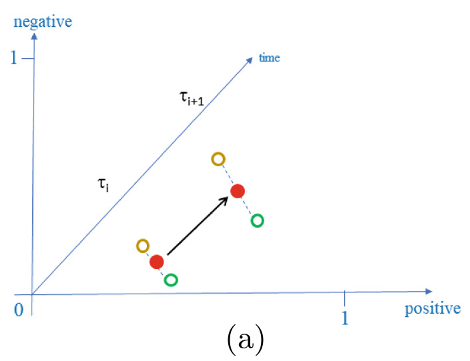 Fig 1: Conceptualizing emotional movement through Displacement, Distance, and Ratio.
3. Hierarchical Clustering
Instead of using standard K-Means, the authors adapted a decision-tree structure. It recursively splits user pairs based on which emotional feature reduces "dissimilarity" the most. This identifies Similarity-based Pair Clusters (SPCs)—groups of people whose emotions "vibrate" at the same frequency over time.
Experiments: Tracking the 2012 US Election
The team tested their method on a dataset of 236,000 tweets regarding Obama and Romney during the 2012 election.
Key Insights:
- The "Hourly" Sweet Spot: The method works best when aggregating data in 60-120 minute windows. Too short (30 mins), and the data is too sparse; too long (240 mins), and local emotional spikes get "washed out."
- Collective Convergence: On the final day of the dataset (Election Day), the number of small trajectories decreased, while large, shared trajectories grew. This indicates a "mass emotional synchronization" as the event reached its climax.
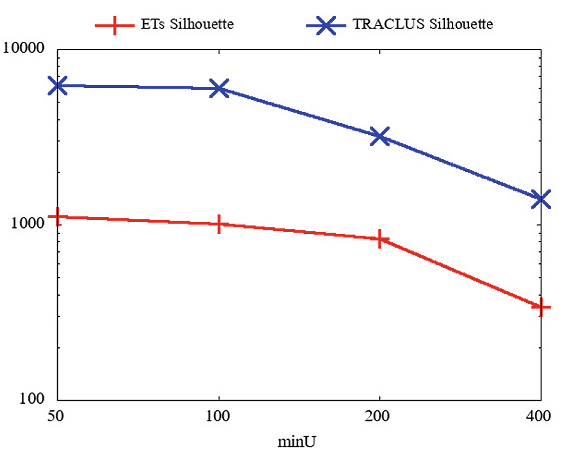 Fig 2: Silhouette Index results show the ET method significantly outperforms the TRACLUS baseline in maintaining cluster cohesion.
Conclusion & Future Outlook
This work shifts the focus from "sentiment classification" to "sentiment dynamics." By treating social media users as moving particles in an emotional field, we can better understand how polarized groups form and how "emotional contagion" spreads.
Limitations: The current model logic is binary (Positive/Negative). Expanding this to the "Ekman Model" (Fear, Joy, Anger, etc.) would add four more dimensions to the cyberspace, potentially revealing even more complex social behaviors.
The Takeaway: For brands or governments monitoring social media, it’s not just about what people are saying today—it’s about the trajectory of their collective mood. If we can predict where a group's emotional trajectory is headed, we can intervene in cyber-bullying or manage social crises before they boil over.