
Customer-Oriented Catalog Segmentation: Beyond Direct Product Purchases
A microeconomic data mining problem: customer-oriented catalog segmentation
This paper introduces "Customer-Oriented Catalog Segmentation," a novel data mining problem within a microeconomic framework. It proposes the Best-Product-Fit (Greedy) and Random-Product-Fit algorithms to maximize customer attraction based on a minimum interest threshold , achieving significantly higher overall utility than traditional methods like DCC.
TL;DR
This seminal paper shifts the focus of catalog optimization from maximizing "item sales" to maximizing "customer attraction." By introducing a minimum interest threshold (), the authors propose algorithms that not only build better catalogs but also drive significant "extra profit" from non-catalog items. Their hybrid Random-Product-Fit algorithm successfully balances computational efficiency with high-quality segmentation.
Problem & Motivation: The Retailer's Real Goal
In the classical microeconomic view of data mining, businesses aim to maximize utility. For a long time, "Catalog Segmentation" was synonymous with finding catalogs of size that maximized the total number of items purchased from those catalogs.
The Flaw in the Old Model:
- The Conversion Threshold: A customer isn't attracted to a store because they like one item; they usually need a cluster of interests (a threshold ) to justify the "overhead" of a visit (online or offline).
- Secondary Purchases: Once a customer is "attracted," they don't stop at the catalog items. They buy other products. Traditional models ignore this "halo effect."
The authors argue that the real objective should be the Customer-Oriented Catalog Segmentation problem: maximizing the number of customers who find at least items interesting in their assigned catalog.
Methodology: Graph-Based Optimization
The authors formalize the task as the k-Maximum Element Cover With Threshold t (k-MECWT). They represent the data as a bipartite graph , where are products, are customers, and represents interest.
1. The Best-Product-Fit (Greedy)
The greedy approach uses a sophisticated scoring function to select the "next best" product. Unlike a naive count, it weights products by how close they bring a customer to the threshold .
This ensures that the algorithm focuses on customers who are "almost convinced" rather than spreading interests too thinly across the population.
2. Random-Product-Fit (The Two-Step Hybrid)
Greedy algorithms are notorious for getting trapped in local optima. To solve this, the authors introduce a randomized refinement step.
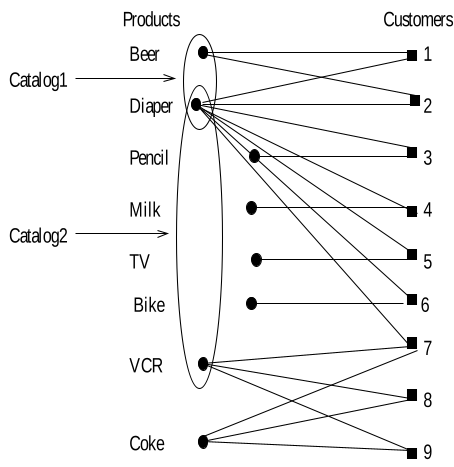 Figure 1: The bipartite graph representation allows the algorithm to track 'Counter(c)', the number of items needed to satisfy a customer's threshold.
The Random-Product-Switch algorithm takes the initial greedy catalogs and iteratively attempts to swap a catalog product with a non-catalog product. If the swap increases (or maintains) the number of covered customers, the change is kept. This stochastic "hill-climbing" is what gives the algorithm its edge.
Experiments & Results
The authors tested their approach against DCC (Direct Catalog Creation), a state-of-the-art clustering-based catalog algorithm.
Key Findings:
- Customer Coverage: On both synthetic and real retail datasets, the Random-Product-Fit algorithm consistently outperformed DCC. As the number of catalogs () or catalog size () increased, the gap widened.
- The "Extra Profit" Revelation: This is the most critical insight. While DCC might lead in "catalog items purchased," the authors' method led to a 30% increase in extra items purchased (non-catalog products).
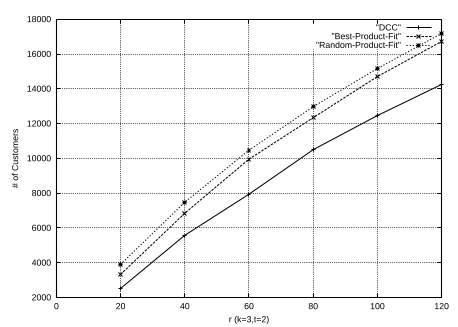 Figure 2: Comparison of customer coverage vs. number of catalogs (k). The Random-Product-Fit (top line) consistently attracts more customers.
Critical Analysis & Conclusion
This paper provides a robust bridge between Microeconomics and Combinatorial Optimization. By redefined the utility function to reflect actual consumer behavior (the threshold effect), it offers a more realistic tool for marketing.
Limitations:
- Static Threshold: The model assumes every customer has the same threshold . In reality, is likely a distribution.
- Computation: While the greedy step is , the randomized step's convergence speed depends heavily on the initial state and the number of iterations ().
Takeaway for the Future: The industry has since moved toward personalized real-time feeds, but the core lesson of this paper remains: Personalization isn't just about matching items to people; it's about reaching the threshold of engagement that triggers a visit. Future work integrating this with Association Rule Mining (cross-selling) remains a highly relevant path for retail AI.