
MicroFilters: Boosting Disaster Response with Automated Image Intelligence
MicroFilters: Harnessing twitter for disaster management
MicroFilters is a disaster management system that automatically identifies damage-related images from Twitter streams to assist humanitarian responders. It employs Haralick texture features and Support Vector Machines (SVM) to filter out irrelevant visual data, achieving an average recall of 88% and an AUC of 78%.
TL;DR
MicroFilters is a specialized system designed to help humanitarian organizations sift through the "noise" of social media during natural disasters. By automatically scraping and classifying images from Twitter using Haralick texture features and Support Vector Machines (SVM), it identifies "mappable damage" with 88% recall. This allows rescuers to focus on identifying victims and assessing structural damage rather than manually sorting through thousands of irrelevant photos.
The "Big Crisis Data" Bottleneck
When a disaster like Supertyphoon Pablo strikes, digital humanitarians are flooded with social media data. While Twitter is a goldmine for situational awareness, organizations like the UN found that manual sorting is prohibitively slow.
The core problem is relevance vs. volume. Most existing tools focus on text. However, text can be misleading; a user might tweet about "severe damage" but attach a satellite weather map or a generic stock photo. Without a way to "see" the damage, humanitarians lose precious hours verifying ground truth.
Methodology: Beyond Simple Color Matching
MicroFilters addresses the technical challenge of identifying "chaos" in images. The author explored three primary feature engineering strategies to handle the "data sparseness" problem—a phenomenon where increasing features requires exponentially more training data.
- Color Histograms: Discarded. They fail to distinguish between a "blue sky over red ground" and a "red sky over blue ground" and are too sensitive to lightning conditions in disaster zones.
- Image Segmentation: Discarded. Rubble and debris often lead to chaotic, useless segments that don't help in classification.
- Haralick Texture Features: Selected. These features evaluate "peaks" and "valleys" in color intensity (texture). Because disaster scenes involving debris have distinctively scattered textures compared to smooth maps or indoor photos, this proved highly effective.
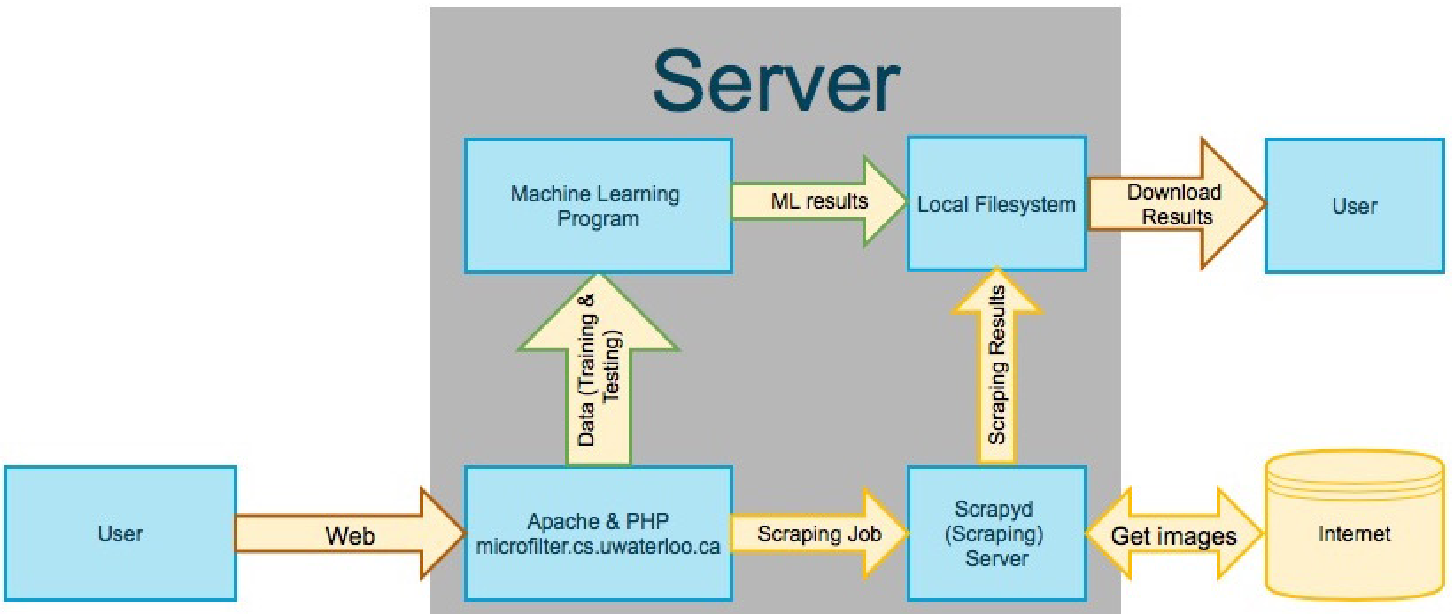 Figure 1: The architecture of the MicroFilters system, from scraping to SVM classification.
The system uses an SVM with an RBF (Radial Basis Function) kernel. Unlike simpler models like Naive Bayes, SVMs excel at re-projecting non-linearly separable data into a higher-dimensional space where a clear decision boundary can be drawn—crucial for the messy reality of disaster imagery.
Experimental Results & Performance
The system was validated using real-world data from the Oklahoma Tornado and Hurricane Sandy.
- Scraping Performance: The specialized Scrapy pipeline achieved a 99% recall, successfully filtering out ads, banners, and profile pictures by implementing aspect-ratio and size tests.
- Classification Accuracy: The model achieved an AUC of 78%, which is on par with AIDR (Artificial Intelligence for Disaster Response), a leading text-only system.
| Metric | Average Score |
|---|---|
| Precision | 0.70 |
| Recall | 0.88 |
| F1 Score | 0.78 |
| AUC | 0.78 |
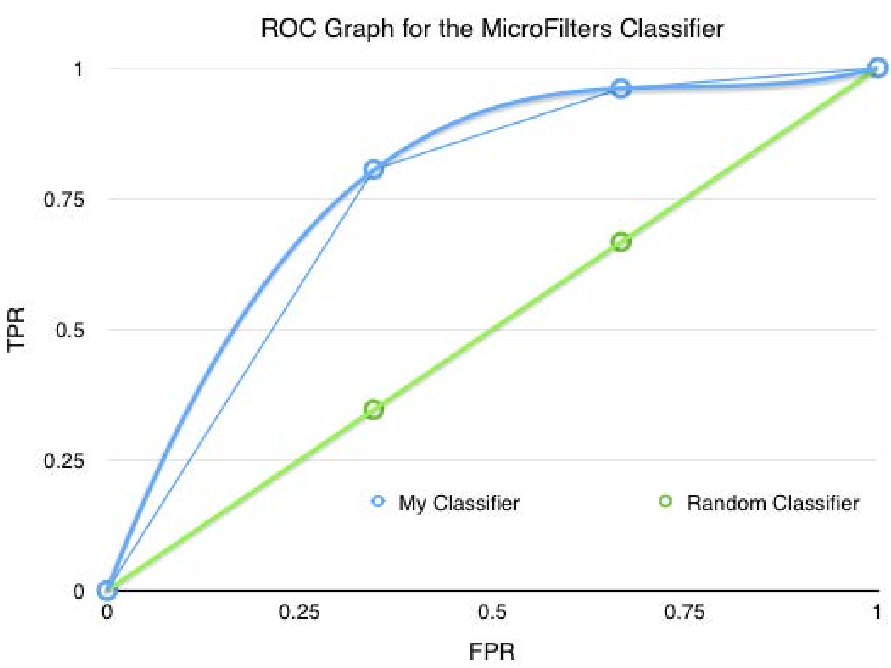 Figure 2: The ROC graph demonstrates the trade-off between sensitivity and specificity, showing robust performance across different disaster types.
Critical Analysis & Future Outlook
The success of MicroFilters lies in its modularity. It wasn't built to replace text-based filters like Tweet4Act or AIDR, but to serve as a "visual layer" that enhances the overall intelligence of crisis maps.
Limitations: The system currently relies on manual labeling of a small set of images (200-250) for each new disaster to "tune" the classifier. This creates a minor delay during the first hour of a crisis.
The Road Ahead: Future iterations could utilize active learning—where the computer asks humans to label only the "trickiest" images—to reduce training time. Furthermore, moving from Haralick features to Deep Learning (CNNs) could provide even higher semantic understanding, though it would require significantly more computational power and data.
Ultimately, MicroFilters represents a shift toward human-machine collaboration, delegating the tedious task of sorting to the algorithm so that humanitarians can focus on the critical mission: saving lives.