
Beyond Connectivity: Untangling Social Dimensions for Faster Innovation Diffusion
Untangling the role of diverse social dimensions in the diffusion of microfinance
The paper introduces "Diffusion Versatility," a novel centrality metric for multilayer social networks designed to optimize the identification of influential seeds. Applied to microfinance diffusion in rural India, the method outperforms traditional single-layer "Diffusion Centrality," providing a more accurate prediction of village-wide participation rates.
TL;DR
How do you pick the perfect "influencer" to spread a new financial program in a rural village? This paper argues that looking at a single social network isn't enough. By using Multilayer Network Analysis, the authors developed a new metric called Diffusion Versatility that identifies leaders based on their influence across different social roles (trust, money, kinship). Their findings reveal that the most effective seeds for microfinance aren't just "popular" people—they are the ones we turn to during medical emergencies or financial crises.
The Problem: The Myth of the "General" Influencer
Most network interventions rely on Diffusion Centrality, a measure of how well a person can spread a message through a single, aggregated network. For example, if you visit my house AND we are cousins, the model just sees "one link."
The researchers realized that this aggregation hides the Inductive Bias of different relationships. Being popular in a "leisure" network (who visits whom) might be useless for spreading a financial innovation that requires high levels of trust. Prior work failed because it couldn't "untangle" which specific social dimensions actually drive behavior change.
Methodology: The Multilayer Tensor Approach
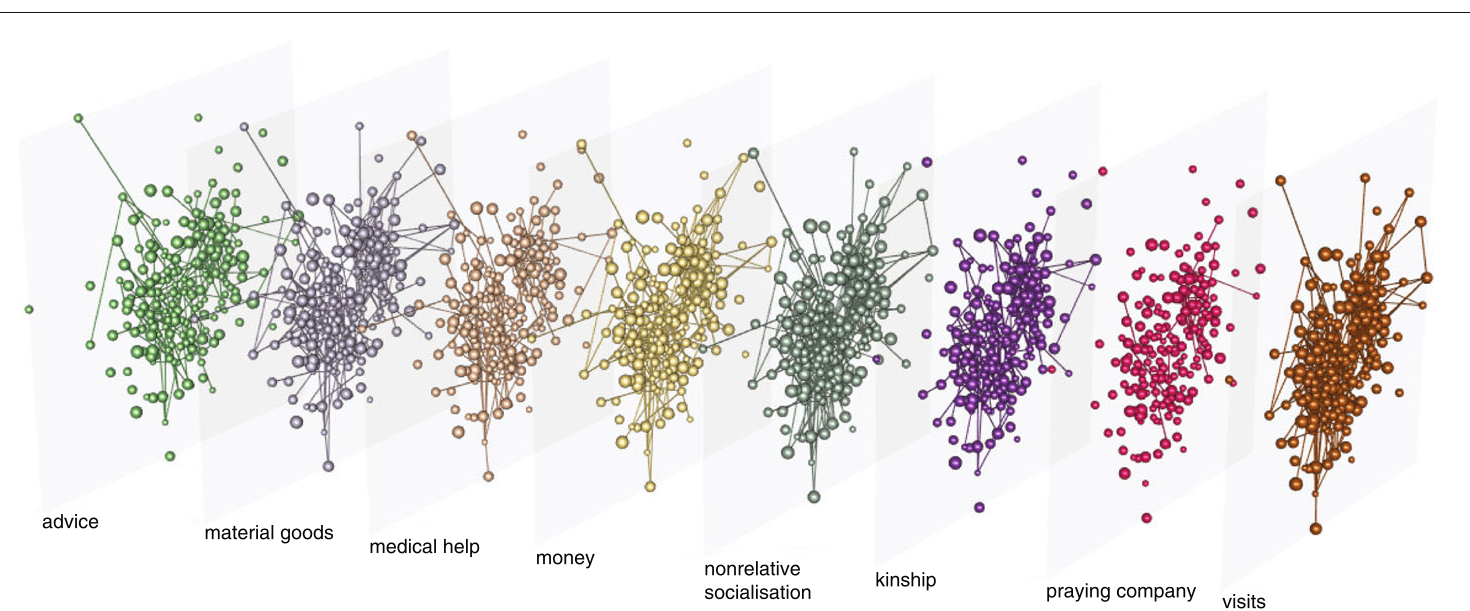
The authors built a multilayer network for 43 Indian villages, featuring 8 distinct layers:
- Socialization
- House Visits
- Material Goods (Kerosene/Rice)
- Money Loans
- Advice
- Medical Help
- Kinship
- Praying Company
The Math of Versatility
Mathematically, they moved from a standard adjacency matrix to a rank-4 tensor . This allows the model to track how information moves not just from person to person (nodes), but from relationship-type to relationship-type (layers).
Diffusion Versatility (DV) was then defined to measure how far a process starting at a specific node can spread within a time , considering the potential for the information to "jump" across different social dimensions.
Experiments & Key Findings: Trust is the Catalyst
The study compared how well the average centrality/versatility of village leaders predicted actual microfinance participation rates.
1. Superior Prediction Power
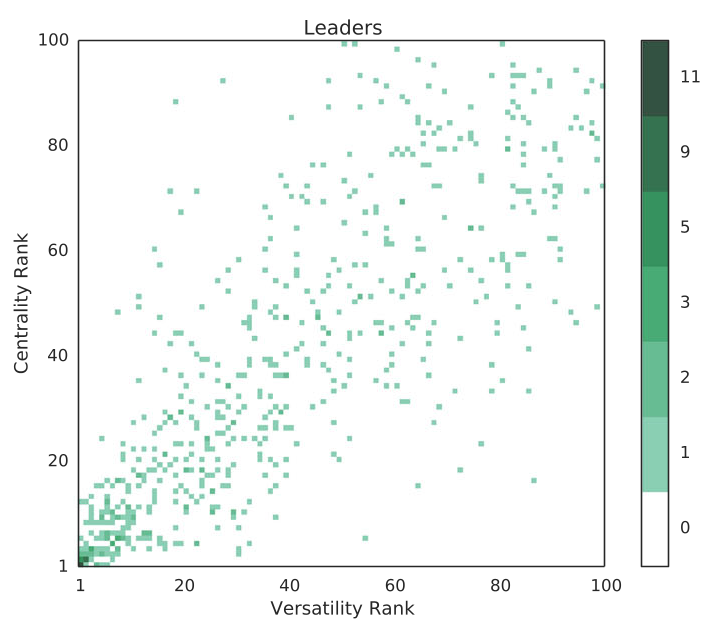
Diffusion Versatility outperformed Diffusion Centrality. The density map below shows that ranking leaders by "Versatility" reshuffles the deck—96% of nodes changed their ranking position compared to the old aggregation method.
2. The Dominance of Trust Layers
When the researchers "untangled" the layers, they found a striking disparity in predictive power ():
- Low Predictors: General house visits ().
- High Predictors: Money loans and Medical help ().
This suggests that microfinance diffusion is NOT a casual information spread; it is a trust-weighted process. If a leader is central in the "Medical Help" layer, they are significantly more effective at convincing others to join a financial scheme.
Critical Insight & Conclusion
The industry takeaway is profound: Context is king. If you are launching a product that requires a leap of faith (like a new bank or a vaccine), don't look for the most social butterflies (the "Visits" layer). Look for the "Versatile" individuals who occupy central roles in the Trust and Support layers of the community.
Limitations
While the multilayer approach is powerful, capturing this level of data requires intensive surveys (12+ detailed questions per household), which might not be scalable for large-scale urban interventions without the use of proxy data (like digital footprints).
Future Outlook
This work sets the stage for "Precision Intervention." By targeting nodes that are versatile across specific functional layers, we can maximize the ROI of social programs in emerging markets and beyond.