
Empowering the Pocket Server: Middleware for Modern Mobile Social Networks
Middleware for Social Networking on Mobile Devices
This paper presents a middleware solution for mobile social networking that enables smartphones to act as service hosts rather than simple clients. It leverages the Jini Surrogate Architecture to handle 3G network reachability and introduces an extensible context-aware framework for real-time social data dissemination.
TL;DR
This research tackles the challenge of turning smartphones into active service providers for social networks. By introducing a surrogate-based middleware, the authors solve the "reachability problem" of 3G networks and provide a scalable, context-aware framework that propagates user status and location without draining the device's battery.
Background & Motivation: Moving Beyond the Browser
In the late 2000s, social networking was synonymous with the desktop web (Facebook, Flickr). While smartphones were emerging, they were treated as passive clients. The authors argued that the rich sensors (GPS, cameras) and processing power of "pocket computers" were being wasted.
The core problem was infrastructure. Mobile Network Operators (MNOs) typically block incoming traffic to phones, making it impossible for a phone to host a service. Furthermore, social networking requires constant updates—a task that would rapidly exhaust a phone’s limited battery and data plan if handled through traditional polling.
Methodology: The Surrogate Architecture
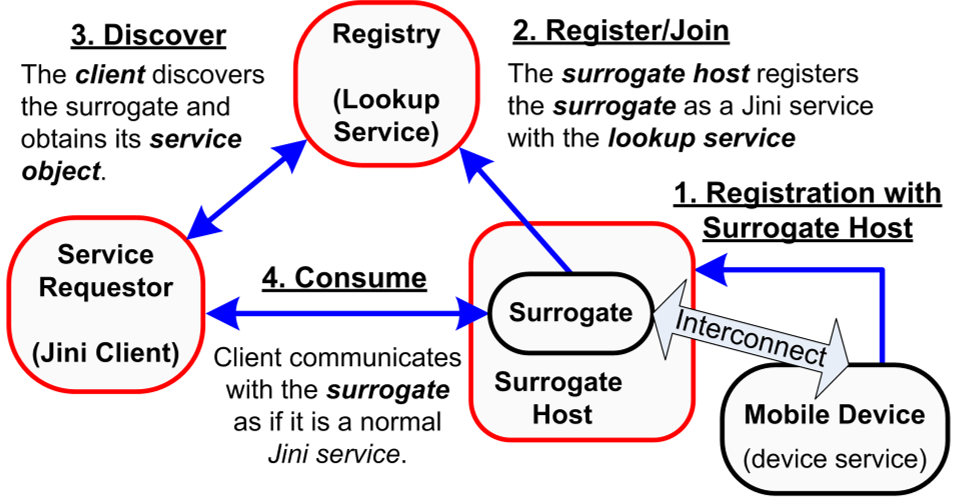
The center of the solution is the Jini Surrogate Architecture (JSA). Instead of a client talking directly to a phone, it talks to a Surrogate—a proxy running on a stable, high-bandwidth server (the Surrogate Host).
1. The Reachability Solution
The paper utilizes an HTTP-based interconnect. Because the phone initiates an outbound connection to the surrogate to send a "heartbeat," it bypasses MNO firewalls. The surrogate then "hitchhikes" client requests onto the return of that heartbeat.
2. Adaptive Heartbeat & Caching
To solve the trade-off between battery life and responsiveness, the authors implemented an Adaptive Heartbeat.
- High Activity: Heartbeat frequency increases (as low as 3s) for near-real-time updates.
- Low Activity: Frequency drops (up to 180s) to conserve power.
Caching allows the surrogate to serve frequent requests (like "Where is Bob?") without waking up Bob’s phone every time, significantly improving scalability.
3. Context-Aware Framework
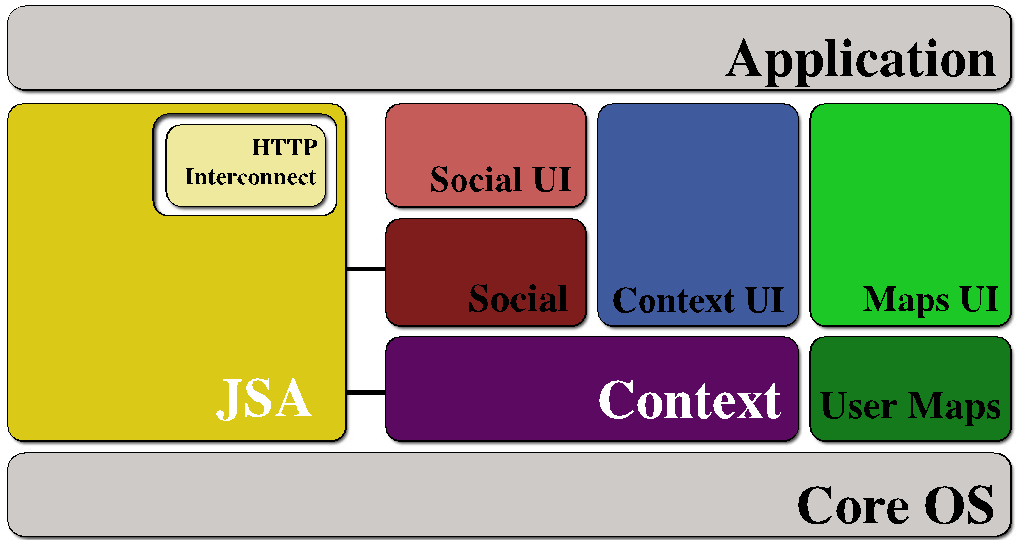
The middleware includes a layered framework to turn raw data into human-meaningful "Context Items":
- GPS Coordinates Street Addresses/Defined Regions (e.g., "At Home").
- Social Module: Connects the address book to surrogate discovery.
Performance & Validation
The evaluation proved that smartphones are poor standalone servers. A direct-hosted web server on an iPhone dropped 51% of requests at a moderate load. In contrast, the surrogate middleware thrived:
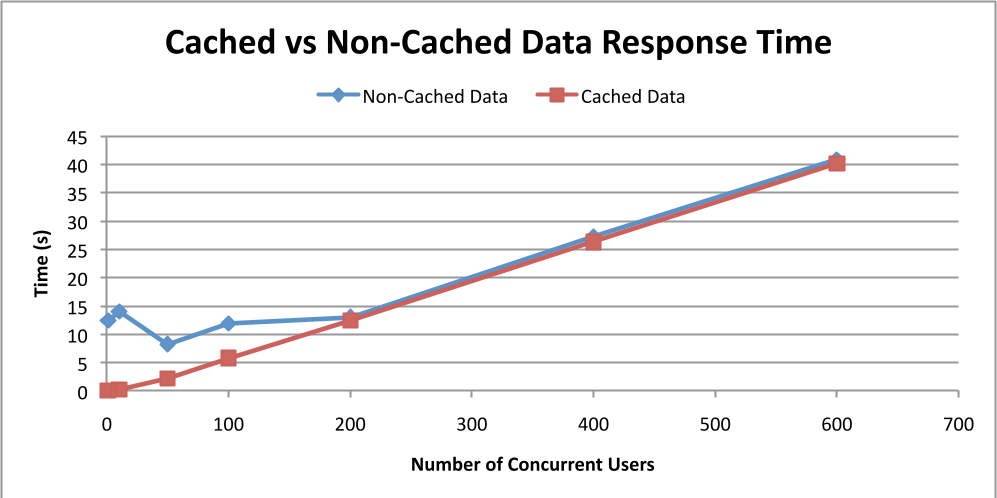
- Scalability: Caching reduced response times predictably for up to 200 concurrent users.
- Efficiency: For 600 users, the device only needed to be contacted once, saving 599 redundant transmissions.
Critical Insight: The Human Element
The user study revealed a vital technical requirement: Granular Privacy. Users didn't just want to share location; they wanted to share different versions of the truth. Some wanted to share "Room 303" with close friends, but only "Auckland" with others. Some even requested a "false location" feature—a reminder that in social networking, technical accuracy must sometimes yield to social utility.
Conclusion
This work highlights that the future of mobile social networking isn't just about better apps, but about a more intelligent "middle layer" that bridges the gap between the volatile mobile world and the stable fixed network. While 3G and the early iPhone era have passed, the principles of surrogate hosting and adaptive communication remain foundational in today's Edge Computing and IoT paradigms.