
Beyond Social Networks: Engineering the Mobile Social Ecosystem (MSE)
Middleware Support for Mobile Social Ecosystems
This paper proposes a middleware framework designed to support Mobile Social Ecosystems (MSEs), integrating contextual data with traditional social networking. It introduces a comprehensive semantic model using RDF to represent heterogeneous interactions—including agents, events, places, and content—enabling cross-application social data sharing in decentralized environments.
Executive Summary
TL;DR: This work moves beyond the narrow "friendship" focus of traditional social networks to introduce Mobile Social Ecosystems (MSE). By proposing a semantic-web-based middleware, the authors enable mobile devices to autonomously build, update, and exchange complex social data—including events, locations, and shared content—without relying on a central authority.
Background: Positioned in the early era of smartphone proliferation, this paper acts as a foundational blueprint for decentralized, context-aware social computing. It bridges the gap between static web-based social graphs and the messy, dynamic reality of human interactions in the physical world.
The Problem: The "Social Silo" and the Lack of Context
Current social giants like Facebook or LinkedIn operate as data silos. If you want to build a new app with social features, you are often forced to create an ad-hoc data representation, leading to redundancy.
More importantly, these platforms are "physically blind." They understand who your friends are, but they struggle to model:
- Proximity: Why can't my phone automatically suggest a meeting with someone nearby who shares my research interests?
- Transience: How do we model a "group" that only exists for a 2-hour conference breakout session?
- Heterogeneity: How do we link a LinkedIn profile, a PDF paper, and a physical conference room into a single queryable graph?
Methodology: The Semantic "First-Class" Model
The core innovation is a formal model built on RDF (Resource Description Framework). Instead of a simple "User-Friend-User" graph, the authors define five First-Class Entities:
- Agent: People or groups with intentions (BDI model).
- Event: Occurrences in space-time (e.g., a keynote talk).
- Place: Physical locations that act as social filters.
- Content: Information objects (e.g., a photo, a research paper).
- Topic: The glue that connects interests across all other entities.
Architecture Overview
The middleware acts as a layer between the OS and the Social App, managing the "MSE" by gathering data from sensors (proximity) and external APIs (LinkedIn).
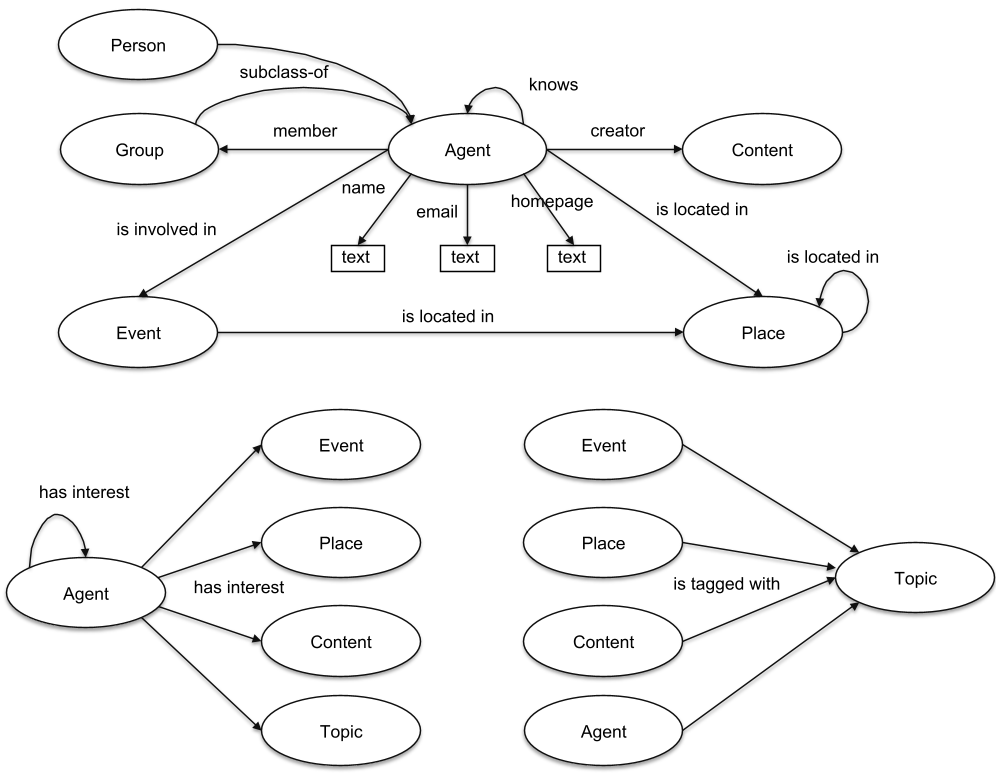 Figure 1: The core ontology schema allows for complex relationships such as "Agent Tags Content" or "Event Located in Place."
Applying the Model: The ECYR Scenario
To prove the model's versatility, the authors simulate a conference environment. Imagine two researchers, Animesh and Arun, meeting at a talk. By exchanging LinkedIn IDs and scanning the keywords of a co-authored paper, Animesh’s device can:
- Infer a shared interest in "Android OS."
- Create a dynamic discussion group on the fly.
- Invite colleagues (like Alessandra) who are at the same venue.
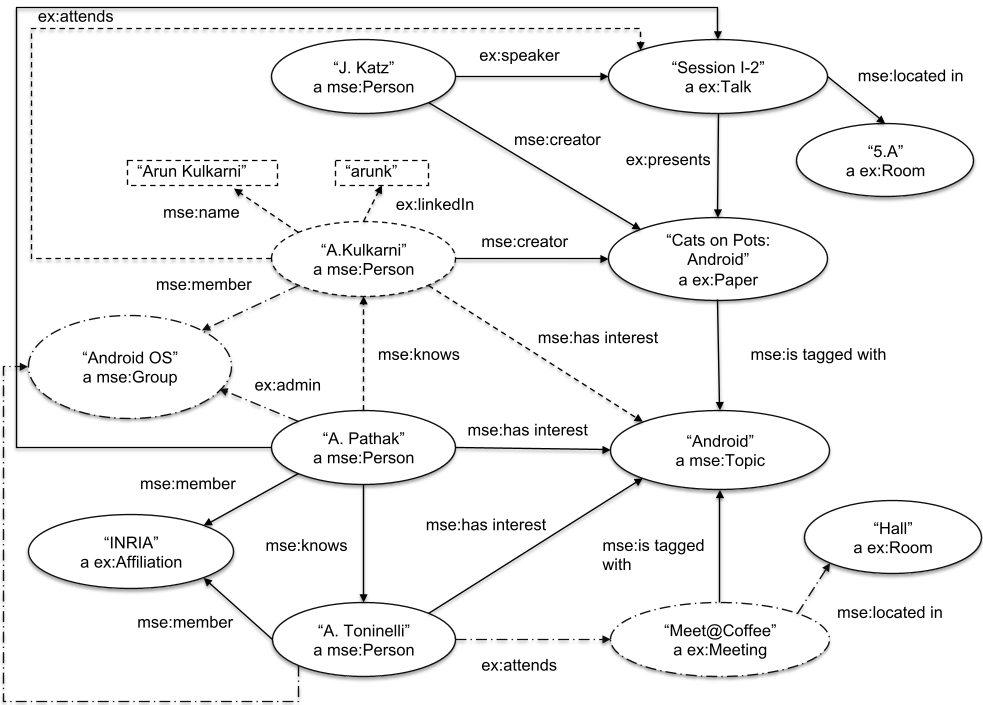 Figure 2: A visualization of the expanded social graph. Notice the mix of static pre-known data (solid lines) and dynamically acquired social knowledge (dashed lines).
Critical Analysis & Conclusion
Takeaway
The shift from "Social Networks" to "Social Ecosystems" is profound. By using Semantic Web standards, the authors provide a way for decentralized devices to "speak the same language" regarding human relationships, even if they have never encountered each other before.
Limitations
- Privacy vs. Utility: While the paper mentions access control, the sheer amount of data being shared (mobility traces, interests) presents a massive privacy target.
- Computational Overhead: Parsing RDF triples and performing reasoning on resource-constrained mobile devices (of the 2010 era) was a significant hurdle.
Future Outlook
This work pre-empted the current trend toward Local-First software and Decentralized Social (DeSo). As we move into an era of AR/VR (the Metaverse), the concept of "Physical Places as Social Filters" described here will become the primary way we interact with digital social layers.