
Balancing the Scales: Migration Cost-Sensitive Load Balancing in Community-Based Social Networks
Migration Cost-Sensitive Load Balancing for Social Networked Multiagent Systems with Communities
This paper introduces a net profit-based load balancing mechanism for Social Networked Multiagent Systems (SN-MASs) that accounts for migration costs and community structures. By categorizing agents as internal or boundary, the method optimizes both intra-community and inter-community task transfers to achieve global load fairness while minimizing overhead costs.
TL;DR
In large-scale social networked multiagent systems (SN-MASs), moving tasks from a busy agent to a free one isn't free—it consumes energy, bandwidth, or time. This paper proposes a Net Profit-based mechanism that balances the "gain" in fairness against the "loss" in migration cost. By specifically empowering boundary agents to manage inter-community task flows, the system reaches global equilibrium faster and with significantly less overhead than traditional greedy methods.
Deep Dive into the Motivation
Why do we need a new load balancing model? Most existing SOTA literature treats task migration as a "black box" where the only goal is to equalize the queue lengths of agents. However, real-world systems like transportation networks or distributed grids face two major hurdles:
- Heterogeneous Migration Costs: Sending a package across town (intra-community) is cheaper than sending it to another city (inter-community).
- Local vs. Global Fairness: Agents often only see their immediate neighbors. Without a specialized strategy for those sitting on the "borders" of communities, a system can get stuck in a state where one community is starving while another is drowning in tasks, simply because the agents between them didn't see the "profit" in an expensive inter-community move.
Methodology: The Net Profit Framework
The core innovation lies in the definition of Net Profit: Where is the benefit (improvement in utilization standard deviation) and is the migration cost.
1. Internal vs. Boundary Agents
The paper makes a critical distinction in social positioning:
- Internal Agents: Only interact with peers within the same community. Their logic is simple: move tasks if it helps local fairness and the cost is low.
- Boundary Agents: These are the "bridges." They maintain dual identities. They estimate the average load of their entire community to decide if they should push tasks across community lines.
2. The Decision Logic
Boundary agents follow a two-step hierarchy:
- Inter-community Balancing: If my community is overloaded compared to the neighboring communities I can see, I export tasks to them (even if the cost is high).
- Intra-community Balancing: Once the community-level flow is settled, I balance tasks with my immediate local neighbors.
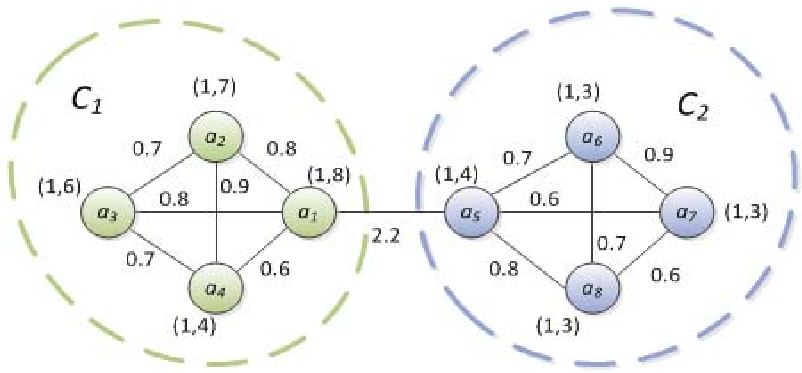 Figure 1: A community-aware social network where edge weights represent different migration costs.
Experiments and Results
The authors tested their approach against three classic baselines: Random, Greedy, and Probabilistic models.
Key Findings:
- Global Fairness: While greedy models perform well initially, they plateau because they get stuck in "local islands" of load fairness. The proposed model eventually reaches a higher benefit ().
- Cost Efficiency: This is where the model shines. By ignoring migrations with negative net profit, it avoids unnecessary "churn."
- Convergence: Paradoxically, being more "selective" about moves leads to faster global stability because boundary agents effectively direct the "macro-flow" of tasks.
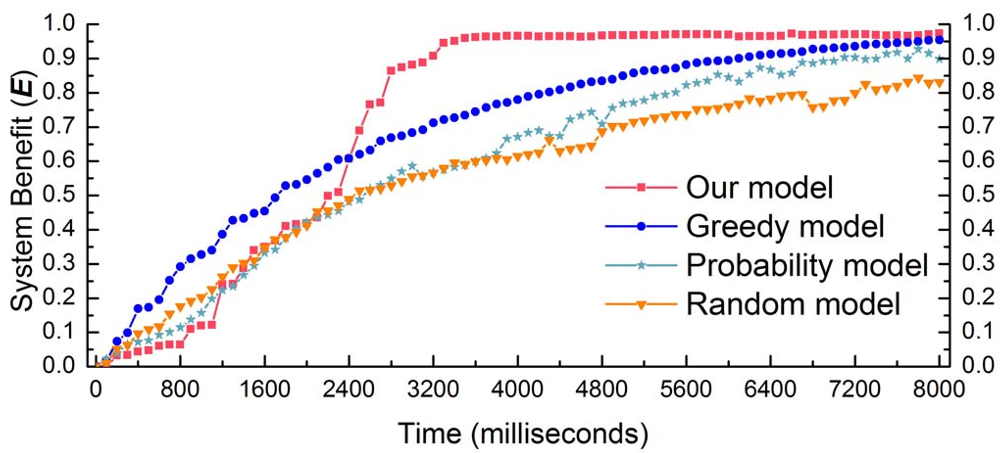 Figure 2: System benefit over time. Note the superior convergence of the community-aware model in the later stages.
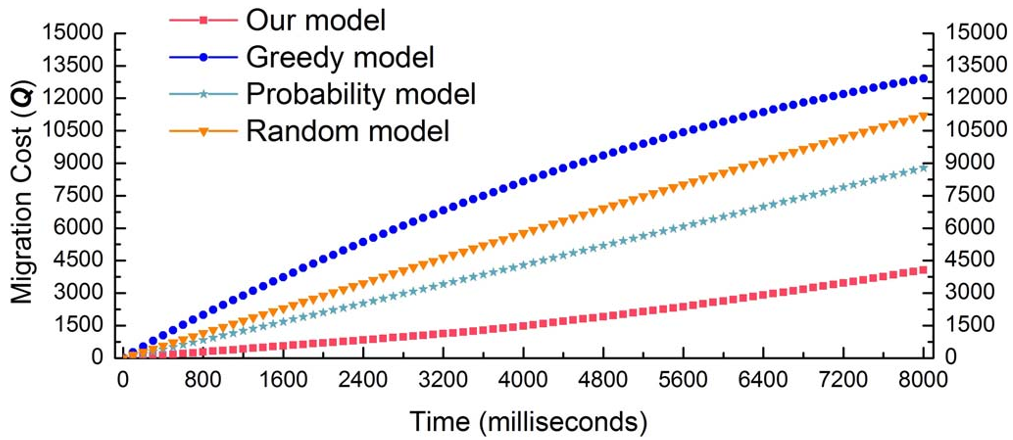 Figure 3: Total migration cost. The proposed net-profit model (red) stays significantly lower than cost-ignorant baselines.
Critical Insight & Conclusion
The "Takeaway" for system architects is clear: Fairness is not free. In decentralized systems, agents must behave like economic actors. By treating task migration as a trade with a cost and a profit, we prevent the "ping-pongs" of tasks that plague simpler load balancers.
Limitations: The current model assumes tasks are independent. In reality, tasks often have dependencies (e.g., Task B needs Task A's output), which creates a secondary "communication load." The authors acknowledge this as the next frontier for "Communication-Aware Load Balancing."