
Millionaire: Empowering Crowdsourcing with Hint-Guided Game Theory
Millionaire: a hint-guided approach for crowdsourcing
The paper introduces "Millionaire," a novel hint-guided crowdsourcing approach inspired by the "Guess-with-Hints" strategy from game shows. It utilizes a hybrid-stage setting and a unique multiplicative payment mechanism to obtain high-quality labels while effectively detecting high-quality workers on platforms like Amazon Mechanical Turk.
TL;DR
To solve the chronic "quality vs. quantity" trade-off in crowdsourcing, researchers have introduced Millionaire, a framework that allows workers to request hints when uncertain. By applying a mathematically proven multiplicative payment mechanism, the system ensures workers only use hints when necessary, allowing the platform to maintain high data volume while simultaneously identifying top-tier experts.
The "Assistance Dilemma" in Crowdsourcing
Modern AI requires massive datasets, but crowdsourcing platforms like Amazon Mechanical Turk (AMT) often suffer from two extremes:
- Noise: Spammers or non-experts provide "best guess" labels that degrade model performance.
- Sparsity: "Skip-based" mechanisms encourage workers to skip hard tasks, leaving the most difficult (and often most important) data unlabelled.
The authors identify a missing middle ground: Guided Assistance. Why force a worker to guess or skip when a small "hint" could provide the necessary context to ensure accuracy?
Methodology: The Hybrid-Stage Framework
The core of this work is the Hybrid-Stage Setting. Unlike standard tasks, Millionaire adds a special button: ? & Hints.
1. The Stages
- Main Stage: The worker sees the task (e.g., "Is this the Sydney Harbour Bridge?"). If confident, they answer directly.
- Hint Stage: If uncertain, the worker clicks the hint button. They receive a concise, discriminative hint (e.g., "Look for concrete pylons") and then provide an answer.
2. The Incentive Mechanism (The "Why" it works)
If hints were free, everyone would use them to maximize accuracy. To prevent this, the authors designed a Hint-Guided Payment Mechanism.
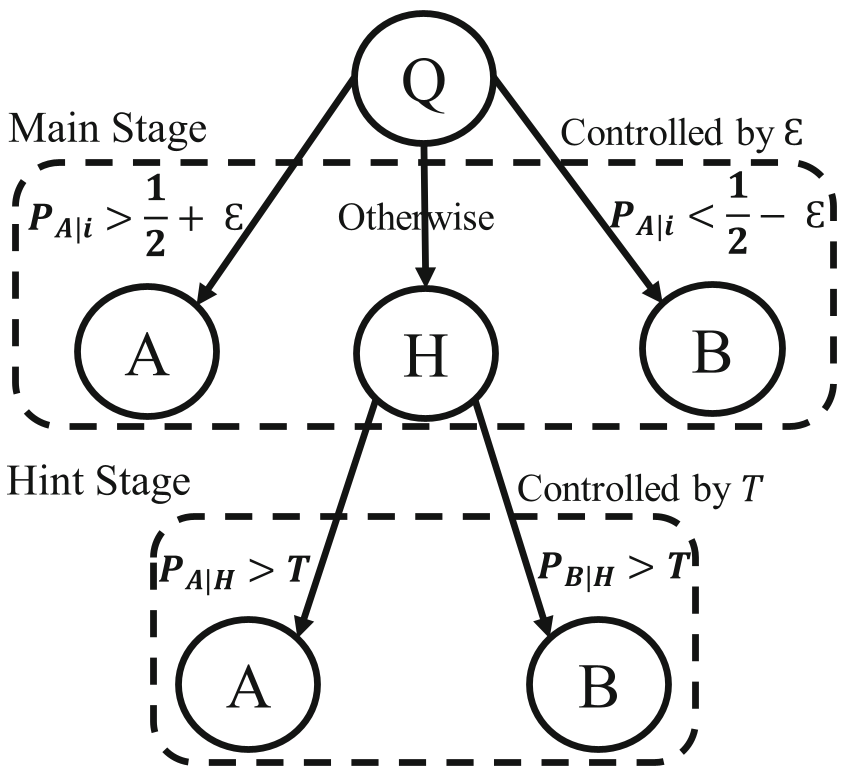 Figure: The decision logic where ε (uncertainty) and T (belief threshold) dictate the transition between stages.
The Mathematical Intuition: The payment follows a multiplicative form: . Crucially, the reward for a correct answer with a hint () is strictly less than a correct answer without a hint (). This creates a "cost" for information, forcing workers to rely on their own expertise unless they are truly stumped.
Experimental Proof: Measuring Quality and Detection
The team tested this on three distinct datasets: binary image classification (Sydney Bridge), multi-class classification (Stanford Dogs), and subjective speech recognition.
Key Findings:
- Quantity: In the "Speech Clips" task, the skip-based method only achieved 30% completion. Millionaire reached 75%.
- Expert Identification: Because the system tracks who uses hints, it can "rank" workers. By giving more weight to workers who rarely needed hints (experts), the final aggregated label error dropped significantly.
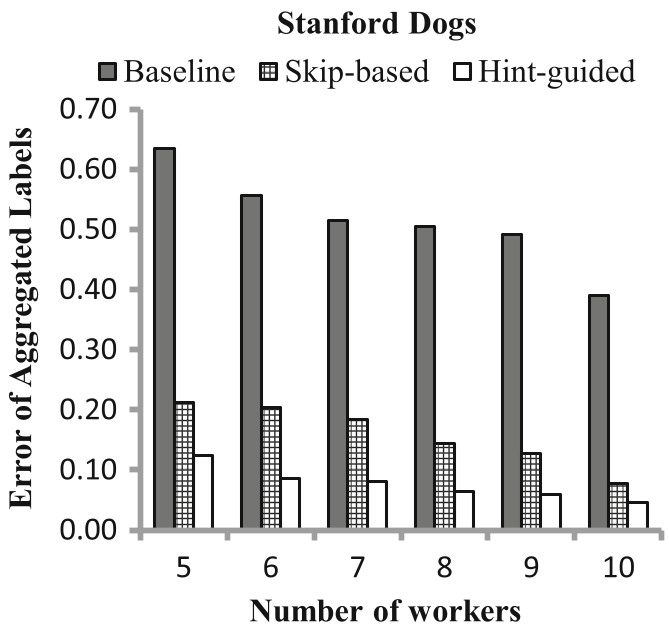 Figure: Millionaire (Hint-guided) consistently maintains lower error rates across varying numbers of workers compared to traditional baselines.
Critical Insight: Beyond Simple Labelling
The true value of this paper isn't just "better labels"—it's Worker Quality Detection. In traditional crowdsourcing, a correct answer from a lucky guesser looks identical to an answer from an expert. By introducing the "Hint" as a variable, the authors have turned the task interface into a diagnostic tool.
Limitations & Future Work
While robust, the approach requires "Gold Standard" questions (tasks with known answers) to calibrate payments. Furthermore, the designer must manually create hints. Future iterations could leverage LLMs to generate these hints dynamically, potentially scaling this to even more complex domains like legal or medical document labelling.
Conclusion
Millionaire proves that human-centric design, when paired with rigorous Game Theory, can solve the fundamental bottleneck of data collection. By treating workers as agents with varying confidence levels, we can build more efficient, "honest" marketplaces for human intelligence.