
Benchmarking the "Small World": Understanding Path Length Bounds in Sociomatrices
Minimal and maximal characteristic path lengths in connected sociomatrices
This paper establishes rigorous upper and lower bounds for the characteristic path length () in connected, undirected, and unweighted sociomatrices with fixed nodes () and lines (). It introduces the "Clique plus Path" (CPP) graph as a local maximum for average path length and proves that the lower bound is achieved by star-like structures, effectively framing the "Small World" phenomenon within precise mathematical benchmarks.
TL;DR
In the study of social networks, we often talk about "degrees of separation." But is a path length of 5 "short" or "long" for a network of 100 people? This paper provides the mathematical "yardsticks" for this question. By defining the Star (minimum distance) and Clique plus Path (maximum distance) structures, the authors provide tight bounds for average path lengths in any connected graph with nodes and edges.
Background: The Benchmark Problem
In the popular "Small World" literature, random graphs are often used as a baseline. However, random graphs are just one type of structure. To truly understand a network, we need to know the absolute physical limits: What is the shortest possible average distance for a given density? And what is the longest?
The Methodology: Archetypes of Distance
The authors move away from complex asymptotic limits to focus on constructive proofs—actually building the graphs that represent the "best" and "worst" cases.
1. The Lower Bound: The Efficiency of the Star
The shortest average path length is achieved by a structure similar to a Star graph. In such a network, most nodes are just a few hops away from everyone else.
- The Formula: , where is the network density.
- Intuition: As you add edges (increasing ), the average distance drops linearly until it reaches 1 (a complete clique).
2. The Upper Bound: The "Clique plus Path" (CPP)
To maximize distance, you want to "waste" edges. The most effective way to do this is to cram as many edges as possible into a single tight cluster (a Clique) and then attach the remaining nodes in a long, inefficient Path.
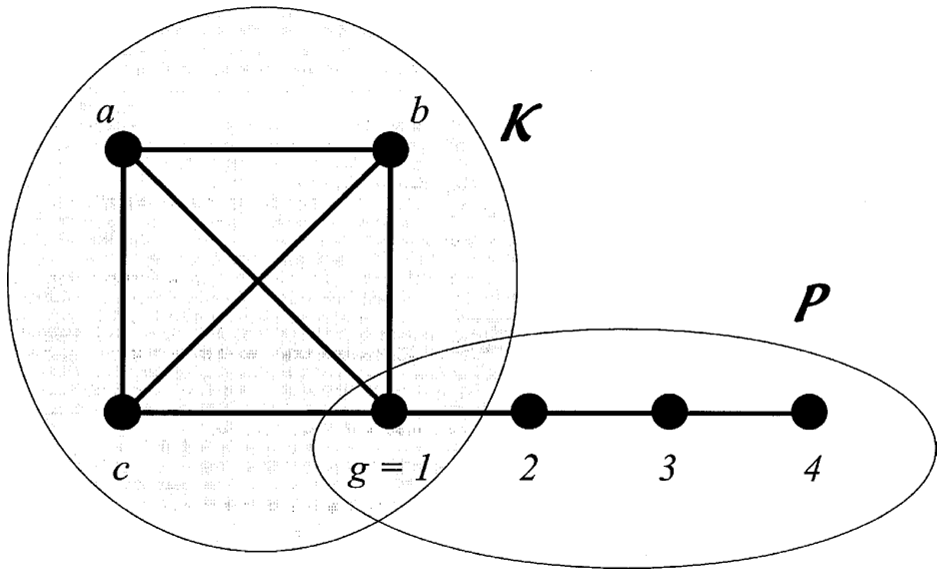 Figure 1: A CPP(7,4) graph. Note how the "Gatekeeper" node connects the dense clique to the long, stringy path.
The authors prove that you cannot increase the average distance of this graph by moving a single edge (a "one-line local maximum").
Experimental Insights: Are Long Paths Rare?
The authors conducted millions of simulations to see where random graphs fall between these two bounds.
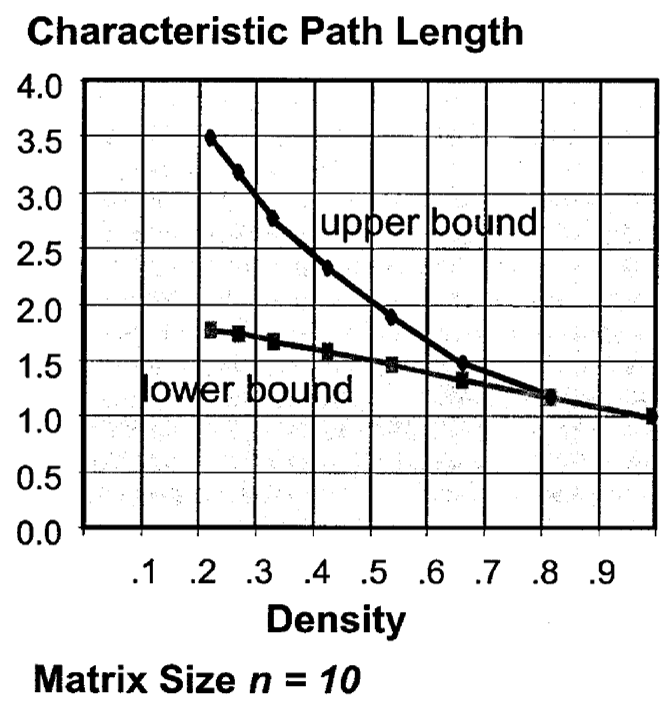 Figure 2: The gap between upper and lower bounds closes as density increases, but for large networks, the range remains significant.
Key Findings:
- Randomness favors efficiency: As the number of nodes () grows, random graphs almost always end up near the lower bound.
- The "Invisibility" of Maxima: Creating a network with a maximum average path length (the upper bound) is statistically nearly impossible through random connections. It requires deliberate, suboptimal engineering (like building a long chain).
Critical Analysis
This paper is a cornerstone for structural analysis because it provides exact benchmarks rather than approximations.
- Strength: The CPP construction is intuitive and the closed-form formula for (the sum of distances) is highly practical for researchers.
- Limitation: The upper bound is a "local" maximum for one-line redeployment. While never refuted in millions of trials, it lacks a universal global proof for all possible edge rearrangements.
- Future Reach: These bounds are vital for identifying "anomalous" networks. If a real-world social network has a path length near the CPP bound, it suggests a highly fragmented or hierarchical organization that inhibits information flow.
Conclusion
Next time you measure a network's average path length, don't just compare it to a random graph. Use the limit to see how close it is to perfect efficiency, and the CPP formula to see how far it is from total gridlock.