
Beyond Reach: Why Cost Structures Shape the Future of Legal AI Workflows
On minimizing cost in legal document review workflows
This paper introduces a formal cost-minimization framework for Technology-Assisted Review (TAR) in legal discovery. It proposes a novel "cost dynamics" analysis to evaluate one-phase vs. two-phase Active Learning workflows, demonstrating that cost structure—not just algorithm efficiency—dictates the optimal strategy.
TL;DR
In the high-stakes world of legal eDiscovery, the debate between "One-Phase" (Continuous) and "Two-Phase" Technology-Assisted Review (TAR) has been fierce. This paper moves the needle by proving that the optimal workflow isn't just about the AI model—it's about the money. By modeling asymmetric costs (e.g., expensive senior partners vs. cheaper contract reviewers), the authors demonstrate that the "superiority" of any TAR method depends entirely on the economic and data landscape of the case.
The "One-Phase" vs. "Two-Phase" Controversy
For years, the legal tech industry has debated "TAR 1.0" (Two-Phase: train once, then cull) versus "TAR 2.0" (One-Phase: Continuous Active Learning). Proponents of One-Phase workflows often claim they are inherently more efficient. However, this paper argues that this claim ignores the reality of Cost Asymmetry:
- Phase Asymmetry: Training data often requires senior associates (up to 40/hr).
- Document Asymmetry: Finding a "positive" (relevant) document often triggers a secondary, expensive "privilege review," making it costlier than a "negative" document.
Methodology: The Cost Dynamics Model
The authors define a mathematical framework to account for these variables. The total cost is represented as a function of the number of positive/negative documents reviewed in each phase:
The Cost Dynamics Graph
To visualize this, the authors created Cost Dynamics Graphs. These plots show the "Total Shaded Area" (cumulative cost) across iterations. The goal is to find the iteration (x-axis) that minimizes the vertical height.
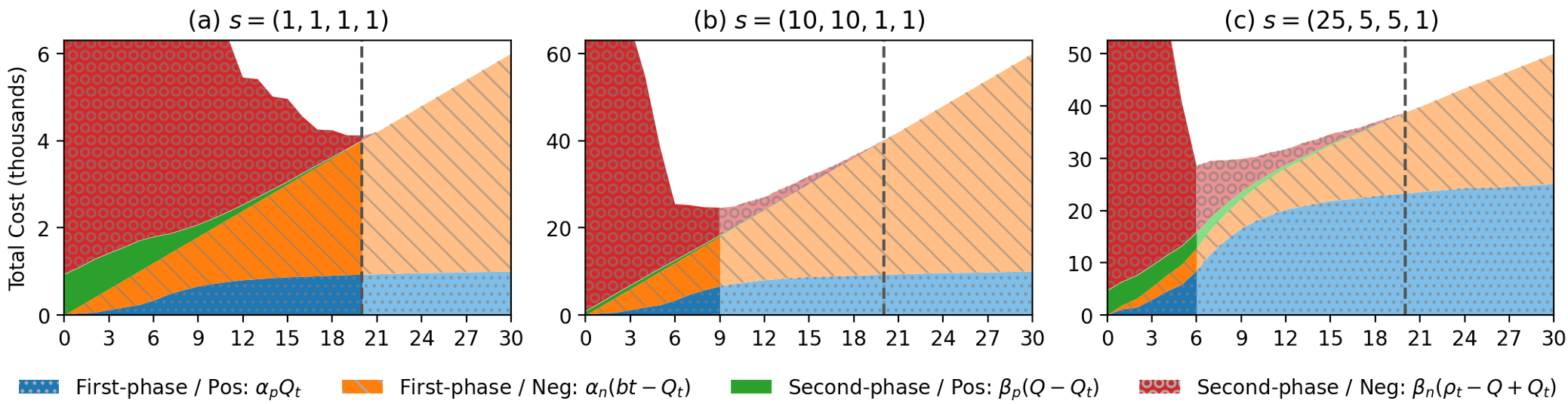 In (a) Uniform costs favor one-phase (stopping late). In (b) Expensive training favors two-phase (stopping early).
Key Insights: When to Use Which Strategy?
Through extensive simulations on the RCV1-v2 dataset, the study provides a roadmap for strategy selection:
- Uniform Costs? Use Relevance Feedback (One-Phase). If every review hour costs the same, staying in a continuous loop is generally optimal because the model keeps improving as you work.
- Expensive Training? Switch to Two-Phase. If your "teachers" are expensive, stop training early. The cost of a slightly less accurate model is offset by the lower hourly rate of the "students" (bulk reviewers) in phase two.
- Hard & Common Categories? Use Uncertainty Sampling. When documents are plentiful but the topic is difficult, Uncertainty Sampling (finding the "boundary" documents) pays off by creating a much better classifier that pays for itself during bulk review.
- Easy & Rare Categories? Exploitation Wins. Don't waste time on uncertainty. Use Relevance Feedback to find the few needles in the haystack quickly.
Experimental Evidence
The results in Table 2 highlight that a two-phase uncertainty workflow can lead to a ~40-46% cost reduction in scenarios where training is 10x more expensive than review.
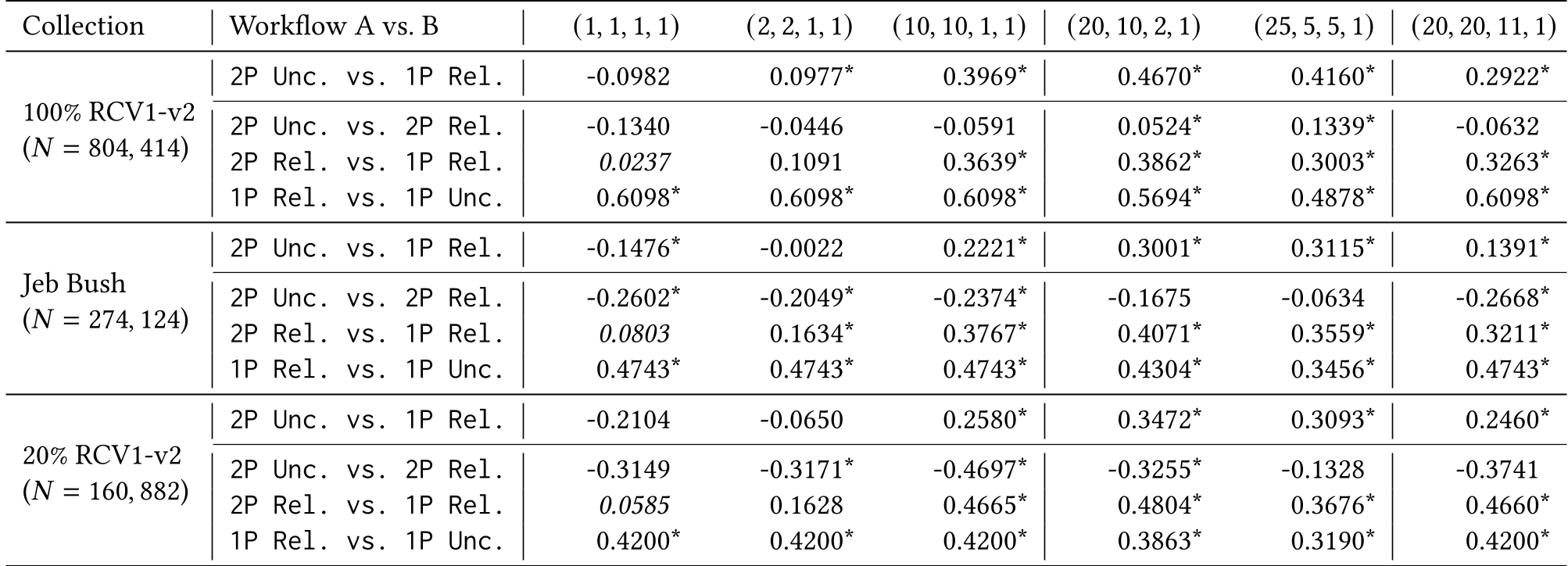 Table 2: Relative cost reduction of different workflows across various cost structures.
Critical Analysis: The Stopping Rule Challenge
Perhaps the most profound insight is the "Stopping Rule Problem." In an expensive training scenario, the window for "near-optimal" cost is extremely narrow. If you stop training too early or too late, costs skyrocket. This puts immense pressure on a system's "stopping algorithm" to be precise, especially when the task is difficult.
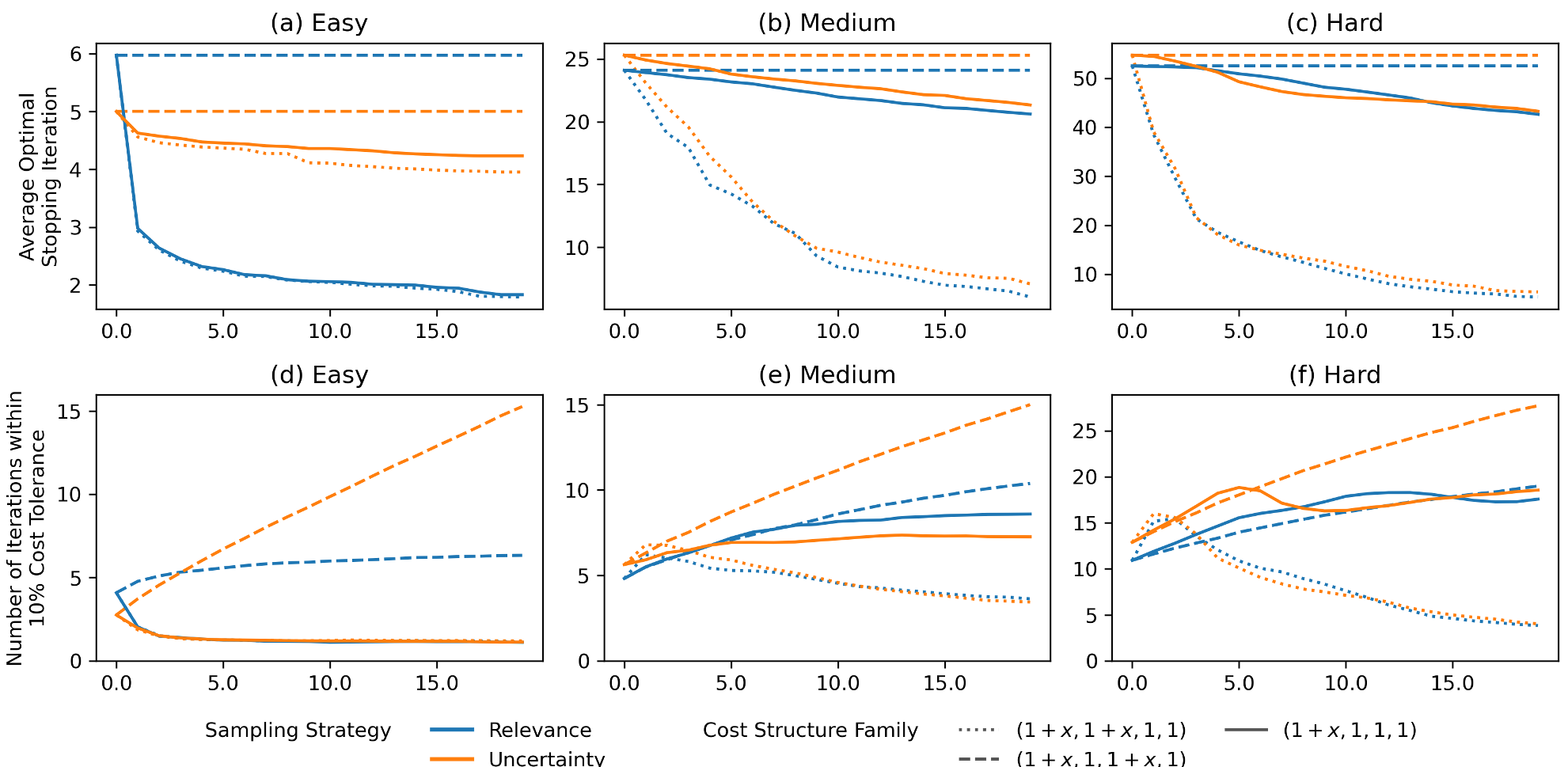 The top row shows how the optimal stopping point shifts as training becomes more expensive (x-axis).
Conclusion
This paper serves as a vital bridge between theoretical Active Learning and the pragmatic economics of the legal industry. It debunks the myth of a single "best" TAR workflow. For researchers, it highlights that Active Learning efficacy cannot be measured by F1-score or Recall alone—it must be measured by the total cost to achieve a target Recall under realistic financial constraints.