
Harmonizing Virtual and Physical Spaces: Low-Latency VR Socializing via Smart Bandwidth Allocation
Minimizing Latency to Support VR Social Interactions Over Wireless Cellular Systems via Bandwidth Allocation
This paper proposes a latency minimization framework for VR social interactions over wireless cellular systems using Mobile Edge Computing (MEC). It introduces a bandwidth allocation strategy that accounts for the discrepancy between virtual and physical topologies, achieving up to 25.1% latency reduction compared to equal allocation baselines.
TL;DR
To enable seamless VR social interactions, this paper tackles the challenge of synchronous latency. By recognizing that users in the same virtual community may be connected to different physical base stations, the authors propose a bandwidth allocation strategy that compensates for backhaul delays, reducing end-to-end latency by up to 25.1%.
Problem & Motivation: The Geometry Discrepancy
In a typical mobile environment, resources are allocated based on physical proximity. However, in a VR Social Network, the "community" is virtual.
The bottleneck arises when User A and User B are high-fiving in a virtual world but are physically miles apart, served by different Base Stations (BS). To synchronize their states, data must travel through the backhaul network, adding significant delay. Since the VR experience is only as fast as its slowest participant (the "worst-case latency"), these "cross-type" users dictate the quality for everyone.
Methodology: The Core Mechanism
The authors model the end-to-end latency as a sum of three components:
- Upload (Uplink): Worst-case delay among all community members, including HARQ retransmissions and backhaul.
- Compute: Server processing time at the Edge.
- Download (Downlink): Multicasting the updated state back to users.
Architecture Insight
The unique insight here is the Joint Optimization of Uplink and Downlink. While downlink utilizes efficient multicasting, the uplink is the primary hurdle due to its unicast nature.
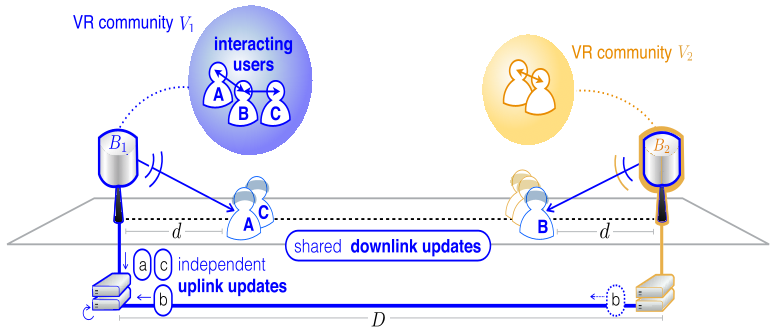
The optimization problem is solved using a Stochastic Approximation method. Because the uplink delay involves max functions over random variables (HARQ attempts and Gamma-distributed backhaul delays), it is non-differentiable. The authors use a Projected Subgradient Method to iteratively find the optimal bandwidth that balances the needs of local versus cross-type users.
Experiments & Results
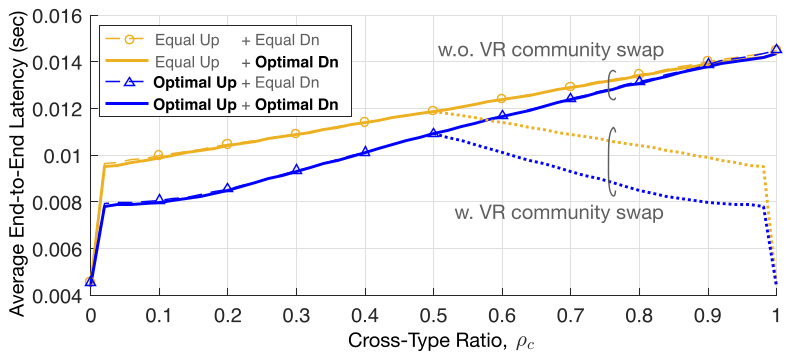
The study defines as the ratio of "cross-type" users. When (half the users are remote), the gap between the proposed optimal allocation and standard "Equal Allocation" is most prominent.
Key Findings:
- Latency Reduction: Up to 25.1% improvement over baseline.
- Uplink Priority: The end-to-end latency is dominated by the uplink. Interestingly, optimizing the downlink provides marginal gains compared to the critical impact of uplink bandwidth management for the "slowest" user.
- Computing Placement: For high values (), the authors found it is actually better to "swap" servers, highlighting that computing resource placement is just as vital as bandwidth.
Critical Analysis & Conclusion
Takeaway
The paper effectively demonstrates that "Fairness" in bandwidth (giving everyone the same amount) is actually "Unfair" in VR. To achieve a synchronized experience, the network must give more resources to those facing the most difficult physical conditions (e.g., those requiring backhaul).
Limitations & Future Work
- Static Users: The current model assumes fixed distances (). In reality, user mobility will cause to fluctuate rapidly.
- One-Dimensional Model: While the linear topology provides clear insights, 3D urban environments with interference will require more complex interference management.
- Future Path: Integrating Service Migration—where the computing task moves between base stations as users move—could further minimize the backhaul penalty.
This work serves as a foundational step toward "Social-Aware" networking, where the logical connections of the Metaverse dictate the physical resource distribution of our 5G and 6G infrastructures.