
MMD-SC: Solving the "Waiting Forever" Problem in Spatial Crowdsourcing
Minimizing Maximum Delay of Task Assignment in Spatial Crowdsourcing
The paper introduces the Minimizing Maximum Delay Spatial Crowdsourcing (MMD-SC) problem, focusing on optimizing the worst-case individual experience in dynamic environments. It proposes a novel Hierarchically well-Separated Tree (HST) based randomized algorithm that achieves a competitive ratio of O(log n), significantly outperforming traditional greedy approaches in worst-case scenarios.
TL;DR
In the world of Uber and DoorDash, platforms usually care about total efficiency. But for the user who waits 40 minutes for a 5-minute ride, the platform has failed. This paper introduces the MMD-SC problem, shifting the focus from "average performance" to "minimizing the maximum delay." By using HST-based space embedding and a clever hold-and-release buffer strategy, the authors provide a solution that prevents users from being stuck in the "worst-case" tail of the distribution.
The "Average" Trap in Crowdsourcing
Most spatial crowdsourcing research focuses on Min-Sum (total cost) or Max-Matching (total throughput). However, these metrics are blind to the "outlier" experience. If a platform minimizes total travel time but leaves one requester waiting for an hour, that user is likely to delete the app.
The problem is particularly hard because it is two-sided online:
- Workers appear and disappear dynamically.
- Request locations and timestamps are unknown until they happen.
- The delay is a sum of wait time (since the request was posted) and travel time (for the worker to arrive).
Methodology: High-Level Intuition
The authors argue that deterministic greedy algorithms are logically limited. A simple greedy choice might match a worker to a nearby task now, only to realize a much better worker appeared 2 seconds later, or that the matched worker was the only one capable of reaching a far-away task that just popped up.
1. HST Space Embedding
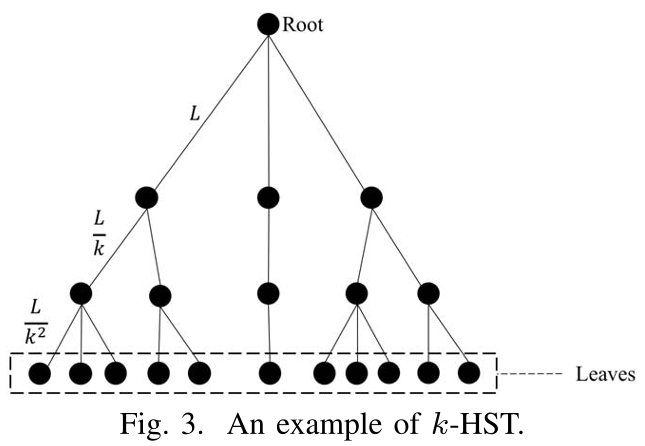
To manage the complexity of real-world maps (metric spaces), the authors embed the environment into a Hierarchically well-Separated Tree (HST). This mathematical structure groups locations into clusters:
- Leaves represent actual locations.
- Internal nodes represent the distance (travel cost) between clusters.
2. The "Hold" Mechanism (The Secret Sauce)
Instead of immediate matching, the algorithm uses a HOLD procedure. When a request arrives, it "virtually" reserves the best available worker but starts a countdown timer.
- If a better worker appears before the timer hits zero, the request swaps the reservation to the better worker.
- This prevents "haste makes waste" and ensures that early requests get the best possible candidates without locking them into suboptimal matches too early.
Performance & Experiments
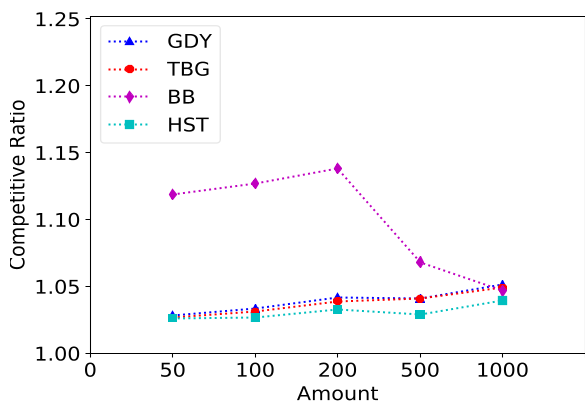
The team tested their approach against Batch-Based and Threshold-Greedy methods.
Key takeaways from the results:
- Competitive Ratio: The HST method maintained a stable competitive ratio (close to 1.1 - 1.2 on average), meaning it was very close to the optimal offline solution.
- Density Robustness: Unlike simple greedy methods, the HST approach doesn't fall apart when the density of workers vs. tasks changes.
- Real-World Application: On NYC taxi data, the HST algorithm consistently leveled out the "maximum wait time," proving it could make car-hailing services more reliable for suburban or remote users.
Critical Analysis & Conclusion
This paper is a significant contribution to fairness and quality of service in crowdsourcing. By moving the goalposts from "efficiency" to "reliability," it addresses the primary reason for user dissatisfaction.
Limitations:
- The HST construction has a time complexity of , which might be slow for massive city-scale grids without the preprocessing techniques mentioned (like grid merging).
- The algorithm assumes we can estimate a reasonable "maximum delay" threshold from historical data to fine-tune the k-HST parameters.
Future Outlook: The "Hold and Release" logic is a powerful primitive. We could see this being integrated into Reinforcement Learning agents that manage fleet logistics, where the agent learns how long to "hold" a worker based on predicted future arrivals.