
Strategizing Containment: Minimizing Negative Influence via Optimal Link Blocking
Minimizing the Negative Influence by Blocking Links in Social Networks
This paper addresses the "Negative Influence Minimization" problem, aimed at curbing the spread of rumors or infections in social networks by blocking a limited budget of links. The authors propose a Greedy algorithm with a theoretical approximation guarantee alongside two efficient heuristics (Betweenness and Out-degree) to solve this combinatorial optimization challenge under the Independent Cascade (IC) model.
TL;DR
In the fight against digital rumors and viral infections, removing users (nodes) is often too drastic. This paper explores link blocking—a surgical approach to isolate "patient zeros." By proving that the reduction in influence spread follows submodular properties, the authors demonstrate that a Greedy algorithm can achieve a near-optimal reduction in contamination, while simpler heuristics based on network centrality offer massive speedups for real-world deployment.
Context & Motivation: Why Links Matter More Than Nodes
Historically, network immunization focused on removing nodes (e.g., banning users or vaccinating individuals). However, the authors argue that link removal is more fundamental. Blocking a link represents a more subtle intervention—such as unfollowing a source or filtering a specific communication channel—without deleting the entity itself.
The real challenge arises when an infection is already underway. If a set of nodes is already compromised, how do we choose exactly links to sever to protect the rest of the graph? This is the Negative Influence Minimization Problem.
Methodology: The Math of Containment
The authors utilize the Independent Cascade (IC) Model, where an infected node attempts to infect its neighbors with a probability .
1. The Greedy Strategy
The core contribution is the definition of the Decreasing Spread Function : This function measures how many infections we "save" by blocking the set of links . The authors prove that this function is monotone and submodular.
- Why does this matter? Submodularity is the "diminishing returns" property. It guarantees that a simple Greedy algorithm—choosing the best link one by one—will achieve at least of the optimal possible containment.
2. Heuristic Alternatives
Since Greedy selection requires many simulations (Monte Carlo) to estimate spread, it is slow. The authors propose:
- Betweenness Scoring: Targets links that act as bridges (shortest paths) between the infected set and the healthy set.
- Out-degree Scoring: Targets links leading to "super-spreaders" (nodes with many outgoing connections).
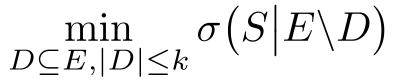 The optimization objective: Minimize the expected infection area by choosing a subset of edges D.
Experimental Insights
The team tested their approach on Facebook (4k nodes) and Diggers (8k nodes) datasets with propagation probabilities of and .
Effectiveness vs. Efficiency
The results reveal a classic engineering trade-off:
- Effectiveness: The Greedy algorithm consistently outperformed others. In the Diggers network, it reduced the reach of the "rumor" from 118 nodes to 80.
- Efficiency: As shown in the benchmarking figures, the Out-degree and Betweenness heuristics are orders of magnitude faster. While Greedy might take minutes or hours for large sets, heuristics provide an answer in seconds.
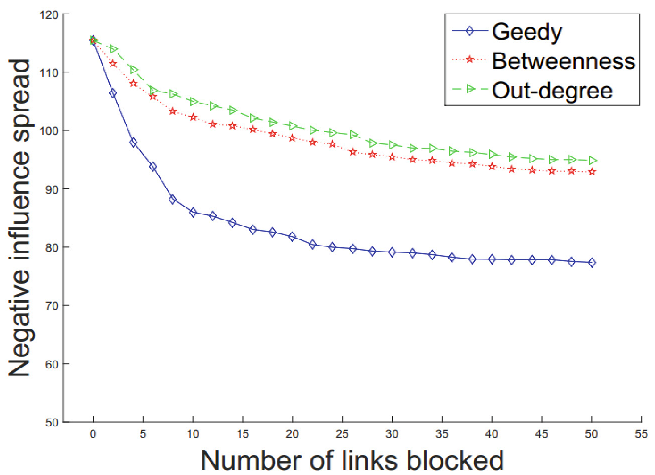 Comparison of Greedy vs. Heuristics. Note the superior containment of the Greedy approach across different probabilities.
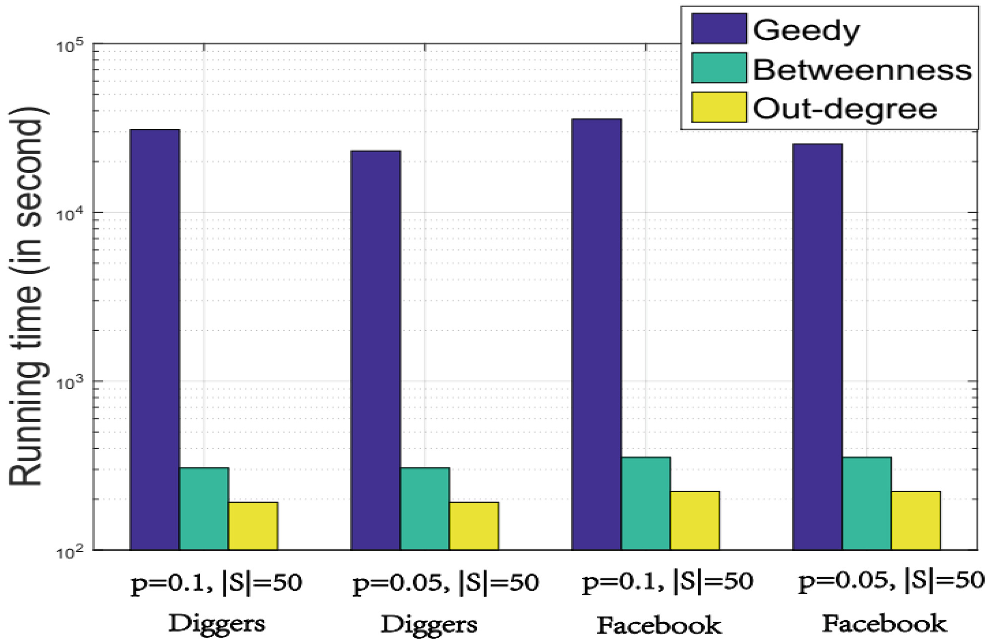 The runtime gap: Greedy selection is computationally expensive compared to structural heuristics.
Critical Analysis & Takeaways
The brilliance of this work lies in providing a theoretical floor for link-blocking performance. By proving submodularity, the authors move the problem from "guesswork" to "guaranteed approximation."
Limitations:
- Network Density: The authors admit the performance is less impressive in dense networks, where too many alternative paths exist for the "infection" to bypass blocked links.
- Static Topology: The model assumes the network doesn't change during the spread, which isn't true for modern social media.
Future Outlook: This research encourages a shift toward link-based moderation in social platforms. Instead of de-platforming (node removal), algorithms could identify and "shadow-block" specific high-influence edges to maximize social hygiene while maintaining network connectivity.