
Graph OLAP: A Multidimensional Shield Against Negative Social Influence
Minimizing Negative Influence in Social Networks A Graph OLAP Based Approach
This paper introduces a novel multidimensional Graph OLAP framework specifically designed for minimizing negative influence in social networks. By integrating context-aware dimensions such as subject, time, influence degree, and user opinion, the approach systematically identifies and blocks malicious links to curb the spread of misinformation or negative sentiment.
TL;DR
Social influence is not a monolithic force; it is deeply contextual, shifting with the topic of conversation and the sentiment of the participants. This paper proposes a Graph OLAP (Online Analytical Processing) framework that filters social networks through dimensions of time, subject, and opinion. By identifying "suspicious" links—those with high influence and strong negative sentiment—the authors provide a scalable method to minimize the spread of negative influence without the prohibitive computational costs of traditional greedy algorithms.
The "Context Gap" in Current Social Defense
Most research into social influence focuses on the "Positive" side—how to make a product go viral. When researchers do look at "Negative" influence (like rumors or misinformation), they often treat it as a structural problem: identify the most central nodes and block them.
However, the authors point out three fatal flaws in this approach:
- Computational Bottleneck: Greedy algorithms are accurate but painfully slow, requiring multiple passes over the entire network.
- Subject Blindness: You might be influential in "Politics" but ignored in "Gardening." Existing models often ignore the topic.
- Opinion Ignorance: High influence is only dangerous if the opinion expressed is negative. An influential person spreading positivity is an asset, not a threat.
Methodology: The Multidimensional Cube
The core innovation is the application of Graph OLAP to influence analysis. Instead of a flat graph, the network is viewed as a collection of snapshots filtered by specific attributes.
1. Learning the Weights (ETL Phase)
The framework calculates two primary metrics for every interaction:
- Influence Degree (): Based on action logs, measuring how often user follows user 's lead on subject at time .
- Opinion Value (): Using the Wilson Lexicon, the system performs sentiment analysis on the text of messages. A value of -1 indicates strong negativity, while +1 is strongly positive.
2. The OLAP Construction
The system builds a "Graph Cube" where users can "drill down" or "roll up" to see different sub-graphs.
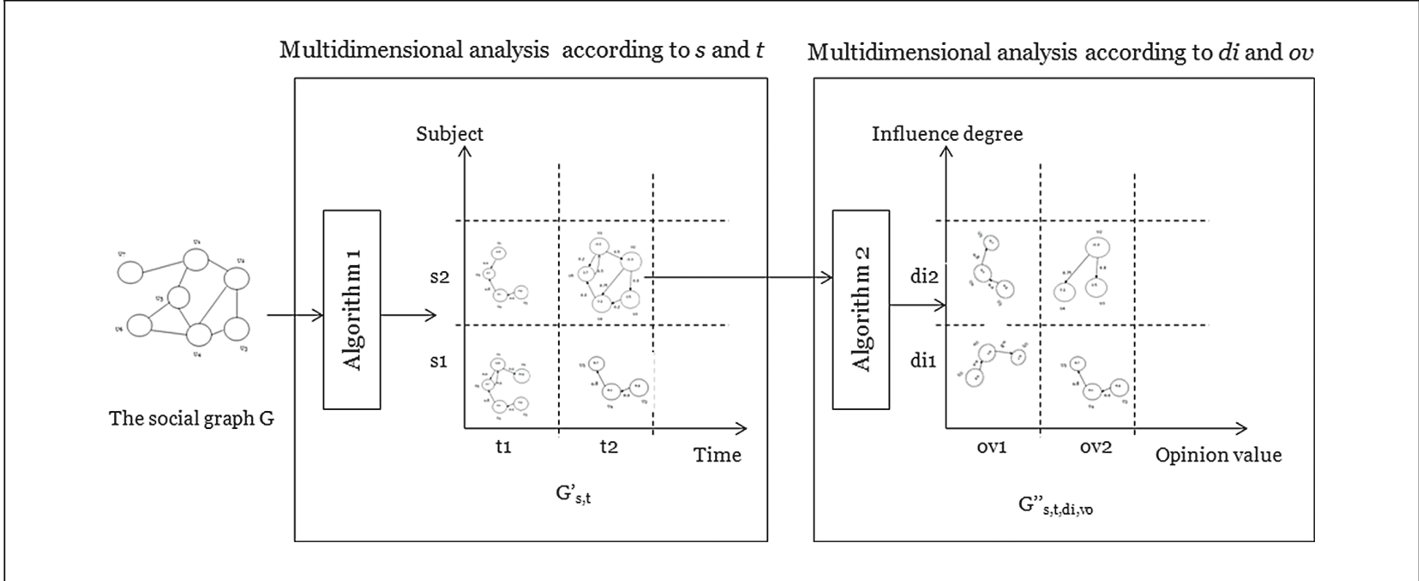 Figure 1: The two-step process of extracting influence graphs based on subject/time, then filtering by degree/opinion.
Application: Minimizing Negative Influence
Instead of blindly blocking high-degree nodes, the algorithm targets arcs where the source has a high influence and a low (negative) opinion.
Algorithm 3 iteratively selects these "suspicious" arcs () and blocks them until the global network influence rises above a safe threshold (). This approach is surgical: it blocks specific relationships rather than deleting users, preserving the healthy parts of the network.
Experimental Validation
The authors tested their approach on a significant synthetic dataset (1.62M arcs). The results validated that their multidimensional approach provides a superior balance between speed and precision.
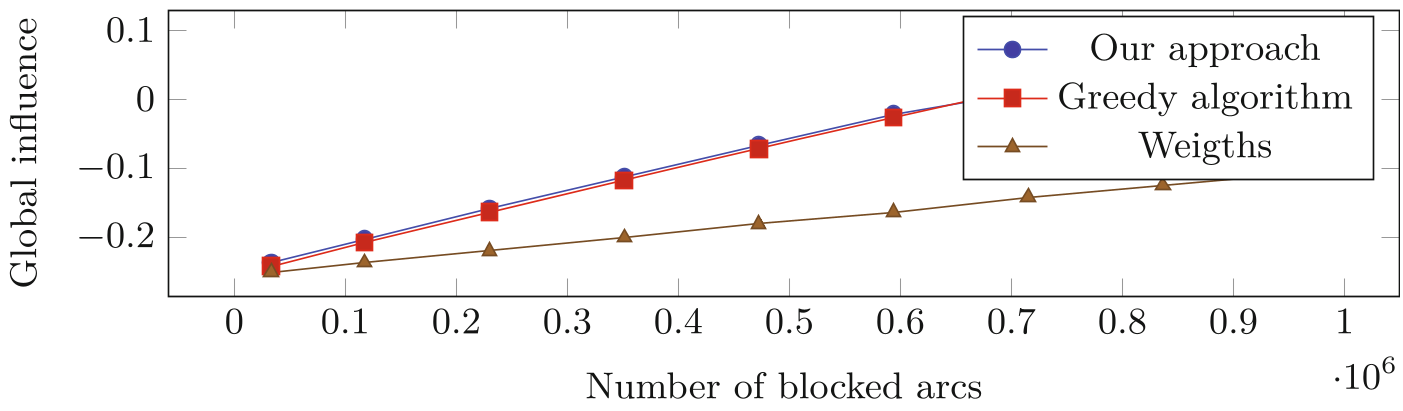 Figure 2: The global influence recovery. The Graph OLAP approach matches the effectiveness of the Greedy algorithm but reaches the goal in fewer iterations by guiding the search through dimensions.
Key findings from the experiments:
- Speed: Unlike greedy algorithms that browse the whole graph times, the OLAP approach guides selection, significantly reducing processing time.
- Precision: By considering Opinion Value, it avoids the "over-blocking" seen in traditional Weight-based centrality measures, which might silence influential but positive users.
Critical Insight & Future Outlook
This work represents a shift from topological analysis to semantic-aware graph mining. The real-world value lies in its flexibility—platforms could use this to dampen "toxicity spikes" around specific controversial topics without shutting down general discourse.
Limitations: Currently, the "learning" phase for opinion and influence (the ETL process) needs further optimization for massive, real-time datasets (e.g., Twitter or TikTok). Future work involving distributed storage and roll-up/drill-down operations will be essential to making this a production-ready tool for social media moderators.
Conclusion
By treating a social network as a multidimensional data warehouse rather than a static map, the authors have demonstrated that we can fight "digital contagion" more efficiently. The integration of NLP with Graph Theory remains one of the most promising frontiers for building safer online ecosystems.