
Strategies for Rumor Containment: Why Simple Centrality Isn't Enough
Minimizing Influence of Rumors by Blockers on Social Networks: Algorithms and Analysis
The paper introduces the Minimizing Influence of Rumors (MIR) problem, a task aimed at selecting a limited set of "blocker" nodes to minimize the total activation probability of other users under the Independent Cascade (IC) model. The authors propose a two-stage heuristic algorithm (GCSSB) for general networks and a dynamic programming approach for tree networks that guarantees an optimal solution.
TL;DR
In an era of viral misinformation, blocking rumors requires more than just picking "popular" nodes. This paper formalizes the Minimizing Influence of Rumors (MIR) problem under the Independent Cascade model. The authors demonstrate that the problem is theoretically challenging due to non-submodularity and propose a two-stage algorithm (GCSSB) that outperforms standard heuristics like PageRank and Betweenness Centrality.
The Motivation: The "Non-Submodularity" Hurdle
Most viral marketing problems rely on "Submodularity"—a property of diminishing returns that makes greedy algorithms highly effective (providing a approximation).
However, the authors prove that when your goal is to block influence by removing nodes, the benefit of adding a blocker can actually increase depending on which other blockers are present. This mathematical shift means that the standard greedy approaches used for Influence Maximization might fail to find good solutions in rumor containment.
Methodology: GCSSB and DP on Trees
1. The General Case: GCSSB
To navigate the complex search space of general networks, the authors propose a two-stage strategy:
- Stage 1 (Generating Candidate Set): Instead of calculating the marginal gain for every node (which is computationally expensive), they use an adjacency matrix power series () to approximate the spreading potential and filter the top candidates.
- Stage 2 (Selecting Blockers): A greedy selection based on the true marginal gain of activation probability is performed on this restricted candidate set.
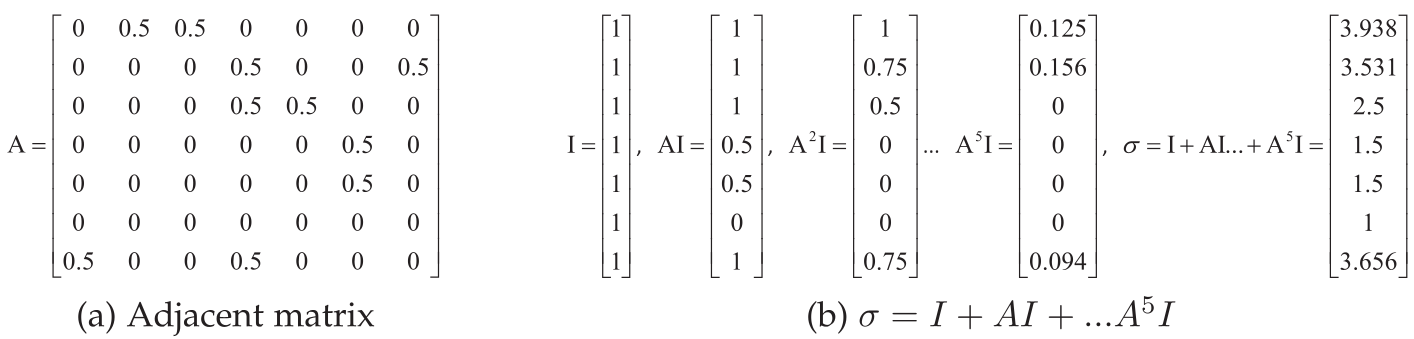 Figure: The iterative process of selecting the node with the maximum marginal gain from the candidate set.
2. The Optimal Case: Trees
On tree networks, the authors prove that the problem can be solved optimally. By converting a general tree into a Binary Tree (adding "phantom" nodes where necessary), they apply a Dynamic Programming recurring relation:
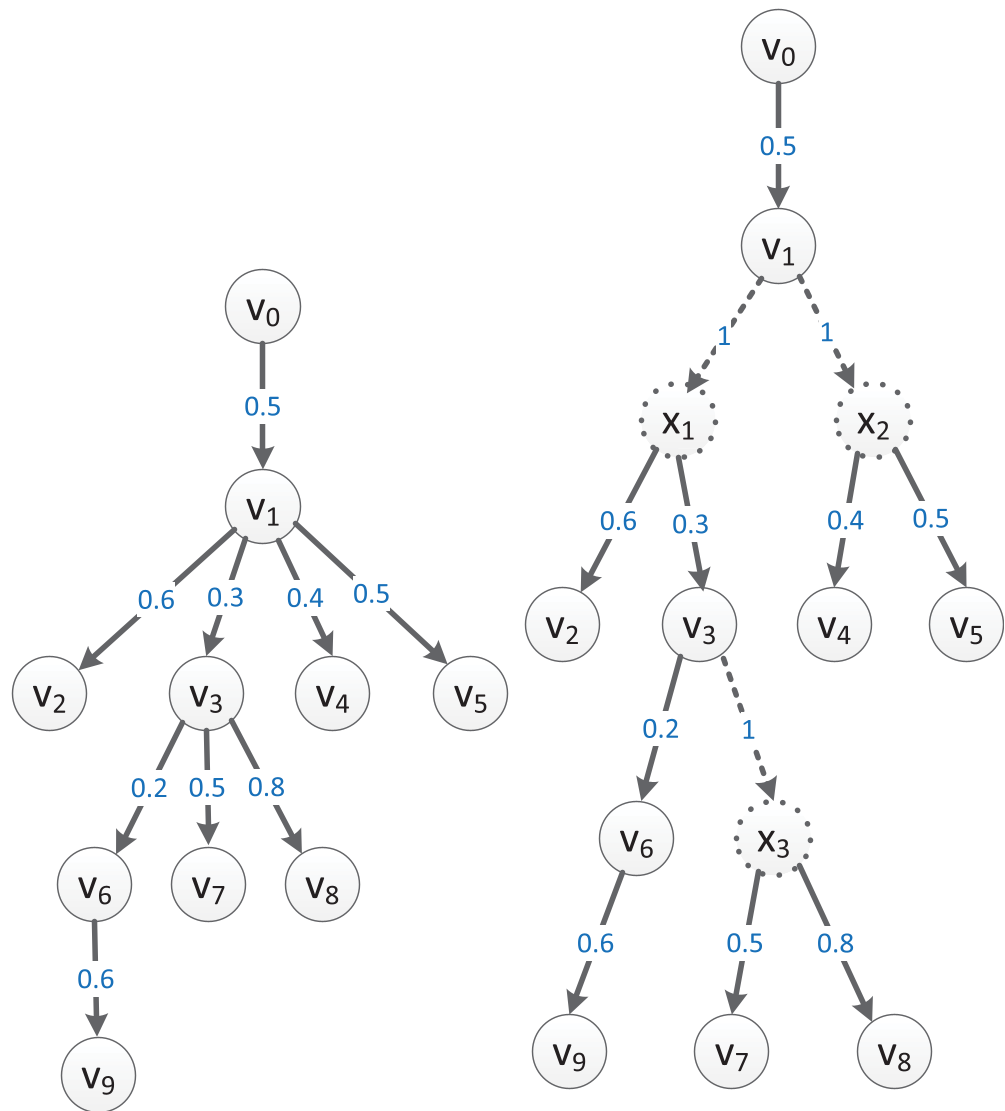 Figure: Transformation of a general social hierarchy into a binary tree to facilitate DP optimization.
Experimental Evidence
The authors tested their approach against common network metrics. The results were clear: algorithms that only look at graph structure (Out-degree, Betweenness) fail to capture the probabilistic nature of rumor spreading.
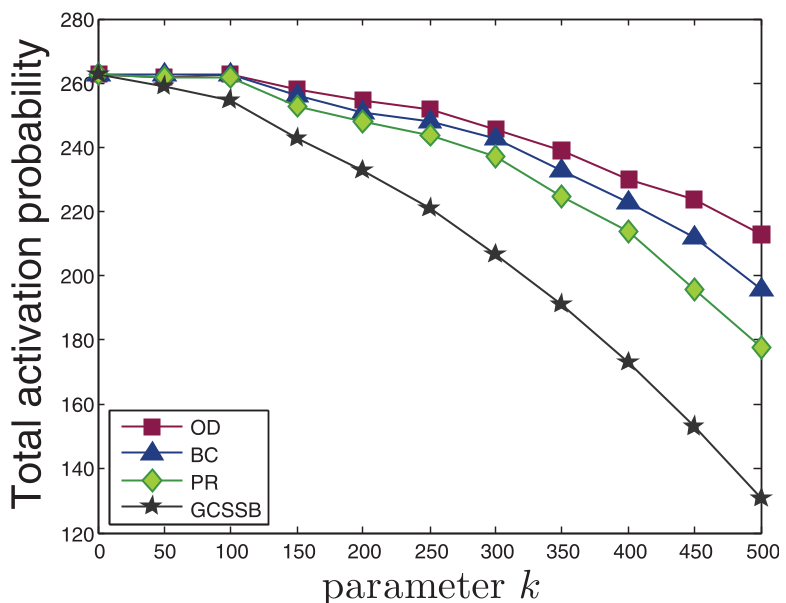 Figure: Comparison of GCSSB against PageRank (PR), Betweenness (BC), and Out-Degree (OD). GCSSB (red line) consistently maintains the lowest rumor activation probability.
Key Findings:
- Budget Impact: As the number of blockers () increases, the rumor influence drops, but the most significant gains happen early on.
- Algorithm Efficiency: By using the candidate set (Parameter ), the authors reduced the greedy search time significantly without sacrificing the quality of the solution.
- Optimal DP: On synthetic trees, the DP algorithm showed a sharp "elbow" in the curve, identifying exactly how many blockers are needed to "seal off" the rumor source.
Critical Analysis & Conclusion
The core contribution of this paper is the rigorous proof of the non-submodularity of the MIR problem, which serves as a warning to researchers using standard greedy tools. While the DP approach is limited to trees (which social networks are rarely), it provides a valuable theoretical baseline.
Current Limitations: The Independent Cascade (IC) model assumes we know the exact propagation probabilities between users—a metric that is notoriously difficult to estimate in real-world environments.
Future Outlook: Future research could extend this logic to "Competing Cascades," where positive truth and negative rumors race across the network simultaneously.