
GCSSB & DP: Orchestrating the Defense Against Viral Rumors in Social Networks
Minimizing Influence of Rumors by Blockers on Social Networks: Algorithms and Analysis
This paper introduces the Minimizing Influence of Rumors (MIR) problem, which aims to select a set of 'blocker' nodes to minimize the total activation probability of rumors under the Independent Cascade (IC) model. The authors propose a two-stage heuristic (GCSSB) for general networks and a Dynamic Programming (DP) approach that achieves optimality for tree-structured networks.
TL;DR
Online rumors can cause catastrophic real-world consequences. This research tackles the Minimizing Influence of Rumors (MIR) problem by identifying a set of "blocker" nodes to be removed from the network to minimize the spread. The authors prove the problem is non-submodular under the Independent Cascade (IC) model and provide a two-stage heuristic for general graphs and an optimal Dynamic Programming solution for trees.
The Core Conflict: Why Rumor Blocking is Hard
Traditional Influence Maximization (IM) often relies on the property of submodularity (the law of diminishing returns), which allows simple greedy algorithms to achieve a approximation.
However, the authors demonstrate that the MIR objective function—minimizing the total activation probability—is monotone decreasing but non-submodular. In plain English: the benefit of adding a blocker can actually increase depending on which other blockers are already present. This lack of submodularity breaks standard greedy guarantees, necessitating more sophisticated specialized strategies.
Methodology: The Two-Stage and DP Approaches
1. General Networks: The GCSSB Strategy
To handle large-scale social networks where exhaustive search is impossible, the authors propose GCSSB (Generating Candidate Set and Selecting Blockers):
- Pre-filtering (GCS stage): Instead of running expensive simulations on all nodes, they use an adjacency matrix power series (up to length ) to estimate each node's "spreading power" and filter down to a candidate set .
- Marginal Gain (SB stage): They then iteratively select nodes from this restricted set that provide the maximum marginal decrease in rumor activation probability.
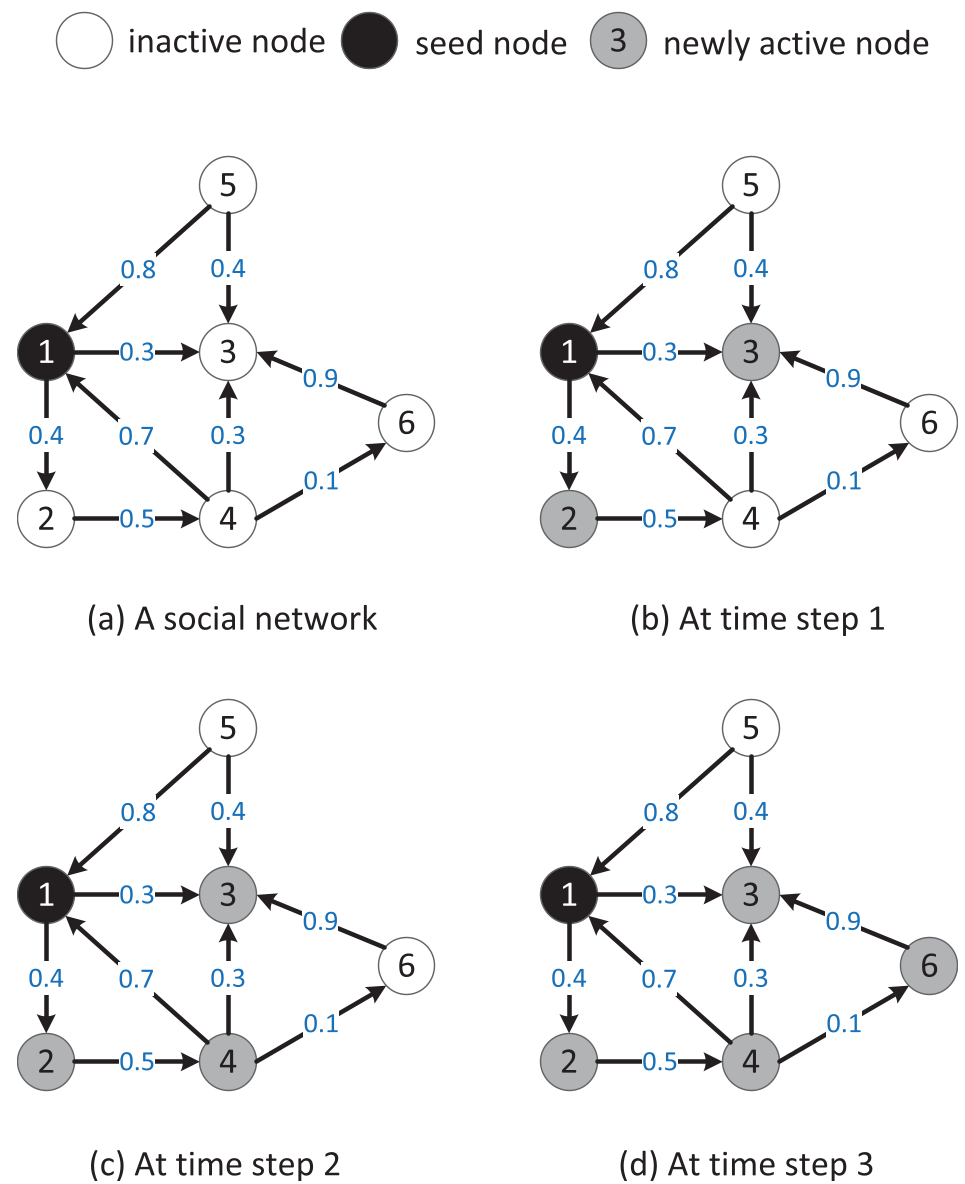 Figure 1: Illustration of the Independent Cascade (IC) process where rumors propagate from seed nodes through directed edges with specific probabilities.
2. Tree Networks: Achieving Optimality
The authors make a brilliant observation: while MIR is hard on general graphs, it can be solved optimally on trees.
- Tree Transformation: They convert any general tree into a binary tree by adding "dummy/dashed" nodes with propagation probability 1. This standardizes the recursion.
- Dynamic Programming: By defining the state as , they recursively decide whether to block a root node or allocate the budget across its children.
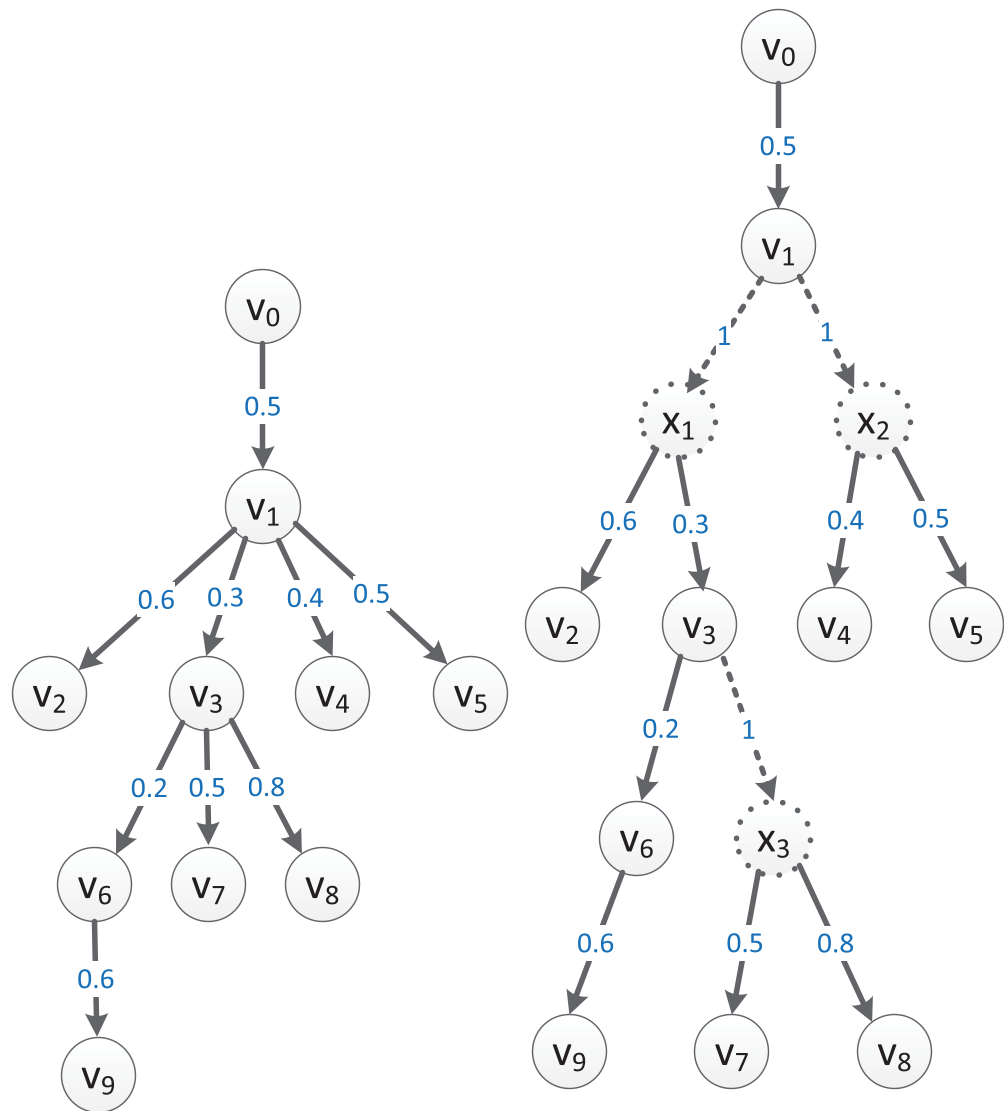 Figure 2: The process of converting a multi-child general tree into a binary tree for recursive DP optimization.
Experimental Validation
The authors tested their algorithms against three heavyweights: Out-Degree, Betweenness Centrality, and PageRank.
- Performance: Across Google+, Twitter, and Wiki-Vote datasets, the GCSSB method consistently outperformed others. Interestingly, PageRank was the strongest baseline, while Out-Degree performed poorly, suggesting that where a node is in the global structure matters more than how many immediate neighbors it has.
- Scalability: The pre-filtering stage (parameter ) showed that once the candidate set reaches a certain size (e.g., ), the performance stabilizes, proving that we only need to look at a small fraction of influential nodes to achieve near-optimal blocking.
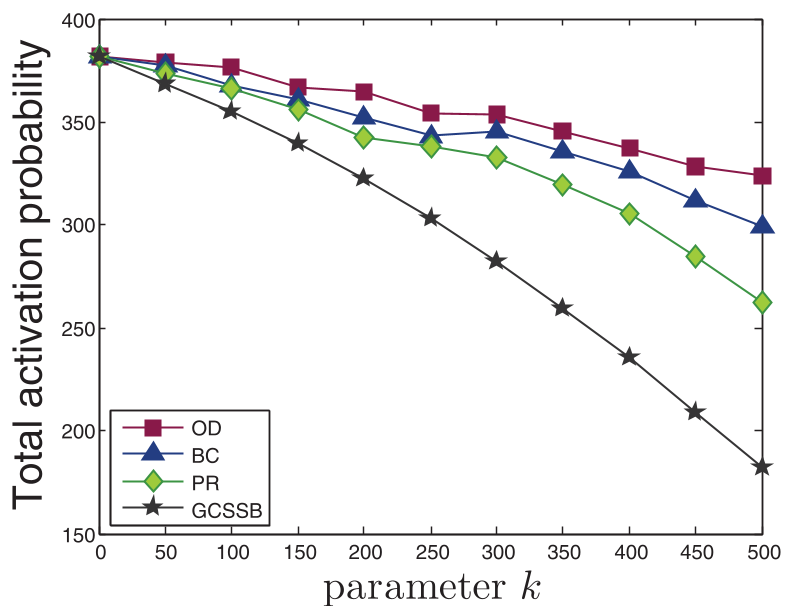 Figure 3: Total activation probability vs. Blocker set size (k). GCSSB shows a steeper decline in rumor influence compared to other heuristics.
Critical Insight & Conclusion
The most valuable takeaway from this work is the rejection of local-only metrics. Simple "hub" nodes (high degree) aren't always the best blockers. By focusing on the total activation probability and using matrix-based approximations for the candidate set, the authors bridge the gap between theoretical hardness and practical efficiency.
Limitations: The model assumes we know the rumor source in advance. In a real-world "Information War," the source might be hidden or dynamic, requiring future research into "blind" rumor blocking or adaptive defense mechanisms.