
SM-PCG: Ensuring Viral Success with Probabilistic Guarantees
Minimizing seed set selection with probabilistic coverage guarantee in a social network
The paper introduces Seed Minimization with Probabilistic Coverage Guarantee (SM-PCG), a novel optimization task aimed at finding the smallest set of seed users to trigger a social network cascade that reaches a specific size threshold with a guaranteed probability. Leveraging the Independent Cascade (IC) model, the authors propose an approximation algorithm that achieves a tight multiplicative ratio of O(log n) plus an additive error.
TL;DR
Most social influence research asks: "How many people will this reach on average?" This paper asks a much more practical question for marketers: "What is the minimum number of seeds needed to be 95% sure we reach our target?" The authors define the Seed Minimization with Probabilistic Coverage Guarantee (SM-PCG) problem, prove it is non-submodular (and thus harder than traditional versions), and provide a greedy algorithm with a tight approximation ratio combined with a small additive error.
The "Expected" Fallacy: Why Expectations Aren't Enough
In traditional viral marketing research (pioneered by Kempe et al.), the goal is usually to maximize "Expected Influence." However, in the real world, "average" success can be misleading. If a marketing campaign needs a "tipping point" of 10,000 users to become a hot topic, a seed set that hits 10,000 users on average might actually fail 50% of the time.
The authors argue that marketers need a confidence level (e.g., a 90% probability of success). This shift from expectation to probability changes the mathematical landscape—specifically, the diminishing marginal returns property (submodularity) that researchers rely on to solve these problems vanishes.
The Technical Hurdle: Non-Submodularity
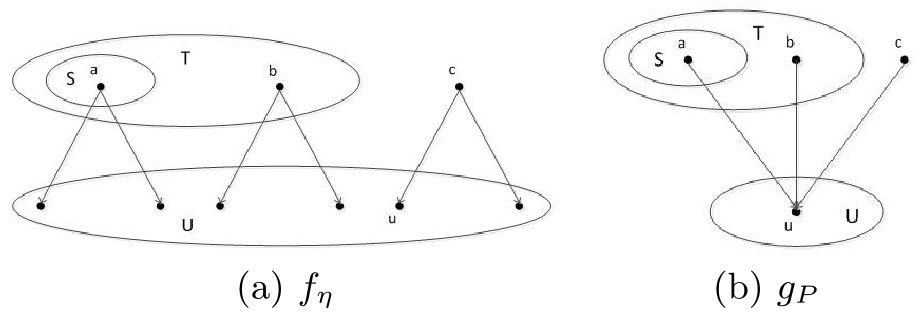
The core of the paper deals with the fact that the probability function is not submodular. In simple terms, adding a seed to a larger set might sometimes provide a larger jump in the probability of hitting the threshold than adding it to a smaller set. This breaks the standard greedy proofs.
Methodology: Leveraging Concentration
The authors' "Aha!" moment is the realization that while the probability function isn't submodular, the Expectation function is. They connect the two using the Concentration Property.
If the random variable of influence coverage () is well-concentrated (meaning it doesn't deviate much from its mean), then hitting a target probability is closely tied to hitting a target expectation.
- They use a greedy approach based on marginal gains in Expected Influence.
- They check the Probabilistic Guarantee at each step using Monte Carlo simulations.
- They prove that the error of this approach is bounded by the variance of the influence distribution.
Algorithm Highlights:
- General Graphs: Uses Monte Carlo (MC-CompProb) to estimate success probability.
- Bipartite Graphs: Uses a Dynamic Programming (DP) approach (Bi-CompProb) for exact calculation.
Experimental Validation
The researchers tested their approach on wiki-Vote, NetHEPT, and Flixster datasets. Two key findings emerged:
- Concentration is Real: The standard deviation of influence coverage in real social networks is remarkably small (roughly ), justifying their theoretical assumptions.
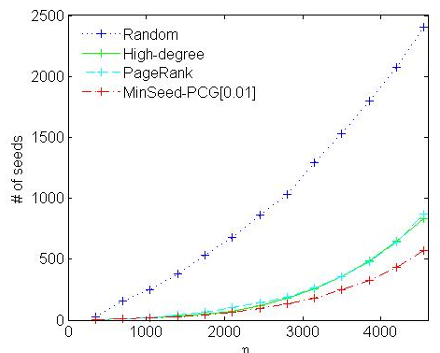
- Efficiency: Their algorithm consistently outperformed High-Degree and PageRank heuristics. In many cases, it achieved the same coverage guarantee with 50-90% fewer seeds.
Deep Insight & Conclusion
This paper is a significant bridge between theoretical computer science and practical marketing. By moving to Probabilistic Guarantees, the authors have made influence maximization "risk-aware."
Takeaway: The success of the greedy algorithm despite non-submodularity suggests that "Expected Influence" is a surprisingly robust proxy for more complex probabilistic goals, provided the network structure allows for sufficient concentration of influence. This opens the door for applying similar "Expectation-to-Probability" mappings in other non-submodular optimization fields.
Limitations: The calculation of the probability remains #P-hard, necessitating Monte Carlo simulations which can be computationally expensive for massive-scale graphs. Future work in faster estimation techniques will be vital.